The Seekers of Deer Creek Themes
by Thao Thai
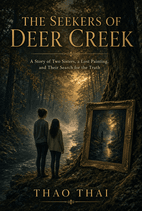
Under its mystery and family drama, the novel wrestles with the cost of silence. Characters keep close and drift apart, hide their lives, and pass down pain without naming it. It asks what we owe the people we love, and what we owe the truth.
On this page you will find the major themes tied to concrete moments: the sisters' tether and estrangement, the layered secrets of paint and walls, art as survival and inheritance. Also covered are the recurring symbols: the Blue Mirror painting, the sundial, water, and the silver antler ring. Each entry points to how the past speaks.
Major Themes in The Seekers of Deer Creek
Sisterhood as tether and estrangement
The novel tracks Vivi and Calla as sisters bound by their mother's last command, 'Keep close to your sister,' and by a shared childhood they keep correcting and remembering together. Their adult rifts come from silence, protection, and unspoken betrayals, and reconciliation happens only when Vivi stops being Calla's keeper and Calla proves she will sacrifice for Vivi.
- After Tuan slaps Calla, young Vivi invents a new version of their father's hiding game to soothe Calla in the Wisconsin woods.
- Vivi finally tells Calla about Wayland's alley kiss, and Calla says the silence was the worst part, then braids her fingers into Vivi's in forgiveness.
- During the flood, Calla lets Tam's folding screen slide away so she can use both hands to pull Vivi onto the roof.
Hidden truths and the layered past
Family secrets in this story are literally layered: overpaint hides women's faces, a wall hides a folding screen, and a hidden letter hides the truth of May's death. Uncovering the past requires stripping, breaking open, and finally telling the truth, so restoration becomes both a conservation act and an emotional reckoning.
- Vivi secretly strips Blue Mirror and reveals two distinct women hidden beneath the painted-over faces, one with a freckle like her own.
- Tuan's posthumous letter confesses that May was returning to her family when she died in a car accident, and that her family kept this truth hidden for nearly twenty-five years.
- Using Ba Anh's father's blueprints, Vivi and Calla hammer open a hollow wall marked with a tiny sundial and find Tam's long-hidden folding screen.
Art as testimony, refuge, and inheritance
Art offers the characters a way to survive, witness pain, and pass down what cannot be said aloud. May gives her daughters stories, Vivi finds home in museum conservation, Tam paints her secret life, and the sisters eventually learn that the sketch and letter are not discoveries but inheritances from their great-grandmother.
- May gave her daughters 'stepping-stones made of stories,' and Vivi later returns to the Forster to feel part of 'the vast river of human accomplishment.'
- At the end of her affair, Tam presses her bleeding hand onto the blue-lovers painting and covers the blood with cadmium red, refusing to let the pain fade because it sought witness.
- Vivi chooses to paint her memories instead of writing the book Paul Quan wanted, calling it 'an act of conservation too, this breathing of life into the discarded past.'
Diaspora, homecoming, and complicated belonging
The sisters' search leads them from Deer Creek to Vietnam, where they meet extended family and begin to understand their father's silences. Yet home remains a complicated idea: Vivi feels rooted in Ho Chi Minh City and is told she is home in Long Xuyên, while the novel also emphasizes the diaspora's fraught relationship to homeland and memory.
- At their hotel in Ho Chi Minh City, Vivi tells Calla, 'I feel like my breath is finally filling me up.'
- Ba Anh recognizes Vivi and Calla as 'little Tuan's American children' and pulls them into the household during Khanh's wedding.
- Kiều shows Vivi the Old House and tells her, 'You're home, Vivi.'
Concealment, identity, and queer love
The story of K. P. Ly and Justine reveals lives that had to be disguised and loves that could not be spoken openly. Tam stages her own disappearance, binds her breasts, and reinvents herself as a male-presenting artist, while Blue Mirror's true subject becomes legible only after the overpaint—and the family story—are uncovered.
- Rereading the journal alone, Vivi catches the word 'priestesses' and realizes K. P. Ly was a woman; she then reinterprets Blue Mirror as showing two lovers rather than twins.
- After being raped and giving birth to Huy, Tam cuts her hair, binds her breasts, and reconstructs herself as K. P. Ly, saying no one could find traces of Tam in her face.
- When Marcel discovers the secret painting, Justine sends Tam and Emil away, and Justine never answers the letters Tam later writes to her.
Symbols and Motifs
Blue Mirror / Blue Lovers
The overpainted painting represents buried truth, hidden queer love, and family inheritance that can only be recovered through care and courage. Its retitling as Blue Lovers marks the recognition of the two women at its center.
- Vivi strips the painting against protocol and reveals two hidden women—one white and one Vietnamese with a freckle like Vivi's own.
- Calla insists K. P. Ly must be connected to their family because the revealed woman in the work resembles Vivi, down to the freckle.
- At the Forster, Vivi sees that the restored women are looking at each other, and the painting is retitled Blue Lovers.
Sundial
The sundial recurs as a mark of time, mortality, and hidden guidance left for descendants to follow. It connects the 1945 letter to the hidden wall, and its inscription ties K. P. Ly's legacy to eternity beginning from the last hour.
- The unsigned 1945 Vietnamese letter found in Tuan's shed ends with a sketch of a sundial.
- Ba Anh's father's blueprints reveal a hollow space behind the wall marked with a tiny sundial, where Tam hid her folding screen.
- Emil takes K. P. Ly to the Hautes-Alpes to see sundials, and she recalls the inscription 'From the last hour begins eternity.'
Water
Water is tied to the family's drowned ancestor, inherited fear, and the moments where sisters are lost and found. The creek and the flood become spaces of memory, danger, and rescue.
- Vivi and Calla recall that their father fears water because a relative drowned, and Kiều later tells the legend that Tam was taken by a river wraith.
- Vivi finds Calla floating fully clothed in Deer Creek, where she apologizes for the kiss and her long silence.
- When the ravine overflows, Vivi and Calla escape onto the roof, and Calla saves Vivi from the flood.
The silver antler ring
The ring passes between the sisters as a token of who is caring for whom, and it carries their mother's ambiguous presence through their adult lives. Its final placement with Phoebe suggests the protection and love being passed to the next generation.
- At the Forster, Calla takes the silver antler ring from Vivi's finger and says it is her turn to wear it.
- In Deer Creek, Vivi takes the antler ring from Calla's hand, puts it on her own finger, and whispers, 'My turn.'
- Samuel later brings Vivi an envelope from Latvia containing the antler ring, and Vivi gives the ring to Phoebe to keep safe.