The Blog Startup Quotes
by Meera Kothand
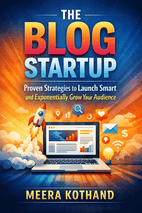
Looking for the best quotes from The Blog Startup by Meera Kothand? Below are the lines that stand out most across the book.
The quotes are organized by chapter, each with a short note on where it appears and why it stands out.
Top Quotes from The Blog Startup
“What was supposed to be a fun and exciting venture is now sucking the life out of you.”
The author describes the emotional state of many struggling bloggers.
This line validates the frustration and burnout many feel, making readers feel understood and not alone in their struggle.
“Of those surveyed, 81% never even made $100 from blogging and only 2% were making $150K+.”
The author cites a survey to provide a reality check on blogger earnings.
This statistic is eye-opening and counters the myth of easy money, reassuring readers that their low earnings are normal and not a personal failure.
“You can work like a digital slave to start and grow your blog, but all those hours don't matter if you don't have a plan for success or a clear road map to follow.”
The author emphasizes the importance of having a plan rather than just working hard.
It underscores the core message of the book—that strategic direction is more valuable than sheer effort, motivating readers to seek a clear roadmap.
“But it's both easier and more difficult at the same time.”
The author contrasts the ease of entry with the increasing difficulty due to competition.
This balanced perspective acknowledges both the opportunity and the challenge, setting realistic expectations for aspiring bloggers.
“The real reason you're not able to pick a niche is that you're afraid to commit.”
The author addresses the reader's struggle with choosing a niche.
It cuts through excuses by pinpointing fear of commitment, a deeply relatable barrier that many aspiring bloggers face.
“In its essence, a niche is a solution to a problem.”
The author defines the core purpose of a niche.
This concise statement reframes niche selection as problem-solving, making the concept actionable and clear.
Quotes by Chapter
CHAPTER 1 — NAIL YOUR LUCRATIVE NICHE
“If the leap across the river is very small, you'll have a happy audience that cross it and never return again to do business with you.”
The author uses a river metaphor to explain the difference between one-time and recurring problems.
The vivid imagery helps readers visualize why evergreen niches with ongoing demand are more profitable.
“But if you can’t monetize it, then it can never become a business and will remain as a hobby.”
The author warns that passion alone is insufficient without a monetization strategy.
It delivers a hard truth that separates hobbies from businesses, motivating readers to prioritize profitability.
CHAPTER 2 — IDENTIFY YOUR BLOG’S CORE MESSAGE
“This will form the basis for every single email, video, image, blog post, or product you create.”
The author explains the importance of identifying your blog's core message.
It underscores how the core message acts as the foundation for all content and materials, giving creators a clear anchor for their efforts.
“Your content is the hub that brings people to your blog.”
The author discusses the necessity of attracting an audience.
This simple, memorable metaphor powerfully conveys that content is the central magnet for readers, reinforcing its critical role in blog success.
“Your content has to educate, entertain, inspire, teach, or help your readers in some way.”
The author describes the purpose that blog content must serve.
It provides a clear, actionable checklist of the essential functions of content, helping bloggers focus on delivering value to their audience.
CHAPTER 3 — YOUR ONE READER
“Knowing your ideal reader is important because you can’t cater to everyone.”
The author explains why defining an ideal reader matters.
This line cuts to the core of niche marketing—it reminds creators that trying to please everyone dilutes their message and effort.
“I find that sometimes it's easier to define what you don't want, rather than what you do want.”
The author shares a personal insight on overcoming the difficulty of pinpointing an ideal reader.
It offers a practical, counterintuitive shortcut that many stuck creators find immediately useful and relieving.
“So focus on just ONE reader. Write for this ONE reader.”
The author advises after explaining that different people may visit the site, but psychographics bind them.
The simplicity and directness of this command cuts through overwhelm and gives a clear, actionable goal for content creation.
“All of this data is gold because when you keep a swipe file of the exact ways your audience are describing their pain points, you can use these very words on your home page, about page, and landing pages to connect with them.”
The author describes how to use research from Facebook groups and product reviews.
It reframes audience research as a treasure hunt and provides a concrete tactic (swipe file) that makes copywriting easier and more resonant.
CHAPTER 4 — YOUR BRAND IN THE ONLINE SPACE
“Your BRAND isn't the logo or color palette you choose. Rather it's the experience someone has with you.”
The author introduces the core concept of brand strategy in the chapter.
This reframes branding from superficial visuals to meaningful interaction, which is a powerful shift for new bloggers.
“The biggest branding sin is thinking about your colors and fonts without thinking about what you want to be for your reader.”
The author lists common mistakes when building a brand.
It vividly highlights a critical error and gives a clear directive to prioritize purpose over aesthetics.
“The more you alienate people, the more you attract your own kind of people too.”
The author discusses the necessity of not trying to appeal to everyone.
This counterintuitive insight encourages authenticity and reassures readers that losing some audience is a sign of focus.
“When you write like everyone else and sound like everyone else and act like everyone else, you're saying, ‘Our products are like everyone else's, too.”
Jason Fried, cofounder of Basecamp, is quoted by the author to emphasize brand voice differentiation.
This memorable analogy makes the case for distinctiveness in a crowded market, resonating with any content creator.
CHAPTER 5 — BRANDING YOUR SITE
“This is where many of us get stuck, and we spend months trying to get things to look right. But it's important not to get too caught up in the branding process.”
The author cautions readers at the start of the chapter about a common trap.
It validates the frustration many feel and gives permission to move forward without perfection, which is liberating for new bloggers.
“A lot of the initial months are about exploring what your brand voice is, who you are as a blogger, and what you like and don't like.”
The author explains the purpose of early branding efforts.
This line reframes branding as a journey of self-discovery, reducing pressure to have everything polished from day one.
“You do not need a professionally designed logo.”
The logo section of the chapter.
A blunt, reassuring statement that saves beginners from wasting money and time on something likely to change.
CHAPTER 6 — 3 MUST-ANSWER QUESTIONS BEFORE YOU PROCEED
“Your blog is a transient medium. You can use it for communication. You can have banners across the top of the page to make announcements. But you don't have your readers’ undivided attention. Email is the only thing that gives you this undivided attention.”
The author explains why an email list is the one constant regardless of content or traffic choices.
This passage powerfully contrasts the fleeting nature of blog traffic with the direct, personal access of email, making a compelling case for prioritizing list building from day one.
“I had a really good blogging friend who had a Facebook group of about eight thousand people just shut down without warning. Gone. Just like that.”
The author shares a real-life cautionary tale to emphasize the risk of relying on platforms you don't own.
The abrupt, visceral phrasing 'Gone. Just like that.' makes the warning unforgettable, driving home the fragility of building an audience solely on social media.
“You don’t need to have a blog if you don’t want to. It’s OK to not like blogging. I always believe that you should double down on your strengths.”
The author addresses readers who feel pressured to start a blog despite disliking it.
This line relieves the guilt many aspiring creators feel, validating the choice to focus on one's natural strengths instead of forcing a disliked format.
“With an email list, it's almost like a chicken and egg equation. You think you need it only after building an audience but without it, it's hard to nurture an audience as well.”
The author describes the common dilemma new bloggers face about when to start an email list.
The chicken-and-egg metaphor perfectly captures the paradox, making the advice to start an email list from day one feel both necessary and actionable.
CHAPTER 7 — WHY YOUR BLOG OVER OTHERS?
“You don’t want to fit in. When you blend in too much with everyone else in your niche, you make it hard for readers to choose you.”
The author explains why differentiation is crucial for a blog's success.
This line directly addresses the fear of being overlooked and motivates bloggers to embrace uniqueness as a competitive necessity.
“This is what Joe Pulizzi, founder of the Content Marketing Institute, refers to as “content tilt.” He says that this is the best way to have “a fighter's chance of breaking through and becoming relevant.””
The author introduces the concept of 'content tilt' from an industry expert.
The vivid metaphor 'a fighter's chance' makes the need for differentiation feel urgent yet achievable, inspiring readers to find their unique angle.
“Once you pick a point of differentiation, ask yourself the following: Is it relevant to your readers? If the way you've chosen to differentiate yourself doesn't matter to your readers, then it doesn’t really matter, right?”
The author advises readers to test whether their differentiation strategy truly resonates with their audience.
This rhetorical question drives home that differentiation must serve the audience's needs, not just the creator's ego, making it a practical litmus test.
CHAPTER 9 — YOUR CONTENT STRATEGY
“Content marketing is building a relationship with your reader through the use of content, and your content strategy is the plan that helps you with it.”
The author defines content marketing and strategy at the start of Chapter 9.
It clearly and concisely frames the purpose of content marketing as relationship-building, which resonates with bloggers seeking to connect meaningfully with their audience.