The Blog Startup — Interactive Mindmaps

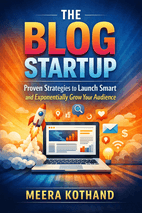
The Blog Startup by Meera Kothand Book Cover

by Meera Kothand

Meera Kothand's The Blog Startup offers a strategic framework for building a blog as a business, covering niche definition, content planning, and monetization for new entrepreneurs launching in a saturated market.

On Insta.page you also get an Apply This Book tool that lets you combine insights from up to 3 books to solve your specific situation.

Chapter mindmaps

Free preview: chapters 1–4 are fully interactive. Click any node to expand or collapse. Subscribe to unlock the rest.

Chapter 1: INTRODUCTION — THE BIG, BOLD PROMISE

Key concepts: INTRODUCTION — THE BIG, BOLD PROMISE

1. INTRODUCTION — THE BIG, BOLD PROMISE

The Reality of Blogging Success

  • Most bloggers earn very little (under $100 or $2,500 annually)
  • The 'laptop lifestyle' promise often leads to exhaustion and disillusionment
  • Success requires a smart plan, not just hard work
  • Struggle is common and should not be viewed as personal failure

Differentiating This Book's Approach

  • Rejects false promises and one-size-fits-all advice
  • Focuses on unsexy but effective tactics for beginners
  • Acknowledges blogging is easier to start but harder to succeed due to intense competition
  • Prepares readers to answer why their blog deserves attention

The Business Mindset Shift

  • Blogs don't make money; businesses behind blogs do
  • Introduces two foundational approaches: content-first vs. offer-first
  • Most beginners start content-first but must transition to a business model
  • Requires identifying problems to solve, monetization pathways, and core brand essence

Core Components for Profitability

  • Certain nonnegotiable elements are crucial regardless of path
  • Provides a 90-day roadmap to lay a solid foundation
  • Designed to help those feeling lost, stuck, or overwhelmed
  • Focuses on priorities like traffic platforms, content choices, and monetization steps

Implementation Tools and Resources

  • Bonus pack includes 90-day task list, stock photos, swipe files, and affiliate lists
  • Workbook available for niche identification, content planning, and legal guidance
  • Stage Identification Sheet helps assess Startup, Growth, or Scale stage
  • Focuses on milestone-appropriate tasks to prevent overwhelm

Chapter 2: CHAPTER 1 — NAIL YOUR LUCRATIVE NICHE

Key concepts: CHAPTER 1 — NAIL YOUR LUCRATIVE NICHE

2. CHAPTER 1 — NAIL YOUR LUCRATIVE NICHE

Overcoming Niche Selection Paralysis

  • Fear of commitment and wasted effort, not lack of options, is the primary barrier
  • Author's personal experience: launched a successful blog in a crowded niche with no prior expertise
  • Hesitation often stems from deep-seated fear rather than practical constraints

Debunking Niche Selection Myths

  • Myth 1: Avoid crowded niches - Crowded niches validate audience demand; room exists for new, authentic voices
  • Myth 2: Need deep expertise - Deep interest and willingness to learn are sufficient; fresh perspective can address overlooked questions
  • Myth 3: Must be completely original - Success comes from unique approach, voice, and specific solutions within known spaces

Four-Fold Foundation Framework

  • Target Audience Pain Points: Specific problems they need to solve
  • Your Strengths and Interests: What you're good at and genuinely curious about
  • Evidence of Monetizable Market: Look for 'signs of money flows' like digital products, coaching, or services
  • Recurring Transformation Potential: Should offer continuous improvement path with ongoing value and revenue opportunities

Addressing Common Concerns

  • Multiple passions: Choose based on clearest monetization path and 3-5 year commitment potential
  • Multiple topics: Possible if unified by single core message (e.g., intentional living) to prevent audience confusion
  • Passion without business model remains a hobby rather than viable business

Actionable Implementation

  • Brainstorm niche ideas using four-fold criteria as vetting checklist
  • Use companion workbook for structured prompts and niche finder tool
  • Focus on practical application of framework rather than theoretical planning

Core Principles for Niche Success

  • Unique voice is competitive advantage in validated markets
  • Look for evidence people are already spending money to solve problems in chosen area
  • Niche must align audience needs with personal strengths plus monetization proof
  • Passion must pair with practical monetization strategy for business, not hobby

Chapter 3: CHAPTER 2 — IDENTIFY YOUR BLOG’S CORE MESSAGE

Key concepts: CHAPTER 2 — IDENTIFY YOUR BLOG’S CORE MESSAGE

3. CHAPTER 2 — IDENTIFY YOUR BLOG’S CORE MESSAGE

The Importance of a Core Message

  • Defines a singular, compelling purpose for your blog
  • Serves as the foundation for all content creation
  • Moves beyond niche selection to a clear value proposition
  • Ensures content educates, entertains, inspires, or helps readers

Attracting an Audience Through Value

  • Content must provide genuine value to attract people
  • Begins with crafting a core message or value proposition
  • Answers how you specifically benefit your readers
  • Content is the hub that draws readers in

Drilling Down to Specificity

  • Start broad and drill down with precision
  • Begin with big business umbrella, narrow to core niche
  • Define Niche Level 1: identify specific audience (the 'who')
  • Refine with Niche Level 2: specify problem solved or action enabled (the 'to do what')
  • Example: 'photography' → 'DIY photography for food blogger moms'

Formulating Your Value Proposition

  • Use statement templates: 'I educate/inspire/entertain/teach/help [who] who want to [what]'
  • Alternative template: 'I show [who] how [what]'
  • Examples: 'I help single moms who want to build a successful VA business'
  • Statement becomes your anchor for all content alignment

Implementing Your Guiding Statement

  • Use internally to filter content ideas
  • Feature prominently on website (e.g., in header)
  • Immediately communicates purpose to visitors
  • Resonates with ideal audience as a strategic tool

Chapter 4: CHAPTER 3 — YOUR ONE READER

Key concepts: CHAPTER 3 — YOUR ONE READER

4. CHAPTER 3 — YOUR ONE READER

The Concept of Your One Reader

  • A foundational tool for effective writing
  • Focus on a single, well-defined audience member
  • Tailor content precisely to resonate deeply
  • Avoid pitfalls of trying to please everyone

Benefits of Focusing on One Reader

  • Enables communication at the right level
  • Conserves energy by not catering to incompatible audiences
  • Eliminates content confusion through clear understanding of needs
  • Prevents generic, ineffective messaging that comes from writing for everyone

Building a Reader Profile

  • Use psychographics: frustrations, worries, online habits, hobbies, mental blocks
  • Examine motivational factors: desires, fears, challenges, long-term goals
  • Dual approach creates vivid picture of who you're speaking to
  • Traditional persona exercise for detailed audience understanding

Exclusion Method for Clarity

  • Start by identifying who your ideal reader is NOT
  • Use statements like 'My ideal reader is unlikely to be...'
  • Clarifies boundaries when defining feels daunting
  • Helps pinpoint core audience you truly wish to serve

Real-World Persona Example

  • Mother of two seeking to start a home business
  • Identifies as solopreneur rather than 'mompreneur'
  • Grapples with time constraints, money mindset, imposter syndrome
  • Action-oriented and willing to invest in herself
  • Demonstrates specific, human reader profile

Managing Audience Diversity

  • Various readers will visit your site naturally
  • Binding force is shared psychographics, not demographics
  • Common desires, frustrations, and aspirations unite audience
  • Writing for one ideal reader attracts others with aligned motivations

Research Techniques for Audience Insights

  • Search Facebook groups with keywords like 'need help', 'desperate for', 'newbie'
  • Uncover raw pain points quickly through social listening
  • Mine reviews on Amazon, Udemy, Product Hunt for authentic language
  • Collect 'swipe file' of audience wording for relatable copy
  • Build accurate persona through active research methods

Continue exploring The Blog Startup