The Blog Startup Key Takeaways

by Meera Kothand
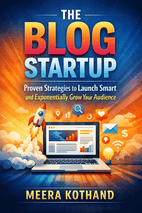
The Blog Startup by Meera Kothand Book Cover

5 Main Takeaways from The Blog Startup

Commit to Your Blog as a Business, Not a Hobby

The book emphasizes that most bloggers earn little because they treat blogging as a hobby. Success requires adopting a business mindset, defining a monetization strategy early, and following a structured roadmap like the 90-day plan to prioritize actions and avoid overwhelm.

Define a Lucrative Niche Aligned with Audience Pain Points and Your Strengths

Your niche should be based on evidence of spending in the market, not just passion. A crowded niche is a validated opportunity, and your unique voice is your competitive edge, ensuring alignment between audience needs and your expertise for sustainable monetization.

Build Your Email List from Day One as Your Most Valuable Asset

Your email list is the only communication channel you fully control, critical for building relationships and business resilience. Start immediately with a simple Minimum Viable Email Marketing plan, including a strategic lead magnet and automated welcome series, to capture and nurture leads.

Launch Quickly with a Minimum Viable Plan, Not a Perfect One

Perfectionism hinders progress. Instead of pre-writing numerous posts, launch a basic landing page with an opt-in to start building your audience right away. This approach reduces psychological resistance and allows you to refine your direction based on real feedback.

Maintain Extreme Focus on One Content Channel and One Traffic Source

Avoid shiny object syndrome by dedicating yourself to mastering one primary channel and traffic source until profitable. This focus, emphasized in productivity and strategy chapters, ensures efficiency and growth by preventing overwhelm and aligning efforts with audience demographics.

Executive Analysis

The five key takeaways form a cohesive argument: blogging success demands a strategic, business-oriented framework from the outset. By committing to a business mindset, defining a monetizable niche, building an email list, launching with minimal viable products, and maintaining extreme focus, bloggers can transition from hobbyists to entrepreneurs. This structured approach prioritizes foundational systems over trendy tactics, ensuring sustainable growth.

This book matters because it provides a practical, stage-by-stage roadmap for beginners, contrasting with vague or advanced advice. It sits in the genre of entrepreneurial blogging guides by offering actionable steps—like the 90-day plan and MVEM framework—that emphasize control, validation, and resilience, making it a valuable resource for building a blog that lasts.

Chapter-by-Chapter Key Takeaways

INTRODUCTION — THE BIG, BOLD PROMISE (Introduction)

  • The majority of bloggers earn very little, so struggle is common and not a personal failure.

  • Success requires moving beyond blog-as-hobby to treat it as a business with a clear model.

  • Beginners should be wary of trendy strategies and focus on proven, foundational tactics.

  • Two main approaches exist: content first (audience building) or offer first (product support), with most starting from content.

  • A staged roadmap, like the 90-day plan, helps prioritize actions and avoid overwhelm.

  • Utilize provided resources like the bonus pack, workbook, and stage identification sheet to streamline your journey.

Try this: Adopt a business mindset by using the provided 90-day roadmap to prioritize actions and avoid overwhelm, rather than following trendy strategies.

CHAPTER 1 — NAIL YOUR LUCRATIVE NICHE (Chapter 1)

  • Fear of commitment, not a lack of ideas, is the primary barrier to choosing a niche.

  • Crowded niches are validated markets; your unique voice is your competitive advantage.

  • A lucrative niche is defined by the alignment of audience pain points and your strengths, supported by proof of monetization and the potential for ongoing audience transformation.

  • Look for evidence that people are already spending money to solve the problems in your chosen area.

  • Passion must be paired with a practical monetization strategy to build a business, not just a hobby.

Try this: Overcome fear of commitment by choosing a niche where people already spend money, aligning your strengths with audience pain points for monetization potential.

CHAPTER 2 — IDENTIFY YOUR BLOG’S CORE MESSAGE (Chapter 2)

  • Your blog's core message is the essential filter for all content and offerings, moving beyond niche selection to a clear value proposition.

  • Attracting an audience requires content that provides real value—through education, inspiration, entertainment, or help.

  • Define your message by drilling down from a broad category to a highly specific audience and their precise need.

  • Formulate a simple, actionable statement (e.g., "I help [who] to [what]") to guide all creative decisions and communicate your purpose.

  • This statement can be used both as an internal compass and a public declaration on your blog to attract the right readers.

Try this: Craft a simple 'I help [who] to [what]' statement to serve as a filter for all content and offerings, ensuring every piece delivers value.

CHAPTER 3 — YOUR ONE READER (Chapter 3)

  • Defining a single ideal reader sharpens your content, making it more engaging and efficient.

  • Use psychographics and motivational factors to build a detailed reader persona.

  • If stuck, start by defining who your reader is not to clarify your target.

  • Your core audience is united by shared psychographics, not just demographics.

  • Research using Facebook group searches and review analysis to gather authentic audience language.

  • Apply these insights consistently across your writing to connect deeply with your readers.

Try this: Create a detailed psychographic profile of one ideal reader using research from Facebook groups and reviews to make your content deeply engaging.

CHAPTER 4 — YOUR BRAND IN THE ONLINE SPACE (Chapter 4)

  • Your brand is an experience, not a logo. Every visual and communicative choice must flow from the strategic decision of what experience you want to create.

  • Specificity attracts. Do not fear alienating people; a clear, focused brand persona is what will magnetically draw your ideal audience.

  • Define your brand as a person. Use introspection and analysis of creators you admire to pinpoint the traits, values, and feelings that will form your brand's core personality.

  • Your brand voice must be intentional and consistent. Use the ADDE Formula to proactively define how you communicate, ensuring your tone and style are authentic to you and distinct from competitors.

  • Authenticity is non-negotiable. Your brand voice must "fit you like a glove"; what works for someone else may undermine your credibility if it doesn't align with your true self.

Try this: Define your brand as a person with specific traits and values, then use the ADDE Formula to intentionally craft a consistent and authentic voice.

CHAPTER 5 — BRANDING YOUR SITE (Chapter 5)

  • Branding is iterative, not final. Early months are for exploration, so avoid large financial investments in design elements upfront.

  • Visuals follow strategy. Your colors and fonts must be derived from your previously defined brand attributes.

  • Apply the 60/30/10 rule for a balanced and professional color scheme on your site.

  • Use commercially licensed fonts (like Google Fonts) from the start to ensure you can monetize without legal worries.

  • A simple font logo is sufficient for a new blog; save the custom logo investment for when your brand direction is stable.

  • Take action immediately to define your core visual palette, preventing paralysis and moving your blog forward.

Try this: Apply the 60/30/10 color rule and use commercially licensed fonts to establish a professional visual brand without upfront financial investment.

CHAPTER 6 — 3 MUST-ANSWER QUESTIONS BEFORE YOU PROCEED (Chapter 6)

  • Focus is foundational: Start by committing to one primary content channel (blog, video, audio) and one primary traffic source to avoid being overwhelmed.

  • Align channels with your audience: Choose your traffic platforms strategically based on the demographics of your ideal customer.

  • Authority is built, not given: Proactively seek credibility through testimonials, guest features, and visible authority markers, even from the beginning.

  • Your email list is your most important asset: It is the only communication channel you fully control and is critical for building lasting relationships and business resilience. Start building it immediately.

  • Play to your strengths: Your primary content channel should be one you enjoy and excel at; other formats can be incorporated later as your business grows.

Try this: Commit to one primary content channel and one traffic source aligned with your audience, and start building your email list immediately as your controlled asset.

CHAPTER 7 — WHY YOUR BLOG OVER OTHERS? (Chapter 7)

  • Differentiation is essential. To succeed, your blog must offer a clear, compelling reason to be chosen over others.

  • Dig deeper than aesthetics. Your unique angle should be rooted in your content strategy, audience focus, or service model.

  • Practical paths include specializing for a niche audience, solving a specific problem, or fostering a unique relationship through access or exceptional service.

  • Test your angle by ensuring it's relevant, authentic, and not just a standard feature everyone else has.

  • Stay adaptable. Your point of differentiation should evolve with your market and audience.

Try this: Differentiate your blog by specializing in a niche audience, solving a specific problem, or offering unique access, and test this angle for relevance and authenticity.

CHAPTER 9 — YOUR CONTENT STRATEGY (Chapter 8)

  • Your content strategy begins with defining 3-5 core thematic categories aligned with your blog's purpose.

  • Use a mix of competitive analysis, your own performance data, and the reader journey model to generate a bank of content ideas.

  • Start with a Minimum Viable Content Plan: a few strategic posts designed to build authority and feed your funnel.

  • Never write a post without first defining its specific purpose and the core pain point it addresses for the reader.

  • Posting consistency is crucial in the early stages to build visibility and systems, even if the frequency is modest.

Try this: Develop a Minimum Viable Content Plan with 3-5 thematic categories, ensuring each post has a defined purpose and addresses a core reader pain point.

CHAPTER 10 — EMAIL: YOUR ONE CONSTANT (Chapter 9)

  • Start Simple with MVEM: You don't need a complex system to begin. The Minimum Viable Email Marketing plan provides a complete, seven-part framework to launch immediately.

  • Align Your Lead Magnet Strategically: Your free opt-in incentive must directly relate to your blog's purpose and act as a natural introduction to your future paid offerings.

  • Promote the Freebie, Not Just the Blog: Actively market your lead magnet using the provided description template anywhere you promote your work.

  • Optimize for Visibility and Conversion: Use multiple, prominent opt-in forms on your site and craft their copy using benefit-driven formulas to maximize sign-ups.

  • Automate the Onboarding: A single welcome email isn't enough. Implement a sequenced welcome email series of 3-5 messages to automatically build trust and guide new subscribers, making your list growth sustainable from day one.

Try this: Implement a Minimum Viable Email Marketing plan with a strategic lead magnet, promote it actively, and automate a welcome email series to build trust.

CHAPTER 11 — TAKE YOUR KEY WEBSITE PAGES FROM “MEH” TO AMAZING (Chapter 10)

  • Prioritize the header section across all website pages for immediate visitor recognition and engagement.

  • Use the home page to drive email list sign-ups with a clear call to action and streamlined navigation.

  • On the about page, focus on the reader's needs, share your authentic story, and include a single, strong call to action.

  • Customize thank you pages to maximize subscriber engagement, but limit elements to avoid overwhelm.

  • Consistently aim for clarity, connection, and strategic prompts to elevate key pages from mediocre to impactful.

Try this: Optimize key website pages—home, about, and thank you—for clarity and conversion by prioritizing header sections and clear calls to action.

CHAPTER 12 — LAUNCH PLAN (Chapter 11)

  • A launch plan is non-negotiable; it provides the structure needed to transition from planning to action.

  • Launch Plan A (landing page & opt-in focus) is the superior strategy, enabling audience building from day one without the pressure of a fully public blog.

  • Perfectionism is the enemy of progress. The goal is a "minimum viable" launch, not a perfect one.

  • The common advice to pre-write numerous posts is counterproductive and amplifies psychological resistance. It’s more effective to launch quickly and refine your direction with a real audience.

  • The final, imperative action is to choose a plan, set a firm launch date, and refuse to make further tweaks once the minimum requirements are met. Just launch.

Try this: Choose Launch Plan A (landing page and opt-in focus), set a firm date, and launch without further tweaks to overcome perfectionism and start building audience.

CHAPTER 13 — REVENUE GENERATION: CREATING A TAILOR-MADE BUSINESS MODEL (Chapter 12)

  • Build for Yourself: Your business model must be tailor-made, aligning with your zone of genius and current business stage, not copied from someone else.

  • Start Simple: Begin with Tier 1 revenue streams (like a small digital product or affiliate marketing) and avoid complex Tier 3 offers (like membership sites) as your first product.

  • Use the 2M+1 Framework: Create stability by developing two main income sources and one supplementary stream from the start.

  • Validate Before You Create: Test product ideas by analyzing market demand and competitor gaps, not just by asking your audience what they want.

  • Mind the Gaps: Treat marketing as a full system (Attract, Capture, Engage, Convert) and understand the five audience segments. Your business health depends on moving people through this journey.

Try this: Build a tailor-made business model using the 2M+1 framework for revenue streams, and validate product ideas by analyzing market demand before creation.

CHAPTER 14 — WHY SOME BLOGGERS MAKE THE LEAP & OTHERS’ DON’T (Chapter 13)

  • Extreme Focus is Non-Negotiable: Combat "shiny object syndrome" by dedicating yourself to one main content channel and one primary traffic source until you achieve mastery and profitability.

  • Invest Strategically, Not Reactively: Let a strict set of rules guide all investments of time and money, ensuring every action is aligned with your current stage of growth.

  • Productivity is a System: Implement batching, sprints, and task categorization to work with your brain's natural wiring, not against it. Limit your quarterly goals to 1-3 actionable items.

  • Validate Internally, Not Publicly: Make business decisions based on direct audience research, not the conflicting opinions of public forums. Avoid comparing your early beginnings to another blogger's well-established middle.

  • Action Trumps Consumption: Limit passive learning. The fastest route to growth is implementing what you already know, then learning precisely what you need for the next step.

Try this: Combat shiny object syndrome by batching tasks and limiting quarterly goals, and make decisions based on internal audience research rather than public comparisons.

CONCLUSION (Conclusion)

  • Mindset is the central challenge: Self-doubt is a constant companion at every stage; preparing for this psychological battle is as important as mastering technical skills.

  • Define your selling ethics: Know your personal boundaries around promotion to handle criticism with confidence and avoid internal conflict.

  • Commit for the long haul: Resist abandoning projects prematurely; success requires iteration and persistence over time.

  • Build systems before scaling: Ensure you have foundational systems for lead capture, nurturing, and sales conversion in place before focusing solely on growth.

  • Feed your brain uniquely: Develop authority by consuming diverse information outside your niche to generate original insights for your audience.

  • Vision must be personal: Your business vision must align with your desired lifestyle, not just follow conventional templates for growth.

  • Embrace the marathon: Success requires consistent action over time, self-compassion, and a steadfast connection to your core "why."

Try this: Prepare for self-doubt by defining your selling ethics and committing to long-term iteration, ensuring your business vision aligns with your desired lifestyle.

Continue Exploring