That Will Never Work Quotes
by Marc Randolph
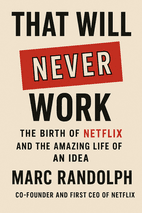
These quotes come straight from the trenches of building Netflix. Marc Randolph shares the messy reality behind the origin story, full of false starts, hard lessons, and moments of doubt. You will find lines that cut through startup mythology and offer blunt truth about ideas, customers, and perseverance.
What makes the book so quotable is its refusal to sugarcoat. Randolph writes with the clarity of someone who has been through it all, from begging for change to facing invisibility. Each line feels earned, not manufactured for a TED talk. The honesty makes these quotes stick.
Top Quotes from That Will Never Work
“Epiphanies are rare. And when they appear in origin stories, they're often oversimplified or just plain false.”
The author Marc Randolph reflects on the oversimplification of origin stories.
It challenges the romanticized notion of sudden inspiration, encouraging a more realistic view of innovation.
“Distrust epiphanies. The best ideas rarely come on a mountaintop in a flash of lightning.”
Randolph states one of the hard-won truths from his experience with Netflix.
It succinctly advises against waiting for a perfect moment, emphasizing gradual progress.
“The truth is that no business plan survives a collision with a real customer.”
Marc Randolph reflects on the futility of elaborate business plans while starting Netflix.
This pithy aphorism encapsulates the startup ethos of testing ideas in the real world rather than overplanning, a lesson that resonates with entrepreneurs and innovators.
“It's called a false positive—also known as being lucky.”
Marc learns their test CD survived only because of the gentle handling of local mail, not a robust system.
This humble acknowledgment of luck's role in success adds authenticity and reminds readers that even the best ideas often depend on serendipity.
“Culture isn't what you say. It's what you do.”
The author reflects on how Netflix's culture arose organically from shared values.
This line distills the essence of organizational culture into a simple, memorable truism. It resonates because it challenges lip service and emphasizes action.
“Before you launch, you're making a beautiful battle plan, coordinating the future movements of your troops. The second you launch, you're in the fog of war.”
Marc thinks about the shift from planning to reacting on launch morning.
It's a vivid military metaphor that perfectly describes the sudden loss of control and certainty when a startup goes live.
“When an opportunity comes knocking, you don't necessarily have to open your door. But you owe it to yourself to at least look through the keyhole.”
Marc reflects on the decision not to sell Netflix to Amazon, framing their exploration as a necessary glimpse.
The keyhole metaphor beautifully balances caution and curiosity, reminding readers that evaluating an opportunity doesn't require immediate surrender.
Themes Behind the Quotes
A central theme is the rejection of the myth of the sudden brilliant idea. The quotes emphasize that epiphanies are rarely real and that the best concepts emerge from iterative, grounded problem solving. Another key theme is the brutal honesty of the startup journey, where raising money and building a company involves vulnerability, rejection, and a willingness to ask for help without offering anything in return.
A third theme is the importance of culture as something built through actions, not words. The quotes highlight that empowering talented people with meaningful problems to solve and trusting them as adults creates real innovation. Finally, the quotes underscore the necessity of focus and perseverance, especially when a goal seems impossible, and the value of being open to opportunities without being blind to risk.
Quotes by Chapter
1. Against Epiphanies
“The truth is that for every good idea, there are a thousand bad ones. And sometimes it can be hard to tell the difference.”
Randolph summarizes the difficulty of distinguishing good ideas from bad.
It resonates because it acknowledges the uncertainty and hard work behind successful ventures.
“But as you'll see in this book, it’s not the whole story. Yes, there was an overdue copy of Apollo 13 involved, but the idea for Netflix had nothing to do with late fees—in fact, at the beginning, we even charged them.”
Randolph corrects the popular myth about Netflix's origin involving late fees.
It reveals the gap between marketable stories and reality, adding authenticity to the narrative.
3. Please, Mr. Postman
“A CD was much smaller than a VHS tape. And much lighter. In fact, it occurred to me that it was probably small and light enough to fit into a standard business envelope, requiring nothing more than a 32-cent stamp to mail.”
Marc Randolph realizes the potential of mailing DVDs while brainstorming with Reed Hastings.
This succinctly captures the pivotal insight that made Netflix's business model possible, showing how a simple observation about size and weight unlocked an entirely new way to rent movies.
“If it only cost 32 cents to mail a DVD, and we could buy them for twenty bucks apiece, we both knew we had a shot.”
After a successful test mailing, Marc and Reed confirm the economic viability of their idea.
This line crystalizes the moment the founders saw a clear path forward, turning a vague concept into a tangible opportunity based on straightforward math.
4. Getting the Band Together
“We had to meet at Hobee's because we were in a weird, in-between place: moving toward being a real company, but without any kind of office. Or the money to rent one.”
Hastings explains why the early Netflix team met at a diner instead of an office.
This captures the scrappy, resourceful reality of startup life—working without funding or a proper space—and resonates with anyone who has built something from nothing.
“I wanted some of Santa Cruz's laid-back ethos for my company. I didn’t want to attract just the same group of ambitious young tech workers from over the hill. I wanted freethinkers, people who were slightly outside the box.”
Hastings describes his vision for the company culture he wanted to create.
It expresses a deliberate choice to prioritize life balance and unconventional thinking over Silicon Valley's growth-at-all-costs mentality, inspiring readers to build companies that align with their values.
“Time is cruel, and there are no monuments in tech.”
Hastings reflects on returning to the Best Western conference room where Netflix started, now converted into a gym.
This poignant line reminds us that even the most formative startup moments are ephemeral, and that success leaves no physical memorial—only the impact of what was built.
“I ate so many Reubens that spring and summer wooing Mitch Lowe that I think I gained what I came to call the “Founder's Fifteen.””
Hastings recounts his persistent efforts to recruit Mitch Lowe over lunches at Buck's.
The humorous, self-deprecating twist on the 'Freshman Fifteen' makes the grind of recruiting relatable and memorable, showing that persistence often comes with a cost—even a literal one.
5. Show Me the Money
“Hen entrepreneurs implore you to remember OPM, what they’‘re saying is: When it comes to financing your dream, use only other people's money.”
The author explains the startup slang OPM (Other People's Money) early in the chapter.
This line distills a core entrepreneurial principle into a single, memorable piece of advice, emphasizing risk management and leveraging external resources.
“But the breakthrough for me was simply telling people the truth. “Can you spare some change? I’m really hungry.” There was something about speaking from the heart that cut right through.”
The author recalls his experience panhandling in Hartford as part of a training exercise.
It reveals the surprising power of vulnerability and honesty in even the most difficult asks, a lesson that applies directly to fundraising and sales.
“But asking for money and offering nothing back—no service, no product, not even a song —is truly terrifying. It's like looking into an abyss.”
The author reflects on the purest form of asking, panhandling, during his Hartford experience.
This visceral metaphor captures the raw fear and psychological weight of making an ask with nothing to offer in return, making the later investor pitches feel manageable.
“But by far the most difficult thing to bear was the invisibility. Mustering up all your courage and desperation, then debasing yourself in front of a stranger, only to be totally ignored—that was worst of all.”
The author describes the emotional toll of panhandling when strangers ignore him completely.
This line resonates because it highlights a universal human fear—being unseen and unheard—while connecting it to the courage required to ask for anything, whether change or investment.
6. How It Feels to Deposit a Check for Almost $2 Million
“It's the difference between an idea in your head and a company in the world. It's the difference between nothing and something. It's everything.”
Reflecting on the significance of the first investor check.
This line distills the emotional and existential leap from concept to reality, making the abstract weight of startup funding feel profoundly tangible.
“One million nine hundred thousand and 00/100 dollars. You hand it over and there's nothing. No glimmer of recognition, no hint of surprise on the teller's face. Business as usual.”
Depositing the huge check at a strip-mall bank.
The anticlimax of a life-changing moment perfectly captures how ordinary the extraordinary can feel to everyone but you.
“That's one of the great pleasures of being at the helm of a startup in the planning stages. The company is small enough that everyone in it has to wear multiple hats, but big enough that you never have to wear one that doesn't fit properly.”
Describing the early days at Netflix.
It perfectly encapsulates the sweet-spot of startup life, where flexibility and autonomy meet meaningful work—a feeling many founders and employees aspire to.
“I firmly believe that a healthy startup culture arises from the values and choices made by the startup’s founders. Culture is a reflection of who you are and what you do—it doesn’t come from carefully worded mission statements and committee meetings.”
On building company culture from the ground up.
This reframes culture as an authentic, lived practice rather than a corporate slogan, a truth that resonates with anyone tired of hollow mission statements.
7. We Were Almost CinemaCenter
“Handpick a dozen brilliant, creative people, give them a set of delicious problems to solve, then give them space to solve them.”
The author describes the early Netflix culture of hiring talented people and trusting them.
This captures the startup ideal of empowerment and autonomy. It's a powerful recipe for innovation that many leaders aspire to.
“People want to be treated like adults. They want to have a mission they believe in, a problem to solve, and space to solve it. They want to be surrounded by other adults whose abilities they respect.”
The author recounts a realization with Patty McCord after overhearing engineers complain in a hot tub.
This reframes employee motivation away from perks and toward respect and purpose. It's a foundational philosophy behind Netflix's famous culture.
“Real innovation comes not from top-down pronouncements and narrowly defined tasks. It comes from hiring innovators focused on the big picture who can orient themselves within a problem and solve it without having their hand held the whole time.”
The author explains the leadership principle of telling people where to go, not how to get there.
This contrasts micromanagement with true innovation. It advocates for hiring smart people and giving them autonomy, a core lesson for any leader.
9. A Day in the Post-Launch Life
“But the best mountaineers aren't quite sane.”
Marc Randolph reflects on the mindset required for mountaineering, comparing it to startup risk.
This line captures the necessary irrational optimism and risk tolerance that entrepreneurs must embrace to succeed.
“Sometimes, as we learned on Netflix launch day, there is no difference. You're both.”
After comparing startup preparation to mountaineering, Marc notes that success and failure can look the same.
This blunt, humorous line underscores the chaotic reality where even thorough planning doesn't guarantee a clear outcome.
“It was a Tuesday night, so our usual babysitter could cover for us, and even though the point of date night was to get away from work—to get away from members of the Netflix board like Reed and Steve—by that time, a week pre-launch, it was almost impossible for me to ever fully leave the Netflix offices behind.”
Marc describes his state of mind before the launch dinner at Steve Kahn's house.
This sentence perfectly captures the all-consuming nature of startup life, where even breaks are consumed by the business.
10. Halcyon Days
“Focus is imperative. Even when the thing you’re focusing on seems impossible. Especially then.”
Marc explains a key lesson from Netflix after his exchange with Reed about betting on rentals.
This triplet of sentences drives home the relentless nature of entrepreneurial focus, inspiring readers to double down when the goal feels most out of reach.