That Will Never Work Key Takeaways
by Marc Randolph
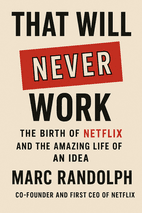
5 Main Takeaways from That Will Never Work
Breakthrough ideas are forged in collaboration, not isolation.
Marc Randolph stresses that Netflix's success came from openly sharing the idea with diverse thinkers who challenged assumptions and stress-tested feasibility, as seen when recruiting from both tech and video rental industries. This collective effort turned a vague concept into a viable business, proving innovation is a team sport.
Sustainable growth requires scalable models and ruthless financial analysis.
The book details how Netflix pivoted from a sales model to a subscription service with unlimited rentals, ensuring geometric growth where serving more customers didn't linearly increase costs. Early lessons from failed ideas like VHS-by-mail highlighted that convenience must outweigh cost, and passion must be tempered by unit economics.
Innovation springs from necessity, not just inspiration.
Facing operational crises like postage costs and near-bankruptcy, Netflix innovated practical solutions such as the queue system and automated recommendations. These fixes, born from hands-on problem-solving rather than planned brainstorming, became core competitive advantages that redefined customer behavior.
Culture is a strategic asset, built by deliberate choice.
By choosing Santa Cruz over Silicon Valley, Netflix fostered a balance-oriented culture that attracted unique talent and maintained morale during layoffs and the IPO process. This intentional culture, emphasizing transparency and collegiality, proved vital for resilience and navigating existential threats.
Resilience and pragmatic adaptation trump perfect plans every time.
Despite multiple rejections, including from Blockbuster, Netflix persevered by pivoting strategies, cutting costs, and rapidly testing ideas. The lesson is that in startups, survival depends on pushing forward through failures, with rapid iteration being more valuable than overplanning a single solution.
Executive Analysis
In "That Will Never Work," Marc Randolph argues that entrepreneurial success is a non-linear, collective journey shaped by iterative collaboration, scalable business models, intentional culture, and resilience in adversity. The book's central thesis is that innovation emerges not from epiphanies but from persistent adaptation to market realities and operational constraints, as demonstrated by Netflix's evolution from a nascent idea to a public company.
This book stands out in the startup memoir genre by offering unvarnished, practical insights into the grueling reality of building a company from scratch. For readers, it provides actionable lessons on team building, financial discipline, and maintaining momentum through crises, making it an essential guide for aspiring entrepreneurs and leaders navigating today's volatile business landscape.
Chapter-by-Chapter Key Takeaways
1. Against Epiphanies (Chapter 1)
Innovation is a Team Sport: Breakthrough ideas are rarely born in isolation; they are forged in collaboration with diverse thinkers who challenge assumptions and stress-test feasibility.
Scalability is Non-Negotiable: A viable business idea must have a model where serving more customers does not require linearly increasing effort or cost. The goal is geometric, not arithmetic, growth.
Convenience Must Outweigh Cost: A new service must offer a compelling advantage over existing alternatives. For VHS rentals, the proposed model added cost, delay, and uncertainty without a sufficient upside to displace the instant, if annoying, local video store.
Passion is Not a Business Model: Enthusiasm for an idea's potential must be immediately tempered by ruthless financial analysis and market reality. The "perfect" idea on paper can be shattered by simple unit economics.
Try this: Share your nascent business idea openly with critical thinkers to pressure-test its scalability and unit economics before committing.
3. Please, Mr. Postman (Chapter 2)
The intense excitement of the late-90s internet boom was a rational response to a genuinely revolutionary technological frontier, not mere irrational speculation.
The era is best understood through the metaphor of exploration and pioneering, with the internet seen as a vast, unclaimed territory full of potential.
A defining sentiment was one of abundant opportunity, where the scale of the new "land" meant there was room for countless ventures to succeed.
Try this: Approach emerging technologies as uncharted territory, focusing on creating value rather than fearing competition.
4. Getting the Band Together (Chapter 3)
Ideas improve through sharing: Contrary to instincts for secrecy, openly discussing the idea provided valuable feedback, attracted talent, and uncovered historical failures.
Compromise on titles, not on roles: Job titles have hidden costs in expectations and promotions. Defining roles clearly is more important than inflating titles, though strategic exceptions are sometimes necessary to secure key people.
Culture is a deliberate choice: The fight to base the company in Santa Cruz was an early, conscious decision to build a different kind of company culture—one valuing life balance and attracting people outside the Silicon Valley mainstream.
Expertise can come from unexpected places: Vital industry insight and future leadership were found not in tech circles, but in the traditional video rental business, emphasizing the value of deep, practical domain knowledge.
Persistence is a founding currency: The early days were defined by relentless pursuit—of team members like Jim Cook and Mitch Lowe, of funding, and of a physical space—often conducted over endless meals in mundane locations.
Try this: Define team roles precisely and intentionally cultivate a company culture that attracts diverse talent, even from outside your industry.
5. Show Me the Money (Chapter 4)
Seed funding is often deeply emotional, involving personal relationships and dynamics that transcend pure financial calculus.
Family history shapes financial psychology; a parent’s personal experiences with money can create an unbridgeable gap for certain types of risky ventures.
The "ask" itself is a performative ritual, especially within families, where pre-existing roles dictate the interaction as much as the business details.
A supportive investor’s grace can be a double-edged sword; transforming a gift into an “investment” preserves pride but can also magnify the emotional weight of responsibility.
Try this: Frame early investment requests within the context of personal relationships, being mindful of the emotional weight and expectations involved.
6. How It Feels to Deposit a Check for Almost $2 Million (Chapter 5)
Building an e-commerce site in the late 1990s was a foundational, code-by-hand endeavor requiring solutions for countless uncharted user experience problems.
Effective development depended on bridging the gap between creative vision and technical execution, often through painstakingly detailed, physical documentation.
The intense, granular work provided a therapeutic focus, offering personal fulfillment and a temporary refuge from external pressures and doubts.
Try this: Dive deep into the granular details of your product's creation, using hands-on work to maintain focus and bridge creative gaps.
7. We Were Almost CinemaCenter (Chapter 6)
Sustainable Passion: The intense effort of a startup is manageable when it's for a personal vision, but intentional boundaries are crucial to prevent it from consuming everything else.
Protect Your Anchors: Proactively guarding non-negotiable personal rituals (like a weekly date night) can preserve key relationships and mental health during periods of extreme professional demand.
The Pragmatism of "Good Enough": Foundational business decisions, like naming the company, often result from exhausted compromise under deadline pressure, not perfect inspiration. The "best" choice is frequently the one that works well enough to allow you to move forward.
Product First: The beta name "Kibble" embodied a vital, enduring lesson: ultimate success depends on the quality of the core product experience, not just clever marketing or salesmanship.
Try this: Guard non-negotiable personal time to prevent burnout, and accept 'good enough' compromises on peripheral issues to keep momentum on core product development.
9. A Day in the Post-Launch Life (Chapter 7)
Strategic Dilemma: Early success can mask a fundamental strategic weakness. Netflix faced a critical choice between pursuing a dying but profitable business (sales) or a promising but unproven one (rentals).
Operational Reality: Theoretical models and prototypes inevitably break under the weight of real-world execution. The postage crisis illustrated that scaling requires constant adaptation and problem-solving.
Innovation in the Trenches: Solutions often arise from immediate, hands-on necessity, not just planned brainstorming sessions.
The Human Cost and Balance: A startup demands extraordinary personal sacrifice and blends work with family life, requiring a supportive network and moments of deliberate respite to sustain the effort.
Try this: Continuously monitor real-world performance data to identify strategic pivots, and empower your team to solve operational problems creatively.
10. Halcyon Days (Chapter 8)
A startup’s foundational culture is often forged in a surprisingly short, intense, and relatively insulated period of early struggle and camaraderie.
Major turning points, like securing pivotal funding, are frequently attributed to a key individual’s proven track record more than perfect planning.
Success requires two phases: the protected "halcyon days" to build and dream, followed by the necessary winds of change and scale to make that dream a sustainable reality.
The end of a cherished early era in a company’s life is often gradual and unrecognized in the moment, even when it coincides with tangible signs of success.
Try this: Document and celebrate the early camaraderie that forms your culture, but plan for the inevitable transitions that come with growth.
11. Two Cents for Bill Clinton (Chapter 9)
Reed’s formal request to re-split stock options in his favor transforms the leadership change into a painful financial and personal betrayal.
Lorraine’s furious reaction highlights the perceived injustice of Reed’s demand, framing it as a reward for his previous lack of involvement.
In solitude, Marc moves from shock to a pragmatic, though uneasy, acceptance, beginning to envision a path where a redefined partnership with Reed could lead the company to success.
Try this: Address partnership and equity changes openly and early, focusing on the long-term health of the company rather than short-term emotions.
13. Over the Hill (Chapter 10)
Scaling a business often requires bringing in seasoned operators with institutional knowledge, as exemplified by the pivotal hiring of Tom Dillon.
True innovation can emerge from dire necessity, transforming a core weakness (like rental logistics) into a defining strength by reimagining customer behavior.
Effective partnerships require mutual commitment; asymmetrical efforts, like the failed Amazon deal, can drain morale and resources.
The combination of a subscription model, an unlimited rental library, and a serialized delivery queue formed the foundational blueprint for Netflix's future success.
In startups, rapid, concurrent testing of multiple ideas is often more valuable than overplanning a single "perfect" solution.
Try this: Hire operational experts when scaling, and use pressing challenges as catalysts to reinvent your core business model through rapid experimentation.
14. Nobody Knows Anything (Chapter 11)
Scalability Demands Automation: Manual curation can't keep pace with rapid growth; automated systems are essential for handling complexity while maintaining user engagement.
User Data Drives Personalization: Crowdsourced ratings and reviews provide richer insights than transactional data alone, enabling more accurate and meaningful recommendations.
Balance Human Touch with Algorithmic Efficiency: Successful products blend empathetic design with smart automation, creating experiences that feel personal yet scalable.
Collaborative Leadership Accelerates Innovation: Partnerships that merge creative vision with operational focus can swiftly turn ideas into transformative realities.
Try this: Invest in automated systems that use user data to enhance personalization, ensuring that technology amplifies rather than replaces human empathy.
15. Drowning in Our Own Success (Chapter 12)
The canceled IPO was a hidden blessing that refocused Netflix on its core competency, away from a doomed “portal” strategy. Success can be financially dangerous, as rapid growth often consumes cash faster than it can be generated. True competitive threats can come from indirect sources and market sentiment, as shown by fears that Kozmo.com’s failure might taint all delivery businesses. When facing an existential cash crisis, exploring a sale to a dominant industry player can be a necessary, if humbling, strategic alternative. Company culture, forged in moments of both pressure and absurdity, becomes a critical asset during periods of extreme uncertainty.
Try this: Maintain rigorous financial discipline during rapid growth, and leverage your company culture as a stabilizing force during crises.
16. Crash (Chapter 13)
A Study in Contrasts: The chapter heightens tension through stark contrasts—Netflix’s makeshift, casual culture versus Blockbuster’s corporate might; the borrowed glamour of a private jet versus the crushing reality of near-bankruptcy; a desperate $50 million ask met with silent, incredulous dismissal.
The Pivot from Salvation to Self-Reliance: The failed Blockbuster pitch is the definitive moment Netflix abandons the hope of being rescued. The “crash” of the title is both the dot-com crash and the crash of this last, best hope for an easy exit. Survival is now an inside job.
Clarity Born of Rejection: Antioco’s near-laugh provides a painful but clarifying dose of reality. It definitively proves that Blockbuster does not perceive Netflix as a serious threat or a valuable asset. This rejection becomes the catalyst for Netflix’s future focus and competitive fire.
“The Only Way Out is Through”: The chapter’s core lesson is encapsulated in Marc’s father’s advice. With external doors slamming shut, the founders resolve that their only option is to push forward with greater intensity, setting the stage for their direct, ultimately victorious assault on Blockbuster’s business model.
Try this: When faced with decisive rejection, use it as a catalyst to focus internally on innovation and operational excellence rather than seeking external salvation.
17. The Belt Tightens (Chapter 14)
Survival Required Ruthlessness: In a shifted financial landscape, survival depended on abandoning a growth-at-all-costs mentality for a disciplined, profit-focused austerity.
The "Barnacle" Metaphor is Vital: Continuous self-assessment and the elimination of outdated features or processes ("barnacles") are crucial for maintaining operational speed and efficiency.
Culture Shapes Difficult Decisions: Even during painful layoffs, Netflix's culture of transparency and collegiality was evident, from the honest company-wide address to the compassionate, performance-driven (not just tenure-driven) selection process.
The Human Element Endures: The process was a brutal reminder that business decisions have profound personal impacts, and the company's humanity was tested and revealed in how it treated departing employees.
Try this: Conduct regular 'barnacle' reviews to strip away non-essential features or processes, and handle austerity measures with transparency to maintain team morale.
18. Going Public (Chapter 15)
The IPO process culminates in a tense, anti-climactic event, especially on the fully electronic Nasdaq, where success is marked by a simple ticker symbol on a screen.
Financial independence, when achieved, prompts deep reflection on one's motivations, often revealing that the real reward was the creative struggle and camaraderie, not the monetary outcome.
Major professional milestones are often best celebrated with simple, personal rituals that reinforce core values and relationships, rather than extravagant gestures.
A successful exit is both an ending and a beginning—it validates the past struggle but does not diminish the ongoing challenges and mission of the company.
Try this: Mark major milestones with personal, low-key celebrations that reinforce core values, remembering that the work continues after financial success.
Randolph’s Rules for Success (Epilogue)
Success is a Collective Achievement: A major endeavor, whether building a company or writing a book, is never a solo act. It relies on a diverse ecosystem of contributors, from creative partners and professional teams to fact-checkers and family.
Humility and Acknowledgment are Strengths: Publicly and specifically crediting those who contributed demonstrates integrity and an understanding that great work is built on collaboration.
The Personal Enables the Professional: The unwavering support of family and close friends provides the essential foundation that makes professional focus and dedication possible.
Legacy is About People and Relationships: Beyond business strategies, the most enduring aspects of an entrepreneurial journey are the friendships forged and the collective pride in what was built together.
Try this: Publicly credit every contributor to your success, and nurture the personal relationships that sustain you through the entrepreneurial journey.
Continue Exploring
- Read the full chapter-by-chapter summary →
- Best quotes from That Will Never Work → (coming soon)
- Explore more book summaries →