Suicidal Empathy Quotes
by Gad Saad
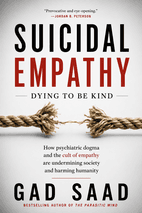
Gad Saad's Suicidal Empathy takes aim at the way modern society twists one of our finest virtues into a weapon of self destruction. The quotes on this page capture that core idea with blunt force and dark wit.
You will find lines that are provocative, cynical, and sometimes brutally honest. Saad mixes evolutionary psychology with sharp cultural observation. What makes the book so quotable is its ability to condense complex arguments into a single punchy sentence that you cannot easily forget.
Top Quotes from Suicidal Empathy
“I posit that in the current zeitgeist, the collective suicide of the West is occurring via the orgiastic misfiring of one of our most noble virtues, empathy, which of course is deeply anchored within the ethos of progressive liberals.”
The author presents his central thesis about suicidal empathy.
This provocative statement directly challenges conventional praise of empathy and frames it as a potential cause of societal collapse. It invites debate and reflection on the limits of compassion in political and cultural contexts.
“Suicidal empathy requires the murder of truth at times.”
The author summarizes the theme of empathy leading to the suppression of truth.
This succinct, provocative statement crystallizes the book's central thesis that misguided empathy can justify the destruction of honest inquiry.
“How is it that when multiple guys named Mohammed gang-rape your daughter, you ended up blaming Mordechai?”
The author sarcastically notes that many blamed Jews when asked to identify commonalities among Muslim grooming gang perpetrators.
The stark rhetorical question highlights the absurdity of deflection and the pervasive antisemitism, delivering a punchy, unforgettable line.
“I wish that my son, Aiden Clark, was killed by a 60-year-old white man.”
Nathan Clark, father of an 11-year-old killed by a Haitian driver, makes this statement to signal he is not racist.
The raw, shocking sentiment exposes how the desire to appear enlightened can override natural grief and outrage, making it a powerful indictment of performative empathy.
“There are no solutions; there are only trade-offs.”
Thomas Sowell's insight quoted by the author in discussing optimization problems and policy decisions.
A succinct and powerful reminder that every decision involves costs and compromises, challenging the simplistic empathy-driven policies critiqued in the chapter.
“Nothing is more unequal than the equal treatment of unequals.”
This line opens the chapter, setting the theme of the critique against equality of outcomes.
It is a crisp, paradoxical aphorism that encapsulates the central argument against treating everyone the same regardless of differing starting points.
“Of all tyrannies a tyranny sincerely exercised for the good of its victims may be the most oppressive.”
Opening line of the chapter, setting up the critique of empathy-based governance.
It encapsulates the central paradox of well-intentioned authoritarianism, making readers question the morality of coercive compassion.
Themes Behind the Quotes
The central theme is the dangerous overextension of empathy toward those who exploit it, at the expense of the innocent and of society itself. Saad argues that this misplaced compassion disarms natural defenses, encourages tolerance of intolerance, and ultimately leads to civilizational decline. He shows how this mindset blames victims, excuses criminals, and destroys the very institutions that protect us.
Another major theme is the war on meritocracy and equality of opportunity. Saad contends that equal treatment of unequal individuals creates new forms of injustice. He also highlights the tension between truth and comforting falsehoods, pointing out that scientific reality often shatters ideological narratives. Throughout, the idea of trade offs recurs: there are no perfect solutions, only choices with consequences.
Quotes by Chapter
1. A Good Virtue Gone Bad
“Deontological pacifists suffer from suicidal empathy in that they shut off adaptive mechanisms meant to ensure their survival, in the service of a maladaptive worldview.”
The author argues that absolute pacifism is a form of suicidal empathy.
The line crystallizes the concept of suicidal empathy with a concrete example, showing how a rigid moral stance can become self-destructive. It underscores the evolutionary logic behind the argument.
“Suicidal empathy eradicates this evolutionary-based calculus.”
The author explains how empathy normally discriminates between in-group and out-group, but suicidal empathy overrides this.
This line crisply defines the core concept of the book—empathy that defeats its own evolutionary purpose—and encapsulates the central thesis.
“Excesses and deficiencies are only the most obvious kinds of emotional abnormalities. Responses can also be too quick, too slow, too enduring, or in response to the wrong cues.”
Randy Nesse, a pioneer in evolutionary medicine, describes how emotional systems can malfunction.
It provides a precise, clinically grounded framework for understanding how empathy can misfire, making the abstract idea of suicidal empathy concrete.
2. Forbidden Knowledge
“Knowledge, for any conscious organism is the means of survival... Man is free to choose not to be conscious, but not free to escape the penalty of unconsciousness: destruction.”
The author presents a philosophical argument about the necessity of knowledge for survival.
This line powerfully frames the stakes of willful ignorance as a form of self-destruction, making the pursuit of truth a matter of life and death.
“He allowed data and facts to destroy a perfectly fine false narrative.”
The author describes Roland Fryer Jr.'s research that contradicted accepted progressive narratives.
It encapsulates the tension between comfortable fictions and uncomfortable truths, highlighting how empirical evidence can shatter ideologically convenient stories.
“It is difficult to imagine that such a reflex could exist in a free society.”
The author comments on the U.S. government's creation of a Disinformation Governance Board.
This line underscores the irony and danger of top-down truth enforcement in a society that claims to value liberty, making it a memorable critique of overreach.
3. Cultural Theory of Mind
“The West is a woman to be mounted.”
The author recounts that many Arabic-speaking men have told him this in Arabic, expressing their view of the West.
This jarring metaphor encapsulates the perceived feminization and vulnerability of the West, making the power dynamic visceral and unforgettable.
“Suicidal empathy requires orgiastic tolerance.”
The author argues that the West's cultural relativism leads to an extreme, self-destructive form of tolerance.
The phrase 'orgiastic tolerance' is a shocking and memorable summary of how unlimited empathy can become pathological.
“Well, actually, I am a Jew-Jew-Jew-Jew.”
The author replies to a Lebanese friend who insisted he wasn't a 'real Jew' because he liked him.
This defiant, personal retort perfectly captures the clash between stereotype and reality, and the author's refusal to be diminished.
4. Blank Slate Felons
“Suicidal empathy seeks to reflexively mitigate the actions of violent criminals by proposing external “root” causes. It is society's fault. It is systemic racism. It is an impoverished childhood. It is an abusive parent. From this perspective, criminals are “blank slate felons.””
The author defines the concept of 'suicidal empathy' and 'blank slate felons' near the middle of the chapter.
This passage crystallizes the chapter's central argument—that excessive empathy denies criminals personal agency and blames society instead, a provocative claim that challenges progressive orthodoxy.
“Civilizational Seppuku requires not only that one empathize with violent criminals more so than their victims, but it also demands a hostility toward those tasked to protect us from such criminals.”
The author discusses the Defund the Police movement and Mayor Michelle Wu's response to a shooting.
This line succinctly captures what the author sees as the ultimate form of societal self-destruction—prioritizing criminals over victims and turning against protectors.
“When children go missing, it is most important to first empathetically cater to the feelings of the Mi’kma’ki people and African Nova Scotians, for realities that might have taken place centuries ago. The whiny missing children will have to wait their turn at the wheel of empathy.”
The author critiques an RCMP officer's land acknowledgment before updating the public on two missing children.
The sarcastic contrast between ancient grievances and immediate child safety vividly illustrates what the author considers absurd priorities driven by suicidal empathy.
5. Settled Science, Taboo Trade-Offs
“[T]he great tragedy of Science—the slaying of a beautiful hypothesis by an ugly fact.”
Opening of the chapter on settled science and taboo trade-offs.
This line perfectly captures the painful but essential process of scientific progress, where evidence overthrows cherished theories.
“The game of science is, in principle, without end. He who decides one day that scientific statements do not call for any further test, and that they can be regarded as finally verified, retires from the game.”
Karl Popper quoted by the author to argue against the notion of settled science.
It underscores the endless, self-correcting nature of science and the folly of declaring any knowledge final.
“I realized then that the medical understanding of ulcer disease was akin to a religion. No amount of logical reasoning could budge what people knew in their hearts to be true.”
Barry Marshall reflecting on the resistance to his discovery that H. pylori causes ulcers.
It highlights how deeply entrenched beliefs can resist even overwhelming evidence, illustrating the concept of the Semmelweis reflex.
6. Selling Indulgences
“The suicidally empathetic destroy meritocracy as a form of selling indulgences.”
The author sums up his argument that woke capitalism and equity measures are modern versions of the Catholic Church's sale of indulgences.
This line ties the chapter's title to its core thesis, using a striking metaphor to condemn how empathy is weaponized to undermine merit.
“Imagine how sinister this worldview is. Genetic differences become an instantiation of cosmetic injustice to be remedied via institutional interventions.”
The author responds to the claim that innate differences in intelligence are unfair and must be corrected.
It exposes the disturbing implications of equity ideology when applied to inherent human traits, provoking strong emotional and intellectual reaction.
“Please starve your children, beat them, and ensure that they are illiterate. Do it out of empathy for the children who might tragically be facing such hardships.”
The author sarcastically addresses the argument that parents who read to their children create an unfair advantage.
The dark, exaggerated irony forces readers to confront the absurdity of extreme equity logic, making it highly memorable and quotable.
7. Govern Me Harder, Daddy!
“It may be better to live under robber barons than under omnipotent moral busybodies.”
Continues the chapter's opening argument about the nature of oppressive empathy.
The stark contrast between exploitative but limited tyranny and relentless moralistic control is memorable and provocative.
“Reality has a way of slapping the misguided empathy and utopian imbecility out of you.”
Author's reflection on how life experience corrects naive political views.
The blunt, visceral language drives home the idea that utopian fantasies collapse under real-world pressures.
“Taxation is theft, purely and simply, even though it is theft on a grand and colossal scale which no acknowledged criminals could hope to match.”
Author's declaration on the nature of taxation, introducing the section on parasitic taxation.
This bold, uncompromising statement challenges readers to reconsider the moral legitimacy of government confiscation of earnings.
8. Inoculation Against Suicidal Empathy
“It was false belief, not barbed wire, that enslaved.”
The author reflects on the fall of the Iron Curtain, arguing that ideas, not physical barriers, are the true instruments of oppression.
This line powerfully condenses the book's core thesis that our deepest captivity is ideological, making the reader reconsider the source of modern enslavement.
“The shingles virus can remain dormant for decades until it painfully flares up in your fifties or sixties. The same applies to these idea pathogens and associated misguided empathy.”
The author warns that suicidal empathy, like a dormant virus, can reemerge after lying hidden for years.
The vivid medical analogy makes the abstract concept of ideological dormancy visceral and memorable, emphasizing the need for complete eradication.