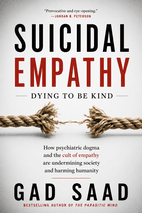
Chapter 1: A Good Virtue Gone Bad
Key concepts: A Good Virtue Gone Bad
A Good Virtue Gone Bad
Empathy's Dual Nature
- Essential for connection but can cripple judgment
- Too little empathy breeds callousness
- Too much empathy leads to poor decisions
- Measurable, inherited, and shaped by culture
Dark Side of Empathy
- Psychopaths fake empathy with no remorse
- Predators weaponize empathy to lure victims
- Hyper-empathy causes compassion fatigue in caregivers
- Terms like toxic empathy capture its backfire
Suicidal Empathy and Mass Self-Destruction
- Drives historical mass suicides like Masada and Jonestown
- Acts as honest signal of commitment under threat
- Civilizations die by suicide, not murder
- Progressive liberalism's overextended empathy fuels this
Empathy as Dysregulated Instinct
- Hyperactive empathy shuts off healthy defensive instincts
- Rigid pacifism leaves people vulnerable
- Like OCD or compulsive buying—healthy instinct gone haywire
- Emotional dysregulation affects positive emotions too
Emotional Misdirection in Suicidal Empathy
- Beach incident: empathy flared for wrong target
- Karsten Hauken felt guilt for his rapist's deportation
- Evolutionarily, empathy should discriminate kin from foe
- Suicidal empathy treats all targets equally
Nesse's Framework for Emotional Dysfunction
- Six ways emotional systems falter
- Suicidal empathy: baseline too high, response excessive
- Triggered by wrong cues
- Calibrated empathy motivates care and cooperation
Gender, Attribution, and Woke Ideology
- Women score higher on empathy, more open to woke capture
- Feminization of academia prioritizes emotional safety
- Progressives favor external attributions for failure
- Suicidal empathy inverts self-serving bias for marginalized groups