Suicidal Empathy Key Takeaways
by Gad Saad
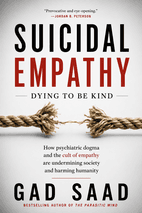
5 Main Takeaways from Suicidal Empathy
Empathy misdirected becomes a tool of self-destruction
When empathy is aimed at the wrong targets—like criminals, migrant rapists, or oppressive ideologies—it ignores real victims and fuels societal decay. Saad shows how therapeutic culture, DEI bureaucracies, and woke capitalism transform a virtue into a suicidal impulse.
Forbidden knowledge is suppressed by misplaced compassion
Research that challenges progressive narratives—like Roland Fryer’s work on police shootings—is buried to protect feelings over facts. This empathy prioritizes identity-based comfort over truth, leading to disastrous policies in crime, education, and medicine.
Blank-slate ideology excuses perpetrators and blames victims
By claiming all behavior stems from environment, suicidal empathy grants leniency to pedophiles, rapists, and extremists while punishing those who resist. Saad documents light sentences for migrant offenders and silenced survivors like Nadia Murad.
Meritocracy is destroyed when empathy replaces competence
From aviation training to medical schools, diversity mandates override actual skill, endangering lives. Saad argues that identity-based entitlements ignore trade-offs and that only meritocracy ensures fairness and safety in any serious endeavor.
Inoculation requires truth over tribal loyalty
The only cure for suicidal empathy is a relentless commitment to reality, even when uncomfortable. Saad shows how empathy unequipped with epistemology collapses into thought control, from the Inquisition to modern decolonization movements.
Executive Analysis
These five takeaways converge on a single thesis: empathy, when detached from reality, boundaries, and truth, becomes a weapon of self-destruction. Saad argues that modern Western societies have hijacked a biological virtue—emotional attunement to others—and aimed it at oppressors and harmful ideologies, ignoring empirical evidence and trade-offs. The result is a culture that protects criminals, silences victims, suppresses uncomfortable research, and replaces competence with identity politics. Each takeaway reveals a facet of this pathology: misdirected empathy, forbidden knowledge, blank-slate relativism, anti-meritocratic policies, and the need for truth as an antidote.
This book matters because it diagnoses a pressing cultural crisis—the weaponization of compassion—with both academic rigor and polemical force. It bridges evolutionary biology, social psychology, and political commentary to explain why “radical empathy” leads to irrational policies, from lenient sentencing to climate alarmism. For readers, Saad offers a clear framework for recognizing and resisting suicidal empathy in daily life: prioritize truth, reject identity-based entitlements, and maintain intellectual boundaries. Situated in the genre of evolutionary psychology and cultural critique (alongside authors like Jonathan Haidt and Jordan Peterson), this book warns against the moral grandstanding that corrodes freedom and public order.
Chapter-by-Chapter Key Takeaways
1. A Good Virtue Gone Bad (Chapter 1)
Suicidal empathy involves emotional responses aimed at the wrong targets, often ignoring real victims in favor of performative compassion.
Nesse’s framework identifies three relevant misfirings: baseline too high, response excessive, and response to wrong cues.
Women are more open to suicidal empathy due to higher baseline empathy, making them prime targets for woke ideological capture.
External locus of control (nurture over nature) drives the belief that all failure stems from environment, justifying unlimited empathy toward criminals, migrants, and adversaries.
The impulse is fueled by narcissistic moral grandstanding, existential guilt over Western privilege, and a collective impostor syndrome that demands civilizational self-destruction.
Ignoring warning signals—as in The Firebugs—doesn’t prevent arson; it enables it.
Try this: Audit your emotional responses: before offering compassion, ask whether your empathy is aimed at a genuine victim or a perpetrator hiding behind an identity label.
2. Forbidden Knowledge (Chapter 2)
Forbidden knowledge is about whether empathy should stop us from facing uncomfortable truths.
Roland Fryer Jr.’s research was suppressed because it challenged the narrative of widespread white supremacy.
Empathy is often used to justify abandoning principles like free speech, presumption of innocence, and journalistic integrity.
The fat acceptance movement and identity politics in academia prioritize feelings over objective facts.
Empathy without reality leads to harmful policies and tragic outcomes.
Try this: Seek out forbidden knowledge: actively read research and perspectives that challenge your political tribe, and judge policies by their outcomes, not their intentions.
4. Blank Slate Felons (Chapter 4)
This empathy protects perpetrators, blames victims, and uses cultural relativism to excuse violence.
A consistent pattern across Europe: light or suspended sentences for migrant rapists, resident permits for pedophiles, and legal punishment for women who insult or resist their attackers.
Progressive institutions cancel victims’ voices (Nadia Murad) while apologizing for rapists’ backgrounds.
The author’s own experience with death threats reveals that even police are disarmed, and suspect identification is blocked by anti-profiling ideology.
Societies that prioritize the feelings of criminals over the safety of citizens cannot sustain freedom or public order.
Try this: Reject cultural relativism that excuses violence: hold every group to the same legal and moral standards, regardless of race, religion, or background.
5. Settled Science, Taboo Trade-Offs (Chapter 5)
The author uses the idea that no progress is ever enough to show how victimhood keeps splitting into smaller pieces, especially in climate activism.
He argues that environmental and trans activism share a pattern of misplaced compassion that ignores reality, statistics, and trade-offs.
Examples include ignoring Islamic terrorism, suppressing failed climate predictions, blaming art deprivation for radicalization, and supporting anti-natalism.
In trans activism, he highlights suppressed research, harm to biological women in sports and prisons, and the absurdity of gender fluidity claims.
The main point: empathy cut off from reality leads to irrational policies and destroys basic truths about sex, family, and safety.
Try this: Demand evidence for every policy claim: when someone invokes empathy to override statistics on climate, crime, or sex, insist on verifiable trade-offs and real-world consequences.
Next chapter: “6. Selling Indulgences” is locked
Keep learning from Suicidal Empathy — and unlock all 600+ book summaries with audio, mindmaps and AI Q&A.
$0.00 due today · 7 days free, then $89.99/year ($7.49/mo) · Cancel anytime before day 7
plus sales tax where applicable