Stillness Is the Key Quotes
by Ryan Holiday
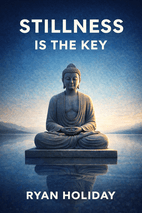
Looking for the best quotes from Stillness Is the Key by Ryan Holiday? Below are the lines that stand out most across the book.
The quotes are organized by chapter, each with a short note on where it appears and why it stands out.
Top Quotes from Stillness Is the Key
“All of humanity's problems,” Blaise Pascal said in 1654, “stem from man’s inability to sit quietly in a room alone.”
Ryan Holiday cites Blaise Pascal to highlight the root of humanity's struggles.
This line resonates because it exposes a simple yet profound truth about distraction and the difficulty of being alone with one's thoughts, a challenge that has only intensified in modern times.
“Stillness is the key to, well, just about everything.”
Ryan Holiday summarizes the book's overarching message after listing various benefits of stillness.
This concise, almost casual statement is memorable and encapsulates the transformative power of stillness in all areas of life.
“To hold the mind still is an enormous discipline,” the late comedian Garry Shandling reminded himself in his journal as he struggled to manage fame and fortune and health problems, “one which must be faced with the greatest commitment of your life.”
Ryan Holiday quotes comedian Garry Shandling's private journal about the challenge of achieving stillness.
It acknowledges the difficulty of stillness, making the pursuit relatable while emphasizing that it requires 'the greatest commitment of your life.'
“The mind is restless, Krishna, impetuous, self-willed, hard to train: to master the mind seems as difficult as to master the mighty winds.”
Epigraph from the Bhagavad Gita at the start of Part I: Mind.
It succinctly expresses the difficulty of controlling the mind, which is a core challenge addressed in the chapter.
“Keep strong, if possible. In any case, keep cool. Have unlimited patience. Never corner an opponent, and always assist him to save face. Put yourself in his shoes—so as to see things through his eyes. Avoid self- righteousness like the devil—nothing is so self-blinding.”
Kennedy quoted this passage from B. H. Liddell Hart's book on nuclear strategy, which became his motto during the Cuban Missile Crisis.
It distills timeless wisdom for high-stakes leadership: patience, empathy, and humility trump aggression. The warning against self-righteousness is a powerful reminder of how bias clouds judgment.
“It isn't the first step that concerns me,” he said to his advisors as much as to himself, “but both sides escalating to the fourth and fifth step—and we don’t go to the sixth because there is no one around to do so.”
Kennedy said this during the Cuban Missile Crisis to his advisors, emphasizing the danger of escalation.
This line captures the terrifying logic of escalation and the need to think beyond immediate moves. It forces readers to consider the ultimate consequences of reactive decisions.
Quotes by Chapter
The Domain of the Mind
“Careful as someone crossing an iced-over stream. Alert as a warrior in enemy territory. Courteous as a guest. Fluid as melting ice. Shapable as a block of wood. Receptive as a valley. Clear as a glass of water.”
This description from the Daodejing is applied to Kennedy's clarity during the Cuban Missile Crisis.
The vivid, poetic analogies offer a concrete ideal for mental stillness and adaptability. They resonate because they present calmness not as passivity but as a dynamic, responsive state.
“If people do not display statesmanlike wisdom,” he said, “they will eventually reach the point where they will clash, like blind moles, and then mutual annihilation will commence.”
Khrushchev wrote this in his letter to Kennedy during the crisis, warning of mutual destruction.
The metaphor of blind moles clashing is both visceral and unforgettable. It underscores the danger of acting without foresight and the urgent need for wisdom in conflict.
Become Present
“Act,—act in the living present! Heart within, and God o’erhead!”
Opening epigraph from Henry Wadsworth Longfellow.
It is a timeless call to action, urging us to seize the moment and be fully engaged in the now.
“The proposition here is just to empty the self. To be able to be present.”
Marina Abramovic describing her performance art at MoMA.
It captures the essence of stillness and the radical simplicity of being fully present without distraction.
“Being present demands all of us. It’s not nothing. It may be the hardest thing in the world.”
The author reflecting on the difficulty of true presence after describing Abramovic's feat.
This line challenges the common assumption that being present is easy, highlighting its profound demands.
“Remember, there's no greatness in the future. Or clarity. Or insight. Or happiness. Or peace. There is only this moment.”
The author's philosophical argument for mindfulness.
It powerfully reframes our search for meaning, directing attention to the only place where life actually happens—the present.
Limit Your Inputs
“A wealth of information creates a poverty of attention.”
Opening epigraph by Herbert Simon.
It succinctly captures the chapter's core problem: information overload undermines focus and stillness.
“Rouse me instantly,” he said, “for then there is not a moment to be lost.”
Napoleon instructing messengers when to wake him with bad news.
Illustrates the discipline of prioritizing urgent, important information over trivial updates.
“If you wish to improve,” Epictetus once said, “be content to appear clueless or stupid in extraneous matters.”
Ancient Stoic philosopher's advice on focusing on what matters.
Encourages letting go of the ego's need to stay informed about trivialities, fostering mental stillness.
“Ask yourself at every moment, ‘Is this necessary?”
Marcus Aurelius in his Meditations, cited as a guide for filtering inputs.
A simple, powerful question that helps cut through noise and prioritize what truly deserves attention.
Slow Down, Think Deeply
“It’s impossible to hit and think at the same time.”
Yogi Berra's warning about the difficulty of hitting a baseball while overthinking.
This concise, paradoxical statement captures the core tension between mental noise and peak performance, resonating with anyone who has ever choked under pressure.
“There's no sense in thinking now.”
Shawn Green tells himself this before his sixth at bat during his record-setting four-home-run game.
It illustrates the power of letting go of conscious thought to allow trained instinct to take over, a lesson applicable far beyond sports.
“The world is like muddy water. To see through it, we have to let things settle.”
The author summarizes a Stoic and Buddhist analogy about the need for patience and stillness to reveal truth.
This vivid metaphor makes an abstract philosophical idea instantly relatable, urging readers to resist hasty judgments and wait for clarity.
Start Journaling
“Paper,” she said, “has more patience than people.”
Anne Frank writing in her diary about why she confides in it.
A simple yet profound metaphor for the non-judgmental, always available nature of a journal, especially for someone in dire circumstances.
“I examine my entire day and go back over what I've done and said, hiding nothing from myself, passing nothing by.”
Seneca describing his nightly reflection practice to a friend.
This emphasizes the power of honest self-examination, showing that stillness and clarity come from confronting every action without evasion.
“It’s spiritual windshield wipers, as the writer Julia Cameron once put it.”
The author describing what journaling feels like.
A memorable, relatable image that conveys how journaling clears mental clutter and restores clarity, just like wipers clear rain from a windshield.
Cultivate Silence
“All profound things, and emotions of things are preceded and attended by Silence. .. . Silence is the general consecration of the universe.”
Opening epigraph from Herman Melville.
It frames silence as a sacred, universal force that precedes all depth and emotion, giving the reader a profound starting point.
“There's no such thing as silence,” Cage said of that first performance. “What they thought was silence, because they didn’t know how to listen, was full of accidental sounds.”
John Cage reflecting on the premiere of his composition 4'33".
It challenges the conventional definition of silence and reveals that true listening uncovers a rich world of sound we usually ignore.
“Thought will not work except in silence," Thomas Carlyle said."”
A brief observation from the philosopher Thomas Carlyle.
It distills the essential link between quiet and clear thinking, reminding readers that mental breakthroughs require stillness.
“In shutting up—even if only for a short period—we can finally hear what the world has been trying to tell us. Or what we've been trying to tell ourselves.”
The author's concluding exhortation to embrace silence.
It captures the dual benefit of silence: external insight and internal clarity, urging readers to stop contributing noise and start listening.
Seek Wisdom
“He knew nothing except just the fact of his ignorance.”
Diogenes Laërtius, writing six hundred years after Socrates's death, described the philosopher's wisdom.
This line perfectly captures the essence of intellectual humility, which is the foundation of wisdom.
“I cannot understand,” he said, “how some people can live without communicating with the wisest people who ever lived on earth.”
Leo Tolstoy expressing his exasperation at those who do not read deeply and regularly.
It powerfully reminds readers that engaging with great minds through books is essential for growth and wisdom.
“In this way, wisdom is a sense of the big picture, the accumulation of experience and the ability to rise above the biases, the traps that catch lazier thinkers.”
The author summarizing the nature of wisdom after surveying various philosophical traditions.
This definition distills wisdom into a clear, aspirational concept that connects experience, perspective, and critical thinking.
“Learning must never cease. ... The noble person who studies widely and examines himself each day will become clear in his knowing and faultless in his conduct.”
The Chinese philosopher Xunzi emphasizing the importance of continuous learning and self-examination.
It underscores the lifelong commitment to study and introspection that leads to clarity and moral excellence.