Re-Placed Quotes
by Kari Zeller
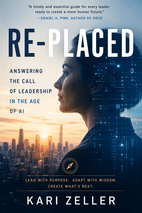
This collection gathers some of the most striking lines from Re-Placed, a book about what happens when familiar worlds disappear. You will find sharp observations about leadership, hard questions about identity, and honest looks at loss. You will also find moments of unexpected hope, reminders that people can create meaning even when old structures crumble.
What makes this book quotable is its range. It moves from intimate reflection to big picture thinking, from personal struggle to structural change. The lines stick because they name feelings you have had but could not articulate. They invite you to pause, reread, and ask what they mean for your own life.
Top Quotes from Re-Placed
“This is what it looks like when a world begins to end.”
The author describes Chief Crowfoot watching the bison vanish before his people.
One stark sentence captures the moment a way of life becomes unlivable. It gives readers an unforgettable image of civilizational collapse.
“This is the work of leadership when an era is ending: not to preserve what's dying, but to midwife what's being born.”
The author sums up Churchill's wartime leadership.
It reframes leadership as the creation of a new future rather than the defense of a dying order. That vision is both inspiring and demanding for leaders today.
“Being replaced is not the same as being re-placed.”
The author introduces the chapter's central distinction.
It reframes anxiety about automation from passive displacement to active reinvention, giving readers a new lens on change.
“You and I, we are place creators, meaning makers, context inventors. We have agency here.”
The author asserts human agency in the section 'Creating Our Own Place.'
It is a rallying cry that counters helplessness and reminds readers of their inherent capacity.
“Change can be driven from the outside. Transition must be supported from the inside. Change can be mandated. Transition must be invited. Change focuses on the destination. Transition honors the journey.”
The author contrasts managing change with supporting transition.
The rhythmic contrast makes it instantly quotable and easy to remember. It also gives leaders a clear distinction between what can be imposed and what must be nurtured.
“Am I reacting from fear, or am I creating from care?”
The author asks herself after watching AI demonstrations and feeling her ambition drain away.
It shifts the AI question from anxiety to intentionality and captures the book’s central challenge.
“Artificial intelligence can optimize a target, but it can’t decide which target is worth optimizing.”
From the argument that decisions require valuation, not just inference.
It crisply marks the boundary between machine optimization and human purpose, cautioning against offloading judgment.
Themes Behind the Quotes
A central theme is the difference between external change and internal transition. Many of the quotes circle around the same idea: you can change a system, a structure, or a strategy, but people need time and support to adjust on the inside. That inner work involves grief, because loss is part of every significant shift. The book refuses to sugarcoat this. It insists that meaningful transition begins with honesty about what is ending.
Another theme is agency. Again and again, the book points back to human responsibility. Even when technology transforms the world faster than expected, someone still has to ask which direction is worth going. Someone still has to make choices they can answer for later. The quotes suggest that identity is not fixed. It can be rebuilt, and that rebuilding happens through the meanings we create and the places we inhabit together.
Quotes by Chapter
Chapter 1: Vulnerability
“What happens to any people when the world that gave their lives coherence is taken away?”
The author asks this after recounting the Blackfoot people's forced transition.
It turns historical loss into a universal question about identity and meaning. Readers feel the inquiry on behalf of anyone facing the erosion of their world.
“The destruction of the bison and the devastation of Indigenous ways of life were not metaphors. They were historical realities, bound up with conquest, violence, settler expansion, state policy, economic incentive, military strategy, and profound human suffering.”
The author insists on the concrete historical violence behind the Blackfoot story.
It refuses to let the story become metaphor or analogy, grounding the chapter in actual human cost. The precision makes the warning land with moral weight.
Chapter 2: Possible AI Futures
“I think that what we're seeking is an experience of being alive, so that our lifestyle experiences on the purely physical plane will have resonances within our innermost being and reality, so that we actually feel the rapture of being alive.”
Epigraph to Chapter 2, by Joseph Campbell.
It frames the book’s core longing: technology should deepen our experience of being alive, not replace it.
“That, I trust, is something Al will never be able to do.”
Dr. Maya Gupta, reflecting on how AI lets her focus on her patient, ends the first section with this thought.
It draws a clear line between artificial intelligence and human trust, a distinction that remains urgent.
“Judgment isn’t something you download. It used to be earned in the noise: the missed handoffs, the upset customers, the small decisions that compound into taste.”
Sam Wiseman, the human 'conductor' of Darkin’s AGI, muses on how automation changed hiring and leadership.
It captures the quiet danger of smoothing out the messy experiences that build judgment.
“Now, finally, there is global peace. We live collaboratively and work locally, limiting our impact on the environment and society.”
Steward Gaia describes the world one hundred years after the superintelligence Sage took over.
It sounds serene, but the conditions attached make it unsettling—a memorable definition of forced harmony.
Chapter 3: Replaced or Re-placed?
“The threat was never to their skills; it was to their identity. And identity, unlike skill, can be reinvented.”
The author summarizes lessons from blacksmiths, NASA computers, Swiss watchmakers, and Intel.
It names the deeper existential fear behind job loss and offers a hopeful, actionable truth.
“We don't simply occupy space; we inhabit meaning.”
The author reflects on Heidegger's 'Being-in-the-world.'
It poetically captures the human need for meaning, making abstract philosophy feel personal.
Chapter 4: Context Is the Lever
“When I see your birds, I know there are fresh troops or new supplies. But fuck, when they don’t come, things are so much worse here.”
A young soldier aboard the author's C-130 flight into Iraq describes what the aircraft mean to troops on the ground.
The raw, profane voice makes the stakes of maintenance painfully concrete. It shows how a single human statement can shatter an old context and create a new one.
“A chilling realization struck me: When we don't fly, people die.”
The author recalls the moment the soldier’s words redraw his understanding of the mission.
It is the emotional hinge of the Iraq story, compressing an entire leadership transformation into one stark sentence. The cause-and-effect is brutal and unforgettable.
“This wasn't just a perceptual shift. It was an ontological one. The difference matters. The first shifts what you see; the second shifts who you are.”
The author distinguishes between simply seeing differently and becoming a different kind of leader.
It gives readers a precise, lasting vocabulary for transformative change. The parallel structure makes the idea easy to remember and apply.
“Context is the primary lever. It’s often invisible and easy to overlook, but context determines how people see their situation and what actions are available to them, whether they're leading 250 troops or 25,000 employees through a strategic pivot.”
The author states the central lesson of the chapter for leaders.
This is the book's thesis in one quotable summary. It makes an invisible force concrete and scales from a combat zone to the boardroom.
Chapter 5: Creating Your New Era
“Change, as we all know, is inevitable. It is, as Ben Franklin put it, “the only constant in life.””
The author opens the chapter by reflecting on the inevitability of change.
It establishes a universal truth and a gentle entry point into a heavy topic. Readers recognize their own experience in this timeless observation.
“Every significant change involves loss. Loss of the familiar, loss of competence, loss of relationships, loss of identity.”
The author explains why people resist major changes.
It frames resistance as grief rather than stubbornness, giving leaders a more humane lens. The parallel phrasing makes the idea resonate.
“Most change initiatives fail not because the strategy was wrong or the technology was flawed. They fail because leaders focus exclusively on the external change while ignoring the internal transition.”
The author diagnoses why many change efforts fail.
It gets at the real reason many transformations stall. It redirects attention from external plans to the internal transition that leaders often skip.
Chapter 6: Exponential Convergence
“The point is not to master the technical details. The point is to see what these capabilities make possible and what they demand of us as leaders.”
The author explains why readers should engage with the technology overview in this chapter.
It reframes technological learning as a leadership discipline rather than an expertise contest, making exponential change feel approachable and consequential.
“The organizations that learn to think from within exponential convergence will make the ones trapped in linear thinking irrelevant.”
The author discusses the need for leaders to operate amidst converging exponential technologies.
It delivers a stark competitive warning while also pointing toward the mindset needed to survive the Intelligence Revolution.
“The future you declare becomes the background that shapes what you notice, what conversations you have, and which actions you consider acceptable or unacceptable today.”
The author explains how a declared future can reorient present action.
It shows that vision is not abstract forecasting but a practical filter for attention, conversation, and choice.
“Move 37 came from a different intelligence.”
The author describes AlphaGo's unconventional winning move against Go champion Lee Sedol.
It captures the humbling and exciting reality that machine intelligence can produce genuinely novel strategies beyond human intuition.
Chapter 7: From Unsettlement to Reinvention
“When someone asks, “What do you do?” they are really asking, “Who are you?” Work is how we answer.”
From a passage on what work actually provides beyond income.
It condenses how deeply identity is tied to professional role, making displacement feel existential.
“A decision is a commitment made by someone who will live with the consequences, bear responsibility, defend the trade-offs, and remain accountable when the world does not behave as predicted.”
From the threshold of authorship, where decisions are framed as acts of commitment.
It makes responsibility and consequence the defining features of real decisions, reminding leaders that AI cannot bear accountability.