Re-Placed Key Takeaways
by Kari Zeller
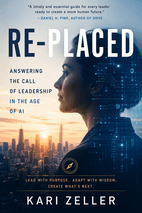
5 Main Takeaways from Re-Placed
Re-placement keeps people valuable when AI replaces tasks.
We experience work and life through placedness — a felt sense of belonging and mattering. When automation displaces roles, leaders must re-place people into new contexts where their contribution can be recognized and their identity can grow. AI can replace tasks, but it cannot replace fundamental cares like dignity, safety, and meaning.
Context shapes reality; leaders must shift it deliberately.
No one responds to objective reality; we respond to the context our brains construct. The most powerful leadership move is to reveal the current context, cocreate a more empowering one, and treat vision as a context to come from rather than a goal to chase. That shift makes new actions feel inevitable.
Change is external; transition is internal — complete before creating.
People resist change when it threatens their place: competence, relationships, identity, and expected futures. The New Era Framework — Complete, Create, Commit, with Care throughout — helps leaders finish the past before coauthoring the future. Skipping completion leaves people anchored to old mental maps and unable to see new possibilities.
People commit when contribution, recognition, identity, and cares are present.
Commitment to a new future is not a motivational problem; it is a design problem. People need to see that their cares will be advanced, they will contribute meaningfully, they will be recognized, and their identity will be enhanced. Missing any one element invites resistance.
Turn exponential convergence into time-boxed pilots, not hype.
Quantum AI, materials research, and financial analytics are already converging, but you do not need to be a technical expert. You need curious, disciplined imagination plus appropriation — enough conversational fluency across domains to spot opportunities. Combined, these turn unsettled feelings into reinvention and testable sprints.
Executive Analysis
The book's central argument is that the disruption caused by AI and exponential technology is fundamentally a crisis of place, not a technology problem. People are replaced when they are displaced from belonging, meaning, and mattering; leaders re-place them by seeing fundamental cares and creating contexts where contribution and identity endure. Context is the lever because humans respond to the meaning they construct, not raw reality. Lasting change therefore requires an internal transition — completing the past, cocreating a new context, and committing through promises while caring throughout. When leaders combine this human-centered foundation with imagination and appropriation, convergence becomes an opportunity to build new futures rather than a threat to survive.
Why this book matters: it provides a practical grammar for the disorientation of the Age of Intelligence. Zeller bridges change management, leadership, and future-of-work thinking by extending transition theory and giving leaders tools like the New Era Framework and Convergence Sprint Challenge. Its impact is immediate: readers can identify who is being displaced, surface the context running their teams, and run time-boxed pilots of convergent technologies. It is especially valuable for leaders who know AI is coming but lack a human-centered way to act with clarity.
Chapter-by-Chapter Key Takeaways
Replaced or Re-placed? (Chapter 3)
Place is existential, not just positional. We experience the world through placedness, a felt sense of belonging and mattering. To be replaced is to be displaced and discarded; to be re-placed is to be moved into a new context where contribution and meaning endure.
Transformative leadership begins with commitment. A commitment larger than ego changes what we see and enables us to hear the fundamental cares beneath positions and solutions.
Fundamental cares are the gateway to the future. When we listen for dignity, belonging, safety, meaning, and mattering, entirely new possibilities appear. AI can replace tasks, but not these cares.
People commit when they can see themselves in the future. Four elements are required: cares advanced, a meaningful contribution, recognition, and identity enhancement. Missing any one of these invites resistance.
Re-placement heuristics turn insight into action. Orient early, name the contextual shift, create new contexts, treat AI as a complement, recontextualize identity, double down on being human, build a learning culture, and make the future meaningful enough to mobilize people.
Try this: Audit who is being displaced in your organization, then re-place them by asking whose fundamental cares — dignity, belonging, safety, meaning, mattering — are threatened and by designing new contexts that offer contribution, recognition, and identity enhancement.
Context Is the Lever (Chapter 4)
Human beings never respond to objective reality directly; we respond to the subjective reality shaped by our context. Neuroscience confirms our brains construct reality rather than passively receive it.
A context shift can be perceptual (changing what you see) or ontological (changing who you are). The most powerful leadership moves change both.
Vision works as a context to come from, not a goal to work toward. When that shift happens, new actions become not only possible but inevitable.
Leaders reveal the existing context, cocreate a new one, then mobilize it into visible action. Each step is necessary; skipping any one leaves you with either inspiration or compliance, but not transformation.
The ultimate leadership test is not technology choice or strategy—it's whether you're aware of the context running you and whether you have the skill to choose one that empowers you instead.
Try this: Surface the context currently running your team's behavior, cocreate a more empowering context together, and then mobilize it into visible action before defaulting to new technology or strategy.
Creating Your New Era (Chapter 5)
Change is external; transition is internal. Change can be scheduled and project-managed. Transition is the psychological process people must go through to come to terms with their new situation. Most change initiatives fail because leaders focus on the external change while ignoring the internal transition.
People resist change because it threatens their place. Every significant change involves loss of competence, relationships, identity, and expected futures. What looks like resistance is often people trying to preserve their sense of belonging and value.
The New Era Framework has three phases: Complete, Create, Commit, with Care throughout. Completion honors and releases the past. Creation coauthors a new context. Commitment embeds the new era through promises and structures. Care attends to fundamental human needs throughout.
We complete before we create because past-based contexts limit future possibilities. Without completion, people remain anchored to old assumptions. They literally cannot see possibilities that don't fit their existing mental maps.
Context cannot be dictated; it must be cocreated. You cannot give someone a context. The best you can do is enroll them in authoring a different, more empowering context with you.
Declarations create new realities. A declaration is not a description of what is. It is language that establishes what will count as real going forward. When you name a new era, you are not offering a slogan; you are attempting to establish a new shared reality.
Promises make the new era real. Without specific, time-bound commitments with clear conditions of satisfaction, declarations remain aspirational. The commitment phase designs the structures and agreements that keep the new context alive.
Care is not a phase but a thread. The Neutral Zone, the messy middle between old and new, is where real transformation happens. Care is what allows people to stay in that discomfort long enough for genuine change to occur.
In the Age of Intelligence, everyone needs this work at once. The transition we're facing is not just organizational but civilizational. The Era Framework gives you a way to do the work even when the ground is shifting.
AI can become a tool for this work, not just a threat to it.
Try this: Complete the past openly, cocreate the new context with people, and lock it in with promises and structures — all while caring through the Neutral Zone.
Exponential Convergence (Chapter 6)
Real-world convergence is already happening across industries: quantum AI in drug discovery, automotive materials research, and financial analytics are no longer hypothetical use cases.
The Convergence Sprint Challenge is a practical, six-step exercise for turning exponential technology combinations into testable, time-boxed pilots.
The mindset you bring to imagining the future determines what you can see. Curiosity and disciplined imagination reveal possibilities that skepticism and obligation hide.
You do not need to become a technical expert in AI, robotics, bioengineering, or quantum computing. You need enough conversational fluency across domains to see opportunities others miss. That skill is appropriation.
Imagination without appropriation is wishful thinking; appropriation without imagination is academic knowledge. The combination is how leaders innovate from within exponential convergence.
The unsettled feeling that comes from understanding these shifts is not a problem to solve. It is the basis for reinvention, the very thing that makes genuine leadership possible in this era.
Try this: Run a Convergence Sprint with curiosity and disciplined imagination, using appropriation to turn converging AI, robotics, bio, and quantum possibilities into time-boxed pilots.