Re-Placed Interactive Mindmaps for Re-Placed (Free)

Re-Placed — Interactive Mindmaps

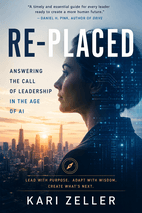
Re-Placed by Kari Zeller Book Cover

by Kari Zeller

Kari Zeller's Re-Placed distinguishes between passive displacement and deliberate reinvention, offering leaders the New Era Framework to guide teams through AI-driven change. Drawing on historical examples from Chief Crowfoot to Dorothy Vaughan, it provides conversational tools and a pivot question—"Am I reacting from fear, or am I creating from care?"—for professionals navigating identity-threatening disruption.

On Insta.page you also get an Apply This Book tool that lets you combine insights from up to 3 books to solve your specific situation.

Chapter mindmaps

Free preview: chapters 1–4 are fully interactive. Click any node to expand or collapse. Subscribe to unlock the rest.

Chapter 1: Vulnerability

Key concepts: Chapter 1: Vulnerability

Chapter 1: Vulnerability

Three Leaders Facing World's End

  • Crowfoot watched bison vanish at Head-Smashed-In
  • Durmugam tried restoring fractured Nangiomeri culture
  • Churchill refused Hitler's terms, authored new context
  • Each faced collapse of their people's entire world

Three Responses to Collapse

  • Crowfoot chose pragmatic adaptation, signed Treaty 7
  • Durmugam chose restoration, trapped between two broken worlds
  • Churchill chose creation, built institutions for unknown future
  • Success or failure less important than shared condition

Ontological Crisis and AI Threat

  • Ground beneath identity, value, meaning gives way
  • Leadership practices face existential threat from AI
  • Question: is work our buffalo?
  • Old virtues like diligence may lose their point

Context vs. Circumstances

  • Circumstances simply are; context assigns meaning
  • Blockbuster failed due to obsolete context, not blindness
  • Excellence within obsolete context is still obsolescence
  • Shift from information economy to intelligence economy

Context Creators vs. Prisoners

  • Leaders must author new contexts, not inherit them
  • Ask what becomes possible because AI changes everything
  • Thriving requires creating meaning, not managing facts
  • New context empowers meaningful action

Future-Now Thinking and Ontological Agility

  • Inhabit possible worlds as present realities
  • Herman Kahn trained RAND strategists to think unthinkable
  • Scenarios are training grounds, not predictions
  • Practice seeing what could be, not what will be

Urgency of Change Itself

  • Change has become pervasive, perpetual, accelerating
  • Waiting to see if AI talk is hype is not strategy
  • Understand ontological scaffolding beneath current life
  • Compose new context, create value, mitigate risk

Chapter 2: Possible AI Futures

Key concepts: Chapter 2: Possible AI Futures

Chapter 2: Possible AI Futures

Three Possible AI Futures

  • Narrow AI: Dr. Gupta's diagnostic partnership with DoctorDoctor
  • AGI: Sam Wiseman's role as Conductor of Darkin
  • Superintelligence: Steward Gaia's managed world after singularity

The Cost of Each Future

  • Gupta cedes cognitive ground to AI software
  • Sam's agency may be illusory figurehead role
  • Gaia's purpose assigned by another intelligence
  • No future shows humans creating new value contexts

Shifting Competitive Advantage

  • Information advantage era is ending
  • AI commoditizes analysis, optimization, pattern recognition
  • Old differentiators become table stakes
  • Wrong question: what humans can do that AI cannot

What Humans Truly Value

  • Dignity, love, belonging, purpose, play, connection
  • These forces shape every decision and dollar spent
  • Scarcity shifts to uniquely human capacities

Human Capacities That Remain

  • Judgment about what should be done
  • Creating contexts that make new realities possible
  • Sensing what people genuinely care about
  • Designing offerings that address those cares

Warnings Embedded in Scenarios

  • Humanity trapped in old context gets commoditized
  • Displacement and eventual beloved irrelevance
  • Gradual erosion of human significance

Leadership in the Age of Intelligence

  • Requires changing trajectory, not just adapting
  • Masters of reinvention for new contributions
  • Stay human and keep others human
  • Mobilize heads, hands, and hearts—work no machine can do

Chapter 3: Replaced or Re-placed?

Key concepts: Chapter 3: Replaced or Re-placed?

Chapter 3: Replaced or Re-placed?

Replaced vs. Re-placed

  • Replaced is passive displacement and erasure
  • Re-placed is active movement into new meaning
  • Place is existential, rooted in Heidegger's thrownness
  • Disruption threatens identity, not just skills

Historical Re-placement

  • Blacksmiths became auto mechanics after Model T
  • Dorothy Vaughan retrained NASA computers as programmers
  • Swiss watch industry reinvented through heritage narrative
  • Intel exited memory to become computing architecture

Transformative Leadership

  • Commitment precedes vision in leaders like Gandhi
  • Ordinary people who perceive differently lead change
  • Fundamental cares underlie positions and solutions
  • Northern Ireland peace process surfaced shared cares

Conditions for Commitment

  • Cares must be advanced in the future
  • People need meaningful, needed contributions
  • Contributions must be seen and recognized
  • Identity enhancement enables pride and commitment

Heuristics for Action

  • Orient early and name contextual shifts
  • Create new contexts, treat AI as complement
  • Recontextualize identity and build learning culture
  • Make the future meaningful to mobilize others

Chapter 4: Context Is the Lever

Key concepts: Chapter 4: Context Is the Lever

Chapter 4: Context Is the Lever

The Balad Story: Context Transforms Reality

  • Same facts, new meaning: 65% readiness became unacceptable
  • Ontological shift: maintenance officer became life-saver
  • New identity drove new actions and 54% fewer aborts
  • New frame led to $5.5M facility, no new resources

Core Argument: Sense-Making Drives Behavior

  • People don't do stupid things; they do what makes sense
  • Influence interpretation, not just information
  • Context highlights some aspects, dims others
  • No opting out—everyone lives inside a frame

Corporate Examples: Kodak vs. Fujifilm

  • Same data, different contexts: film vs. innovation company
  • Kodak defended legacy, managed decline to bankruptcy
  • Fujifilm pivoted to healthcare, cosmetics, worth $20B
  • Lehman/Bear saw manageable risk; Goldman saw systemic danger

Neuroscience: Brain as Prediction Machine

  • We respond to subjective experience, not objective reality
  • Consciousness is a controlled hallucination, a best guess
  • Problems are assessments from within a context
  • Transformative leadership changes experience of reality

Exponential Era: New Historical Context

  • Past revolutions were linear; now change is exponential
  • AI forces sense-making about work, value, identity
  • Information matters less than existing context
  • Same AI: 'extra IQ points' vs. 'homogenization of spirit'

Four AI Contexts in Organizations

  • Opportunity: actively integrate the technology
  • Threat: see obsolescence, training won't help
  • Implementation: lip service, wait for change to fade
  • Adopt-immediately: speed over understanding, 'workslop'

Self-Referential Questions Shape Responses

  • All four contexts are rational within their frames
  • People ask: What does this mean for me and my identity?
  • If self equals expertise, AI makes them feel replaceable
  • Context determines which questions become imaginable
You've reached the end of the free mindmaps

Next chapter: “Chapter 5: Creating Your New Era” is locked

See every chapter of Re-Placed as an interactive mindmap — and unlock all 500+ book summaries with audio and AI Q&A.

$0.00 due today · 7 days free, then $89.99/year ($7.49/mo) · Cancel anytime before day 7

Continue exploring Re-Placed