Open to Work — Interactive Mindmaps

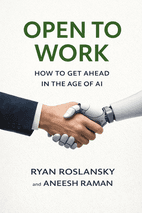
Open to Work by Ryan Roslansky Book Cover

by Ryan Roslansky

Ryan Roslansky's Open to Work provides a pragmatic roadmap for professionals to future-proof their careers by collaborating with AI, not fearing it. It advocates shifting from rigid job titles to viewing work as tasks and careers as nonlinear paths, emphasizing uniquely human strengths like creativity and the 5Cs framework.

On Insta.page you also get an Apply This Book tool that lets you combine insights from up to 3 books to solve your specific situation.

Chapter mindmaps

Free preview: chapters 1–4 are fully interactive. Click any node to expand or collapse. Subscribe to unlock the rest.

Chapter 1: Foreword

Key concepts: Foreword

1. Foreword

AI as Collaborative Partner

  • AI handles technical tasks and busywork efficiently
  • Frees humans to focus on creativity and strategy
  • Requires skilled prompting and human oversight

Human Skills as Differentiator

  • Soft skills become increasingly valuable with AI
  • Curiosity, empathy, and relationship-building are irreplaceable
  • Personal voice and judgment remain essential

Historical Pattern of Technological Disruption

  • Technology eliminates specific jobs but creates new ones
  • Resistance to change is a recurring historical theme
  • Disruptions have ultimately transformed work positively

Proactive Adaptation to AI

  • We have advance knowledge of AI's impact unlike past generations
  • Individuals can learn to integrate AI on their own terms
  • Combining human qualities with tools paves way forward

Ume's Personal Framework for AI Integration

  • Uses AI to scale her mission without losing authentic voice
  • Infuses AI with personal problem-solving approaches
  • Views AI through lens of resilience and growth mindset

Chapter 2: Chapter 1: Buckle Up

Key concepts: Chapter 1: Buckle Up

2. Chapter 1: Buckle Up

The Inevitable AI Shift at Work

  • AI-skilled professionals gain decisive competitive edge
  • Leadership demands AI skills in hiring decisions
  • 70% of job skills will change by 2030 due to AI

S-Curve of Technological Adoption

  • AI is in explosive middle phase of adoption
  • Adaptation time compressing from decades to months
  • Creates cognitive mismatch with exponential change

Biology of Resistance to AI

  • Fear triggers primal freeze/fight/flee response
  • Anxiety stems from threat to identity and purpose
  • Resistance is natural biological reaction

The Red Queen Effect

  • Must run fast just to stay in place
  • Continuous upskilling is new baseline requirement
  • Work itself transforms around professionals

Amplifying Human Uniqueness

  • Collaborate with AI, don't compete
  • Use AI to free time for creativity and connection
  • Inject authentic human voice into AI outputs

Learning from Historical Resistance

  • Understand what's lost but envision what's created
  • Avoid repeating cycles of technological resistance
  • Tools for adaptation are now widely accessible

Adaptation Mindset

  • Demystify AI through application, not creation
  • Intentional experimentation is key skill
  • Frame moment as opportunity, not crisis

Chapter 3: Chapter 2: Let It Go

Key concepts: Chapter 2: Let It Go

3. Chapter 2: Let It Go

The Efficiency Trap

  • Industrial mindset values output over human potential
  • Turns complex skills into single repetitive tasks
  • Creates systems that waste human abilities

Factory Mindset Migration

  • Industrial Revolution replaced craft with assembly lines
  • Efficiency model moved from factories to offices
  • Created rigid work structures like the 9-to-5 schedule

Collar Hierarchy Reality

  • White-collar work promised creativity but delivered routine
  • Advanced degrees often train for process management
  • Most knowledge work involves administration, not deep thinking

AI's White-Collar Reckoning

  • Reveals that much knowledge work is process, not thinking
  • Exposes 'work about work' like meetings and emails
  • Makes skilled blue-collar trades more valuable comparatively

The Entrepreneurial Shift

  • Mindset of creating value beyond job titles
  • Focus on solving problems with available resources
  • Future success based on augmenting human skills with technology

AI as Thought Partner

  • Use AI to handle routine tasks and gather ideas
  • Maintain human control over judgment and creativity
  • Avoid over-reliance that weakens independent thinking

Augmentation Over Replacement

  • AI frees humans for strategy and creation
  • Cultural insight remains uniquely human
  • Technology enables new, more meaningful work

Chapter 4: Chapter 3: The Humans Are Coming

Key concepts: Chapter 3: The Humans Are Coming

4. Chapter 3: The Humans Are Coming

Brain Plasticity and Deliberate Practice

  • Brain physically grows with use, like in taxi drivers
  • Extraordinary skill is built, not innate
  • Deliberate practice involves focused, feedback-driven effort

The IQ Test and Narrow Intelligence

  • IQ test reduced intelligence to a single score
  • Prized speed and standardized logic over creativity
  • Created a century-long hierarchy favoring technical skills

Soft Skills as Better Predictors of Success

  • Resilience predicts success better than credentials
  • Willingness to be publicly wrong indicates active learning
  • These are uniquely human strengths machines lack

The 5Cs Framework

  • Curiosity: Drive to ask 'what if?' and explore
  • Courage: Willingness to act amid uncertainty
  • Creativity: Capacity to reimagine what's possible
  • Compassion and Communication: Foundation of trust and shared meaning

Emotional Intelligence in the AI Age

  • 5Cs and EQ are the new essential hard skills
  • AI lacks genuine emotional attunement and connection
  • These capabilities are irreplaceable human edges

Historical Need for Deep Work

  • Great innovators required time for slow, deep thinking
  • Breakthroughs emerge from sustained curiosity over years
  • Deep thinking was fundamentally collaborative

AI as Liberator for Human Creativity

  • AI can automate routine, efficiency-driven tasks
  • Frees humans to focus on creative, slow processes
  • Enables collaboration with AI on human terms

Continue exploring Open to Work