Open to Work Key Takeaways
by Roslansky, Ryan
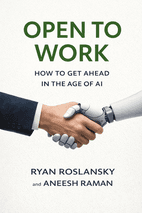
5 Main Takeaways from Open to Work
Human skills like empathy and creativity are your irreplaceable AI-age advantage.
As AI automates routine tasks, your ability to connect, understand, and innovate becomes essential. This book emphasizes cultivating curiosity, emotional intelligence, and ethical reasoning to stay relevant and impactful in any role.
Partner with AI as a collaborative tool to amplify your human potential.
AI is not a replacement but a liberator; use it to handle efficiency tasks so you can focus on strategic and creative work. Examples include using AI for research while you build relationships and generate novel ideas.
Redefine your career by skills and tasks, not by job titles or ladders.
Your work is a collection of capabilities—audit them using the three-bucket framework to offload routine tasks, collaborate on complex ones, and develop human skills. This mindset shift enables continuous adaptation in a fluid job market.
Embrace an entrepreneurial mindset to navigate change and build networks.
See constraints as opportunities, cultivate a multidirectional network for insights, and showcase your work through projects. This approach helps you thrive in a non-linear career landscape where agility beats seniority.
Democratize innovation by leveraging AI to unlock diverse talent.
AI can level the playing field, allowing people from all backgrounds to innovate. Supporting inclusive education and adoption drives economic growth and solves problems from new perspectives, benefiting society as a whole.
Executive Analysis
The five key takeaways interconnect to present the book's central thesis: navigating the AI revolution requires a fundamental shift from viewing technology as a threat to embracing it as a collaborator that amplifies human potential. By prioritizing irreplaceable human skills like empathy and creativity, redefining careers around adaptable capabilities, and fostering an entrepreneurial mindset, individuals and organizations can transform disruption into opportunity. This argument is built on historical patterns of technological change, emphasizing that proactive adaptation is now possible with foresight and tools.
'Open to Work' stands out in the genre of future-of-work literature by providing concrete, actionable strategies rather than speculative warnings. It empowers readers to audit their tasks, build multidirectional networks, and leverage AI for personal and economic inclusion. The book's practical impact lies in its step-by-step guidance for career resilience, making it essential for professionals, leaders, and policymakers aiming to thrive in an exponentially changing world.
Chapter-by-Chapter Key Takeaways
Foreword (Foreword)
Human skills are the differentiator: In an AI-augmented world, traits like curiosity, empathy, and the ability to build genuine relationships become increasingly valuable and irreplaceable.
AI is a collaborative tool, not a replacement: Effective use of AI, as demonstrated by Ume, involves skilled prompting and human oversight to enhance creativity and efficiency, not to substitute for personal voice and judgment.
Technological disruption is a historical constant: While new technologies displace specific jobs, they historically create new forms of work and industries, though this offers little immediate comfort to those displaced.
Proactive adaptation is possible: Unlike past revolutions, we have advance knowledge and tools for AI, allowing individuals to learn new skills and integrate these technologies on their own terms.
Try this: Start using AI today to handle routine tasks, freeing you to practice and develop your irreplaceable human skills like empathy and curiosity.
Buckle Up (Chapter 1)
The pace of change is exponential, not linear. Change will never be this slow again. The time for intentional experimentation is now.
Your resistance is biology, not weakness. The discomfort felt toward rapid change is an evolutionary protective instinct. Recognizing this allows you to consciously choose adaptation.
Don’t fight the future; build it. The adapters focus on what can be gained and use tools like AI to amplify human potential, rather than dwelling only on what might be lost.
Try this: Consciously override your biological resistance to change by scheduling regular time to experiment with new AI tools and technologies.
Let It Go (Chapter 2)
The efficiency trap is ending. AI will take over the routine, repetitive tasks that have filled our workdays. This makes us ask what human work should really be.
Cultural insight is an irreplaceable advantage. The best ideas often come from personal experience and understanding people—areas where AI cannot go.
Collaboration beats competition. The best path is to partner with AI, not fight it. Let it handle the routine work so humans can focus on creative and strategic thinking.
The goal is liberation, not replacement. Used well, AI can free us from the "more, better, faster" cycle. It lets us put our energy into work that is truly new and meaningful.
Try this: Delegate repetitive tasks to AI and redirect your energy towards collaborative projects that leverage cultural insights and creative thinking.
The Humans Are Coming (Chapter 3)
Emotional Intelligence is Non-Negotiable: In the AI age, the human capabilities of the 5Cs transition from being advantageous to being essential for irreplaceability.
Innovation Demands Time and Trust: History's greatest breakthroughs required deep thinking and collaboration—conditions most modern workplaces have eliminated for efficiency.
AI is a Liberating Tool, Not Just a Competitor: By automating efficiency-driven tasks, AI gives us the opportunity to reclaim time for the deeply human, collaborative work of innovation.
Democratizing Potential: AI tools can level the playing field, allowing more people to test ideas by reducing barriers of time, money, and specialized training.
Try this: Schedule dedicated, uninterrupted time for deep collaborative work to foster innovation, using AI to manage administrative burdens.
Next chapter: “The Lost Einsteins” is locked
Keep learning from Open to Work — and unlock all 600+ book summaries with audio, mindmaps and AI Q&A.
$0.00 due today · 7 days free, then $89.99/year ($7.49/mo) · Cancel anytime before day 7
plus sales tax where applicable