Open to Work Quotes
by Ryan Roslansky
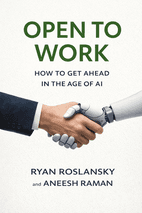
This collection brings together the sharpest lines from Ryan Roslansky's "Open to Work." You will find quotes that challenge how we think about AI, skill, and the future of our careers. Some quotes are blunt warnings. Others are quiet reminders of human potential. What makes this book so quotable is its honesty. It does not pretend technology will save us or destroy us. Instead, it offers clear, practical insights that stick with you long after you put the book down. These are the kind of lines you want to highlight, share with a colleague, or tape to your monitor.
Top Quotes from Open to Work
“I always say Al is not going to take over my job, because I know what I bring to the table that Al cannot,” Ume says. “Soft skills are so much more than ‘I can talk to a person.’ It's being kind to people. It's showing compassion and being able to offer those human aspects that Al just can't.”
Ume, a content creator and computer science graduate, explains why she is not threatened by AI.
This quote powerfully reframes AI as a tool that amplifies uniquely human qualities like kindness and compassion, resonating with anyone anxious about automation.
“Al won't replace you at work, but someone using Al likely will.”
The opening lines of the chapter, setting the urgent premise.
This concise statement captures the core anxiety of the AI era—it's not about being replaced by technology, but by those who embrace it. It immediately reframes the problem from a passive threat to an active competitive challenge.
“First, change at work will never be as slow as it is now. Second, Al as a tool will never be as basic as it is now. Third, every day you wait, the gap between those experimenting with Al and those hesitating widens.”
The author's three key insights about the accelerating nature of change.
This tripartite warning uses repetition and clarity to emphasize urgency. It gives readers a clear, actionable takeaway: delay is costly.
“You're a collection of distinctly human capabilities, contributions, and potential that no title captures.”
The author explaining that people are more than their job title.
This line powerfully reframes professional identity as a collection of human capabilities rather than a narrow label, encouraging readers to see their full value beyond any title.
“Real transformation happens when we stop forcing new tools into old patterns and start asking what's possible, now, that was never possible before.”
The economist Paul David drew this lesson from studying the transformation of factories during electrification.
It encapsulates the book's central argument that true innovation requires reimagining work itself, not just adding new tools. This line challenges readers to think beyond incremental improvements.
“It's not about the tool; it's about whether or not you're going to change behavior.”
Conor Grennan uses this analogy to emphasize that AI adoption is about behavioral change, not technology.
The treadmill metaphor makes the abstract concept of change management tangible and memorable. It forces readers to confront the real obstacle to AI transformation: human habits.
Themes Behind the Quotes
A central theme is that AI will not simply replace people but will reshape what work looks like and force us to rethink our own value. The book emphasizes that soft skills, human connection, and critical thinking become more important, not less, as machines take over routine tasks. Another theme is the gap between those who experiment with new tools and those who wait. The message is clear: the biggest risk is not being replaced by a machine but by someone who knows how to use one.
A second major theme is opportunity and responsibility. The book argues that we have a rare chance to redesign work around human strengths like creativity, empathy, and collaboration. But that opportunity requires action, not passivity. It calls for deliberate practice, willingness to be wrong, and a shift from asking for what we need to offering what we can contribute. Ultimately, the quotes point to a future where our identity and worth are not tied to a job title but to the unique human capabilities we bring.
Quotes by Chapter
Foreword
“Technology doesn't just replace work; it transforms what work can be, creating new jobs and new job categories in the process.”
The author reflects on historical patterns of technological disruption, citing MIT and LinkedIn data.
This concise statement captures the central hopeful thesis of the chapter, offering a broader perspective on job evolution rather than loss.
“This time, the knowledge of what's changing is available to everyone, and the ability to manage the change is available to everyone who has access to Al tools.”
The author contrasts past disruptions with the current AI era, emphasizing that people now have awareness and agency.
It empowers readers by suggesting that unlike the Luddites, we can proactively adapt rather than resist, making the future feel manageable.
“I'm the old dog that learned the new trick,”!® says Jonetta Gresham, a fifty-something nurse turned project manager. “And Al is the new trick.”
Jonetta Gresham, a late-career professional who successfully adopted AI, shares her personal motto.
This quote is memorable and relatable, proving that lifelong learning is possible at any age and turning a cliché into an inspiring call to action.
Chapter 1: Buckle Up
“What if your skills don’t matter anymore? What if who you are doesn’t matter? That's the fear beneath the fear: not just the loss of a job, but the loss of a livelihood and an identity.”
The author delves into the psychological depth of workers' anxiety about AI.
It names the existential dread many feel but may not articulate, validating their deepest concerns. This passage builds emotional resonance and trust with the reader.
“The Luddites, as they came to be known, weren't skeptical of technology. They believed in it. And that's why they were desperate.”
Historical discussion of the Luddite rebellion against mechanical looms.
This line subverts the common stereotype of Luddites as technophobes, revealing a more tragic truth. It warns readers that resisting change often comes from a clear-eyed understanding of loss, yet still leads to obsolescence.
Chapter 2: Let It Go
“The missed opportunity wasn't the work itself, but that the world of work funneled all of Mary Smith's potential into a single repetitive task.”
Reflecting on the story of Mary Smith, a knocker-upper whose job was made obsolete by alarm clocks.
It reframes job loss not as a tragedy of unemployment but as a failure to use human potential more fully, a theme that resonates deeply in an age of automation.
“We have a once-in-a-lifetime, once-in-a-century, once-in-a-millennium opportunity to lift up jobs that depend on human relationships and connection and value them financially and socially.”
Anne-Marie Slaughter of New America describing the potential of the New Care Economy in the age of AI.
This line offers a hopeful, ambitious vision for revaluing care work at a moment when many fear technological displacement.
“What Al did for Neil was trigger new thinking for him to do. It didn't do that thinking for him.”
Describing how consultant Neil Pretty uses AI as a collaborative tool rather than a crutch.
It crisply captures the ideal relationship between humans and AI: augmentation, not replacement, preserving human judgment and creativity.
“When we outsource our thinking entirely to Al, we don’t just get worse outcomes; we actually degrade our own ability to think critically.”
Citing a study from MIT on the cognitive risks of overreliance on AI.
A stark warning that resonates in an era of easy AI tools, reminding us that outsourcing thought weakens our own mental muscles.
Chapter 3: The Humans Are Coming
“The human brain! is a three-pound organ that consumes less energy than a typical lightbulb but somehow generates consciousness, conscience, and the capacity for everything from love to faith.”
Opening of the chapter describing the extraordinary capabilities of the human brain.
This line captures the awe-inspiring contrast between the brain's physical modesty and its immense power, setting up the central theme that human abilities far exceed what machines can replicate.
“Excellence is not simply born but built through what he called “deliberate practice”: focused, feedback-driven effort that is designed to consistently stretch one's abilities beyond comfort.”
Anders Ericsson's research on expertise, summarized from his book Peak.
It challenges the myth of innate talent and empowers readers by showing that mastery is achievable through intentional effort, a message especially relevant in an age of AI.
“The test became what Binet feared: a tool for measuring human worth by how well minds could serve the demands of a system that valued speed over depth, standardization over creativity, and measurable output over unmeasurable insight.”
Describing how IQ testing evolved from Binet's original intent into a narrow, industrial-age metric.
This critique of standardized measurement resonates deeply today, as we reconsider what truly matters in human capability versus what machines can do.
“Individuals who achieve at a high level, she says, are “willing to be wrong in front of other people for the privilege of learning what's right.””
Vivienne Ming summarizing her research on what predicts extraordinary careers.
It reframes failure as a courageous, essential part of growth and highlights a uniquely human trait that AI cannot replicate.
Chapter 4: The Lost Einsteins
“Overall, children from the wealthiest 1 percent of families were ten times more likely to become inventors than those from lower-income households. Ten times.”
Raj Chetty's research on inventors
This stark statistic highlights the enormous inequality of opportunity in innovation.
“Everyone is amazing. It is simply that the vast majority of people will never lead the life that allows them to actually realize that amazing. I don’t even like to think of potential. Not they could be amazing; they are amazing. We have to own the failure of not allowing them to become that person.”
Vivienne, a neuroscientist, speaking about untapped human potential
It reframes potential as already present and places responsibility on society for failing to nurture it.
“We have this opportunity to imagine something. We have the opportunity to create and steer it in a particular direction, but people think about technology as destiny. Actually, we are at this inflection point, and we do have the power and the responsibility to shape it.”
Tess Posner, CEO of AI4ALL, on the role of human agency in shaping AI
It calls on readers to recognize their power and responsibility in directing technological progress.
“If I have seen further, it is by standing upon the shoulders of giants.”
Isaac Newton, quoted in the chapter about cumulative innovation
This timeless quote encapsulates the ratchet effect of human progress through building on prior knowledge.
Chapter 5: Jobs Are Tasks, Not Titles
“She succeeded because she recognized that her real job wasn't typing, it was producing perfect documents.”
The author summarizing Bette Nesmith Graham's realization about her job.
It illustrates the core insight that focusing on the purpose of a job rather than its defined tasks enables innovation and success.
“It comes for tasks, one by one, upending roles from the inside out.”
The author explaining how AI disrupts traditional job roles.
This concise, punchy statement captures the threat of AI in a memorable way, emphasizing that AI targets specific tasks rather than whole jobs.
“Automating some subset of a position’s tasks doesn't make the other ones unnecessary—in fact, it makes them more important and increases their economic value.”
Economist David Autor's observation from a TED Talk about automation.
It succinctly explains why automating some tasks doesn't eliminate jobs but enhances the value of remaining human tasks, a key counterintuitive insight for adapting to change.
Chapter 6: Careers Are Climbing Walls, Not Ladders
“If you're doing work you love, work you'd happily do for free, then it's not work but play. Someone who views the same tasks as work can never compete with someone who loves it, because work wears us out and play doesn’t.”
Ethan Evans explaining the competitive advantage of aligning work with passion.
This memorable contrast between work and play underscores the intrinsic motivation that becomes a key asset as traditional career ladders dissolve.
“The actual projects, results, and contributions you have made are what employers will look for to see what you can do.”
The author describes how employers now value demonstrated work over credentials.
It succinctly states a key theme of the chapter: your tangible output is your new resume, a powerful call to action for readers.
“Don't lead with what you need; lead with what you can offer.”
Advice given in the book on building networks.
This practical wisdom flips the typical networking mindset from self-serving to generous, making it memorable and actionable.
“The network is like a spotter, who can tell us what lies out of our immediate sight: the clients, partners, new roles, and opportunities that can make our next move.”
Ethan, a network builder, compares a professional network to a climbing spotter who provides crucial information.
The metaphor vividly illustrates the value of networks in navigating a nonlinear career path, making the abstract concept concrete.