Invest Like Warren Buffett Quotes
by Matthew R. Kratter
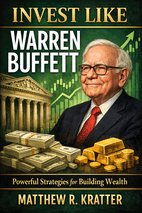
Looking for the best quotes from Invest Like Warren Buffett by Matthew R. Kratter? Below are the lines that stand out most across the book.
The quotes are organized by chapter, each with a short note on where it appears and why it stands out.
Top Quotes from Invest Like Warren Buffett
“There seems to be some perverse human characteristic that likes to make easy things difficult.”
The author quotes Warren Buffett's observation about human nature.
This line captures a timeless psychological truth that explains why many investors overcomplicate simple, effective strategies.
“I don't look to jump over 7-foot bars; I look around for 1-foot bars that I can step over.”
Buffett's own words, quoted by the author to illustrate his investing philosophy.
It powerfully conveys the value of simplicity and staying within one's competence, a core lesson for all investors.
“Buy shares in a few high-quality, well-run businesses at a fair price, and then hold them forever.”
The author's one-sentence summary of Warren Buffett's main investment strategy.
This distilled formula encapsulates Buffett's entire approach in a memorable, actionable phrase that readers can immediately apply.
“When you purchase a stock, you become a part-owner in that business.”
The author explains the fundamental nature of stock ownership.
This simple reminder shifts the mindset from speculating on price movements to thinking like a business owner, which is key to long-term success.
“Time and money are too valuable to waste on researching or investing in a sub-par business.”
Buffett's philosophy on focusing on great businesses.
It succinctly captures the principle of capital allocation and the opportunity cost of wasting resources on mediocre investments.
“Staples are a commodity. Lots of different companies make them, but none of those companies really stand out.”
The author uses staples as an example of a commodity product.
This simple, relatable example illustrates what a commodity is and why it lacks competitive differentiation.
Quotes by Chapter
2. What A Not-So-Great Business Looks Like
“This is what a not-so-great business looks like. It produces a commodity product in a highly fragmented and competitive marketplace. The company has little to no brand recognition, and no pricing power— any cost savings end up accruing to the customer, rather than to the owner of the business.”
The author summarizes the characteristics of a not-so-great business.
This passage provides a clear, memorable definition that helps investors identify businesses to avoid.
“It is extremely difficult to become wealthy owning a price-competitive business.”
The conclusion after discussing price-competitive industries.
This blunt statement delivers the core lesson of the chapter in a powerful, actionable way.
3. How To Spot A Great Business
“The single most important decision in evaluating a business is pricing power. If you've got the power to raise prices without losing business to a competitor, you've got a very good business. And if you have to have a prayer session before raising the price by 10 percent, then you've got a terrible business.”
Warren Buffett's statement about pricing power, quoted in the chapter.
It distills the essence of a great business into a single, memorable measure, and the humorous contrast between 'pricing power' and a 'prayer session' makes the concept stick.
“If your wife loves See's Candies, will you really go to a competitor to buy her a box of Valentine's candy, just because See's price has gone up from $1.95 to $2.25 (as it did in the 1970's)?”
An example in the chapter illustrating pricing power through See's Candies.
It makes the abstract idea of pricing power personal and relatable, showing how emotional attachment overrides price sensitivity.
“Personally, I would never own a cigarette company, though I would own a coffee company.”
The author's personal ethical stance after discussing addictive products.
It adds a human, moral dimension to investment criteria, reminding readers that values matter even in business analysis.
4. Sneaky Tricks For Identifying A Great Business From Its Financial Statements
“A great business will have earnings that show a smooth upward trend.”
This is the first rule the author introduces for identifying a great business from its financial statements.
It distills a key insight of Buffett's investing philosophy into a simple, actionable criterion that any investor can check.
“A great business will show a consistent return on equity (ROE) above 20%.”
This is the second rule presented, contrasting Coke's high ROE with Ford's erratic figures.
The rule provides a clear quantitative benchmark that separates truly efficient, moat-protected businesses from mediocre ones.
“Buffett typically invests in companies where the long-term debt could be paid off using 4 years or less of net profit.”
This is the fourth rule, offering a simple debt-safety test used by Warren Buffett himself.
It gives readers a concrete, memorable metric to assess financial risk, demystifying Buffett's conservative approach.
“We want to own businesses that drown us in cash.”
Charlie Munger, Buffett's business partner, is quoted saying this to emphasize the ideal of cash-generating companies.
The vivid imagery of being 'drowned in cash' makes the concept of free cash flow unforgettable and aspirational.
5. How Much To Pay For A High-Quality Business
“When you purchase a stock, you are buying partial ownership in a black box.”
The author explains the concept of stock ownership using a black box analogy.
This metaphor makes the abstract idea of stock ownership tangible and memorable, simplifying a complex financial concept.
“Coke is little bit like a bond, but with a yield that should grow over time.”
The author compares Coke's investment characteristics to a bond.
The analogy helps readers intuitively grasp how a high-quality stock can offer increasing returns, unlike a fixed bond yield.
“The lesson? Be very wary of paying a high P/E for a stock, even if it is a high quality company.”
After discussing Microsoft's stagnant decade despite earnings growth.
This stark warning reinforces a critical investing principle and guards against overpaying based on optimistic expectations.
“If you purchase a great business at a good price and hold it for 25 years, the dividend yield on your cost should also be quite high.”
The author concludes by encouraging long-term investing, citing Buffett's Coke example.
This line is inspiring and actionable, showing that ordinary investors can achieve extraordinary results through patience and discipline.
6. The Best Time To Buy Stocks
“A simple rule dictates my buying: be fearful when others are greedy, and be greedy when others are fearful.”
Warren Buffett's rule during the 2008 financial crisis.
It encapsulates the contrarian mindset essential for successful investing, making it one of the most memorable and actionable pieces of advice.
“Bad news is an investor's best friend. It lets you buy a slice of America’s future at a marked-down price.”
Another Buffett quote from the same period.
It reframes market panic as a buying opportunity, empowering disciplined investors to act against the crowd.
“It did not require inside information, or stock tips. All that it required was nerves of steel to buy when it appeared that the financial world was ending.”
The author reflecting on buying Coke at its 2009 low.
It demystifies successful investing, emphasizing emotional fortitude over special knowledge, which resonates with all readers.
“A time like this will come again. I do not know if it will happen in 2016, or later, but it is certain to come.”
The author predicting future bear markets.
It instills patience and readiness, reminding readers that opportunities are cyclical and inevitable, encouraging preparation.
7. How To Get Started Today Investing Like Warren Buffett
“The best way to learn about investing is to start doing it.”
The author gives final advice on how to begin investing.
It cuts through analysis paralysis and directly encourages action, a core principle for new investors.
“Start with very small positions, and then slowly increase them as your capital (and your confidence!) increases.”
The author recommends a cautious, gradual approach to investing.
It makes investing feel accessible and less risky, turning theory into a manageable first step.
“There's no better way to learn than simply by doing.”
The author reiterates the value of experiential learning in investing.
This line reinforces the timeless idea that practical experience trumps theoretical knowledge, motivating readers to take the plunge.