Invest Like Warren Buffett — Interactive Mindmaps

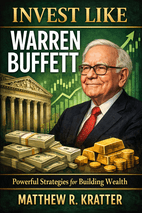
Invest Like Warren Buffett by Matthew R. Kratter Book Cover

by Matthew R. Kratter

Matthew R. Kratter's Invest Like Warren Buffett distills the legendary investor's value philosophy into actionable steps for individual investors, covering fundamental analysis, margin of safety, and long-term wealth building.

On Insta.page you also get an Apply This Book tool that lets you combine insights from up to 3 books to solve your specific situation.

Chapter mindmaps

Free preview: chapters 1–4 are fully interactive. Click any node to expand or collapse. Subscribe to unlock the rest.

Chapter 1: 1. Why Investing Is Easier For You Than Warren Buffett

Key concepts: 1. Why Investing Is Easier For You Than Warren Buffett

1. Why Investing Is Easier For You Than Warren Buffett

The Paradox of Scale: Buffett's Constraints

  • Buffett's immense capital restricts him to investing only in the world's largest companies
  • He must move with extreme slowness and secrecy to avoid moving market prices against him
  • His position in Coca-Cola (1999) illustrates how scale can trap investments even when overvalued
  • His success has created limitations that prevent him from replicating his early investment approach

The Individual Investor's Strategic Advantages

  • You can invest in companies of any size without affecting share prices
  • Access to smaller, faster-growing companies that were foundational to Buffett's early success
  • Ability to buy and sell decisively without bureaucratic hurdles or market-moving repercussions
  • Your portfolio operates with agility and freedom unburdened by billions in capital

Core Buffett Philosophy Simplified

  • Buy shares in a few high-quality, well-run businesses at a fair price and hold them forever
  • Reject complexity in favor of searching for '1-foot bars' rather than attempting spectacular leaps
  • Stock represents legal ownership in a real business, not just a ticker symbol or chart line
  • Success comes from identifying wonderful businesses and allowing compounding to work over time

Actionable Mindset Shifts for Individual Investors

  • Your small size is your superpower—leverage your agility in the market
  • Think like an owner of businesses rather than a trader of stocks
  • Focus on consistent, simple opportunities rather than heroic market timing
  • Maintain discipline to ignore market noise and avoid unnecessary complexity

Chapter 2: 2. What A Not-So-Great Business Looks Like

Key concepts: 2. What A Not-So-Great Business Looks Like

2. What A Not-So-Great Business Looks Like

Buffett's Investment Framework

  • Simplifies businesses into two categories: wonderful businesses vs. everything else
  • Advises focusing precious time and capital exclusively on seeking wonderful businesses
  • Analyzing sub-par companies is an inefficient use of resources

The Commodity Business Example

  • Uses the paper staple as a classic example of a not-so-great business
  • Consumers have no brand loyalty or excitement about staple innovation
  • Staples are fungible, price-sensitive commodities purchased based solely on cost
  • Manufacturers operate in brutally competitive arenas where lowest cost producer wins
  • Efficiency gains are passed to customers rather than retained as profit

Characteristics of Mediocre Businesses

  • Operates in fragmented, highly competitive markets
  • Produces commodity products with little to no meaningful brand differentiation
  • Lacks pricing power - cannot raise prices without losing customers
  • Cannot retain benefits of cost savings - profits are constantly squeezed by competition

Industries Prone to Price Competition

  • Semiconductor manufacturing, airlines, automobile production
  • Agriculture (corn, wheat), mining for metals
  • Most restaurants (with rare exceptions)
  • Manufacturing and raw material production often face these challenges
  • Companies like Apple strategically avoid owning factories to build moats instead

Owner's Perspective on Wealth Building

  • No moral judgment - these businesses provide vital goods, services, and employment
  • From wealth accumulation perspective, price-competitive businesses are tough paths to prosperity
  • Constant pressure on margins makes generating outsized returns extremely difficult
  • Requires shift from appreciating societal role to evaluating durable owner profit potential

Chapter 3: 3. How To Spot A Great Business

Key concepts: 3. How To Spot A Great Business

3. How To Spot A Great Business

Simplicity and Understandability

  • Invest only in businesses whose operations and profit generation you can clearly comprehend
  • Personal affinity for a company's products can be a significant advantage
  • Avoid investing in anything you don't understand to prevent catastrophic losses

Powerful Brand Recognition

  • Great businesses occupy permanent space in consumers' minds
  • Strong brand equity makes brands synonymous with product categories
  • Iconic brands like Disney, Apple, and Coca-Cola create powerful 'mindshare'

Product Longevity and Stability

  • Timeless products require minimal reinvention over decades
  • Contrast with technology-driven industries that require constant R&D reinvestment
  • Stable products allow profits to flow to shareholders rather than being reinvested for survival

The Power of Repeat Purchases

  • Fantastic businesses sell products people need to buy repeatedly
  • Recurring-need items create predictable revenue streams
  • Products with mildly addictive qualities enhance customer retention

Pricing Power: The Ultimate Test

  • The most critical characteristic of a great business
  • Ability to raise prices without losing customers to competitors
  • Strong brand loyalty enables price increases that outpace inflation

The Protective Moat

  • Durable competitive advantage that protects profits from competitors
  • Can manifest as brands, patents, low-cost structures, or local monopolies
  • A durable moat allows profits to be paid to owners rather than constantly reinvested for defense

Chapter 4: 4. Sneaky Tricks For Identifying A Great Business From Its Financial Statements

Key concepts: 4. Sneaky Tricks For Identifying A Great Business From Its Financial Statements

4. Sneaky Tricks For Identifying A Great Business From Its Financial Statements

The Foundation: Earnings Per Share Trend

  • A great business shows a smooth, upward trend in EPS over the long term.
  • This reflects pricing power and a durable competitive advantage (moat).
  • Volatile or cyclical earnings (e.g., Ford) indicate a business competing on price and lacking stability.
  • The EPS trend is the most immediate financial signal of business quality.

Measuring Efficiency: Return on Equity

  • Return on Equity (ROE) measures profitability relative to shareholders' invested capital.
  • A consistently high ROE (above 20%) signals a powerful economic engine (e.g., Coke).
  • Erratic or low ROE indicates operational weakness or cyclicality.
  • High ROE can be artificially inflated by excessive debt, adding risk.

The Debt-Adjusted View: Return on Total Capital

  • Return on Total Capital (ROTC) includes long-term debt in the capital base.
  • It reveals true operational efficiency by accounting for all permanent funding.
  • A great business consistently generates ROTC above 15%.
  • A low ROTC (e.g., Ford) confirms that high ROE spikes are debt-driven, not from excellence.

Assessing Financial Risk: The Debt Burden

  • A great business has a manageable debt load relative to its profits.
  • A prudent rule: long-term debt should be payable using ≤4 years of net profit.
  • This test highlights financial resilience and balance sheet strength (e.g., Johnson & Johnson).
  • Excessive debt (e.g., Ford's 21-year payback) signals fragility and high risk.

Returning Cash to Shareholders

  • A mature great business generates excess cash beyond operational needs.
  • Excess cash should be returned via dividends and/or stock buybacks.
  • This signals financial strength and shareholder-friendly management.
  • Substantial, consistent returns (e.g., Coke) are the hallmark of a cash-generating 'moat' business.

Key Takeaways: Five Financial Filters

  • Look for Smooth Growth: Consistent upward EPS trend.
  • Demand High Efficiency: Consistent ROE > 20%.
  • Look Through the Debt: Consistent ROTC > 15%.
  • Check the Debt Load: Debt payable with <4 years of net profit.
  • Follow the Cash: Reliable return of capital via dividends/buybacks.

Continue exploring Invest Like Warren Buffett