Invest Like Warren Buffett Key Takeaways
by Matthew R. Kratter
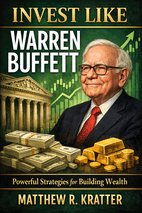
5 Main Takeaways from Invest Like Warren Buffett
Your Small Investor Agility is a Superpower Over Buffett
Unlike Buffett's massive scale, you can quickly invest in a wide range of companies and seize opportunities he cannot. This agility allows you to focus on '1-foot bars'—simple, high-probability investments—rather than complex maneuvers, making investing easier for you.
Invest Only in Businesses with Durable Moats and Pricing Power
Great businesses have strong brands, timeless products, and repeat customers that give them pricing power. This sustainable competitive advantage protects profits and ensures long-term wealth building, unlike commodity businesses in fragmented industries.
Use Financial Metrics Like ROE and ROTC to Validate Business Quality
Consistently high Return on Equity (above 20%) and Return on Total Capital (above 15%) indicate efficient management and a durable moat. Also, check for smooth earnings growth, manageable debt, and shareholder-friendly capital allocation to avoid value traps.
Value Stocks by Earnings Yield, Not Just P/E Ratios
Calculate the earnings yield (E/P) to understand your return on investment. For a high-quality business, aim for a yield of 5% or more, ensuring you don't overpay for growth and that patience compounds your returns over time through growing earnings and dividends.
Accumulate Cash and Buy Quality Stocks During Market Panics
The best time to buy is during bear markets when fear creates bargains. Prepare by building a watchlist and having cash ready to invest when valuations are low, such as when P/E falls below 15 or prices drop 40-50%, following Buffett's 'be greedy when others are fearful.'
Executive Analysis
The book's central argument is that individual investors can outperform by adopting Warren Buffett's core philosophy: focusing on high-quality businesses with durable competitive advantages, acquired at reasonable prices during market downturns. This thesis is built on the premise that small investors have the agility to exploit opportunities Buffett cannot, and by combining this with disciplined financial analysis and psychological fortitude, they can build long-term wealth. The five key takeaways interconnect to form a cohesive strategy: from identifying great businesses to timing purchases effectively.
'Invest Like Warren Buffett' matters because it demystifies complex investing concepts into actionable steps, empowering readers to avoid common pitfalls and capitalize on market inefficiencies. In the crowded field of investment guides, it stands out for its practical framework that emphasizes mindset over jargon, making Buffett's timeless wisdom accessible to beginners and reinforcing the importance of patience and preparation for seasoned investors.
Chapter-by-Chapter Key Takeaways
1. Why Investing Is Easier For You Than Warren Buffett (Chapter 1)
Your size is your superpower. You have the agility to invest in a vast universe of companies and make quick decisions, freedoms denied to Buffett due to his colossal scale.
The strategy is simple, but not easy. Buffett’s core philosophy is publicly available and straightforward, but it requires discipline to ignore market noise and the temptation to make investing needlessly complex.
Think like an owner, not a trader. The foundational shift is viewing a stock as partial ownership of a business with underlying profits, not as a speculative token to be traded.
Look for "1-foot bars." Extraordinary returns often come from consistently stepping over easy obstacles—finding high-quality companies at fair prices—rather than attempting heroic feats of market timing or stock picking.
Try this: Adopt an owner's mindset and use your agility to invest in simple, high-probability opportunities.
2. What A Not-So-Great Business Looks Like (Chapter 2)
Warren Buffett’s framework divides businesses into two groups: the exceptional few and all the rest, advising investors to focus solely on the former.
A "not-so-great" business is often defined by its commodity product, lack of brand power, and operation within a fragmented, hyper-competitive industry.
The most damaging trait is a lack of pricing power, where cost benefits are transferred to the customer and profits are perpetually thin.
Many essential industries—from airlines to textiles—are populated by such companies, making them poor vehicles for long-term wealth building.
The chapter underscores a critical shift in mindset: from appreciating a business's societal role to evaluating its potential for generating durable owner profits.
Try this: Screen out investments in fragmented industries with commodity products and no pricing power.
3. How To Spot A Great Business (Chapter 3)
Invest only in businesses you genuinely understand.
Seek companies with iconic brands that own a piece of the consumer's psyche.
Favor businesses with timeless products over those in relentless technological races.
Prioritize companies that benefit from repeat customer purchases.
The single most important sign of a great business is strong pricing power.
Always look for a wide and durable "moat"—a sustainable competitive advantage that protects profits.
Try this: Build a watchlist of companies with strong brands, repeat purchases, and durable moats.
4. Sneaky Tricks For Identifying A Great Business From Its Financial Statements (Chapter 4)
Look for Smooth Growth: A great business displays a consistent, upward trend in earnings per share, not volatile swings.
Demand High Efficiency: Seek a consistent Return on Equity (ROE) above 20%.
Look Through the Debt: Ensure a consistent Return on Total Capital (ROTC) above 15% to confirm efficiency isn’t debt-driven.
Check the Debt Load: The company’s long-term debt should be manageable, ideally payable with less than four years of net profit.
Follow the Cash: A mature great business will return excess capital to shareholders through reliable dividends and/or stock buybacks.
Try this: Analyze financials for consistent high returns on capital, low debt, and reliable dividends or buybacks.
Next chapter: “5. How Much To Pay For A High-Quality Business” is locked
Keep learning from Invest Like Warren Buffett — and unlock all 600+ book summaries with audio, mindmaps and AI Q&A.
$0.00 due today · 7 days free, then $89.99/year ($7.49/mo) · Cancel anytime before day 7
plus sales tax where applicable