How Change Really Works — Interactive Mindmaps

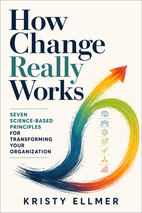
How Change Really Works by Julia Dhar Book Cover

by Julia Dhar

Julia Dhar's How Change Really Works reveals why 70% of organizational transformations fail and offers a seven-principle framework—drawn from behavioral science—for closing the hidden "change distance" between leaders and employees. Written for senior executives, it treats change as a product and employees as customers, providing a structured playbook from deciding to end a transformation.

On Insta.page you also get an Apply This Book tool that lets you combine insights from up to 3 books to solve your specific situation.

Chapter mindmaps

Free preview: chapters 1–4 are fully interactive. Click any node to expand or collapse. Subscribe to unlock the rest.

Chapter 1: Introduction: The Distance between Us (and Them)

Key concepts: Introduction: The Distance between Us (and Them)

1. Introduction: The Distance between Us (and Them)

The Change Distance Gap

  • 68% executives positive vs 45% employees
  • Same change, entirely different experiences
  • Leaders speak clearly, employees hear static
  • False consensus effect widens the gap

Why Executives Are More Positive

  • Executives benefited from past changes
  • Identity tied to leading change
  • Financial incentives for executives
  • Mathematics of misalignment multiplies gaps

Reframing: Employees as Customers

  • Change is the product, employees are customers
  • Reverse burden of adaptation onto leaders
  • Ask for attention, adoption, then advocacy
  • Make change natural, not push resistance

History of Change Failure

  • Harwood 1948: imposed changes caused 35% drop
  • 70% of change initiatives still fail today
  • 25% succeed with knowable, repeatable secrets
  • Consequences: wasted potential, exhaustion, turnover

Design Gap, Not Knowledge Gap

  • Paul Fitts: cockpits poorly designed, not pilots
  • System blocks desired behaviors
  • Real problem is how, not what to do
  • Fix design gap to close change distance

Seven Principles to Close Distance

  • Get true agreement, not false alignment
  • Increase agency for everyone involved
  • Use emotions through feedback, not instinct
  • Share stories and symbols for meaning

Five-Phase Playbook for Change

  • Phases: deciding, planning, starting, persisting, ending
  • Concrete tactics for the messy middle
  • Goal: close leader intent vs employee experience
  • Build momentum throughout the journey

Chapter 2: 1 Get True Agreement, Not False Alignment

Key concepts: 1 Get True Agreement, Not False Alignment

2. 1 Get True Agreement, Not False Alignment

The Problem of False Alignment

  • Forty-six hidden priorities at Pandora
  • Executives shocked by differing visions
  • Three fates: paralysis, hyperactivity, tunnel vision
  • Abilene paradox: agreeing to unwanted change

Root Causes of False Agreement

  • False consensus effect: assuming shared views
  • Affective forecasting: overestimating disagreement pain
  • Deferring resolution: 'we'll sort details later'

Five-Step Process to True Agreement

  • Set clear parameters: define question and decision method
  • Provoke early exchange: make case in writing, invite dissent
  • Create space for quality debate in one-on-ones
  • Formal verdict: ask each individual, document with ritual

Handling Remaining Disagreement

  • Disagree again with persistence and minor concessions
  • Subtract and defer controversial parts
  • Offer an attractive exit for dissenters
  • Proceed despite disagreement as last resort

Pandora's Turnaround: Three Key Agreements

  • Clear priorities reduced to three major themes
  • Single success metric: like-for-like revenue growth
  • Brand clarity: jewelry for people's loves

Chapter 3: 2 Increase Agency, Not Just Involvement

Key concepts: 2 Increase Agency, Not Just Involvement

3. 2 Increase Agency, Not Just Involvement

The Core Problem: Resistance to Imposed Change

  • People resist change imposed on them, not change itself
  • Imposed changes trigger same brain regions as physical pain
  • Skepticism from employees protecting legacy is a major obstacle
  • Surveys and town halls often feel like box-ticking exercises

The Solution: Building Agency Through Ownership

  • Agency is the capacity to make choices and act on them
  • High-agency mindset means deciding in spirit of change
  • IKEA effect: people value what they build themselves by 63%
  • Co-ownership creates investment in success

Practical Implementation: Ericsson's Co-Ownership Model

  • Handpicked employees given genuine co-ownership of platform
  • Full-time team from Sales, Operations, Finance, Delivery
  • Symbolic fee charged for development and maintenance
  • Resulted in 30-50% process improvements and faster lead times

Scalable Agency: Three Distinct Experiences

  • Decision-making experience for those most exposed to change
  • Influence experience for broader group with real input
  • Representation experience for everyone via trusted delegates
  • Asking for ideas backfires if you don't demonstrate listening

Key Principles for Leaders

  • Give real decision power and ownership, not just a voice
  • Financial co-ownership, even symbolic, drives commitment
  • Effort invested increases perceived value (IKEA effect)
  • Enthusiasm is a resource, not a burden to manage

Chapter 4: 3 Expect Take Up to Be Earned, Not Automatic

Key concepts: 3 Expect Take Up to Be Earned, Not Automatic

4. 3 Expect Take Up to Be Earned, Not Automatic

The Take Up Problem

  • Behavioral gap between leader intent and employee action
  • Leaders commit fundamental attribution error blaming resistance
  • Even beneficial changes have surprisingly low take up
  • Successful leaders earn take up by removing obstacles

COM-B Model for Behavior Change

  • Capability: psychological and physical capacity to act
  • Opportunity: external environment enabling the behavior
  • Motivation: inclination driven by gains and losses

Seven Conditions for Take Up

  • Knowledge and skills required for capability
  • Time, resources, and permission for opportunity
  • Belief in gains and minimal losses for motivation
  • All seven must be met for individual change

Five-Step Diagnostic Process

  • Define whose behavior needs to change specifically
  • Specify exact new behavior to start or stop
  • Identify barriers using seven conditions and feedback
  • Act to minimize barriers and measure take up monthly

Etsy's Blameless Postmortems

  • Key barrier was fear of blame and loss
  • Shifted focus from 'who' to 'how' errors occurred
  • Self-reporting triggered debriefs, not punishment
  • Most surprising error won annual award

Earning Take Up vs. Assuming Compliance

  • Cannot assume automatic adoption of change
  • Prove worth by systematically removing barriers
  • Don't blame character flaws for low take up
  • Look for knowledge, skill, time, or fear barriers

Results of Earned Take Up

  • Engineers voluntarily helped improve platform safety
  • Etsy's reliability supported growth to $12.6B sales
  • Accountability shifted to preventing recurrence
  • Culture of learning replaced culture of fear

Chapter 5: 4 Understand Emotions through Feedback, Not Instinct

Mindmap locked. Subscribe to unlock all chapters of How Change Really Works.

Subscribe to unlock

Chapter 6: 5 Use a Process with Rituals, Not Reactions

Mindmap locked. Subscribe to unlock all chapters of How Change Really Works.

Subscribe to unlock

Chapter 7: 6 Share Stories and Symbols, Not Just Dollars

Mindmap locked. Subscribe to unlock all chapters of How Change Really Works.

Subscribe to unlock

Chapter 8: 7 Create Momentum Throughout, Not Just at the Start

Mindmap locked. Subscribe to unlock all chapters of How Change Really Works.

Subscribe to unlock

Chapter 9: PART TWO: PUTTING THE PRINCIPLES TO WORK

Mindmap locked. Subscribe to unlock all chapters of How Change Really Works.

Subscribe to unlock

Chapter 10: 8 Deciding to Change

Mindmap locked. Subscribe to unlock all chapters of How Change Really Works.

Subscribe to unlock

Chapter 11: 9 Planning for Change

Mindmap locked. Subscribe to unlock all chapters of How Change Really Works.

Subscribe to unlock

Chapter 12: 10 Starting Change

Mindmap locked. Subscribe to unlock all chapters of How Change Really Works.

Subscribe to unlock

Chapter 13: 11 Persisting with Change

Mindmap locked. Subscribe to unlock all chapters of How Change Really Works.

Subscribe to unlock

Chapter 14: 12 Ending Change

Mindmap locked. Subscribe to unlock all chapters of How Change Really Works.

Subscribe to unlock

Chapter 15: Afterword: Change Is a Choice

Mindmap locked. Subscribe to unlock all chapters of How Change Really Works.

Subscribe to unlock

Continue exploring How Change Really Works