How Change Really Works Quotes
by Julia Dhar
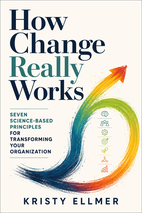
Here you will find a selection of the most memorable lines from Julia Dhar's book on change. These quotes capture the practical wisdom and human insights that make the book stand out. Each one offers a fresh perspective on why transformation so often fails and what leaders can do differently.
What makes this book quotable is its blend of sharp observation and actionable advice. Dhar doesn't shy away from the messy human side of change, from invisible divides to cognitive biases. The quotes you'll see are the kind you want to underline and share with your team. They stick because they ring true.
Top Quotes from How Change Really Works
“Same company. Same change. Entirely different experiences. We call this invisible divide change distance.”
The author describes the gap in perceptions between executives and employees regarding organizational change.
It succinctly captures the core problem of change management—that leaders and employees inhabit different realities. The term 'change distance' is memorable and actionable.
“It's like trying to relay instructions over a crackling phone line. Leaders speak into the microphone, confident that their message is getting through. But on the receiving end, employees hear fragments—staticky, delayed, sometimes entirely scrambled.”
The author uses a phone line metaphor to illustrate communication breakdown during change.
The vivid analogy of a crackling phone line makes the abstract concept of miscommunication tangible. It resonates because anyone who has experienced a bad connection can relate to the frustration.
“Alignment and agreement are not the same.”
The author explains the difference between false alignment and true agreement.
This concise statement cuts to the heart of the chapter's thesis, making it easy to remember and apply.
“To set yourself up for successful change, you need to go slow to go fast.”
The author concludes the section on reaching true agreement, citing former US Marine Damian Pitts.
This counterintuitive maxim encapsulates the core insight that investing time upfront accelerates execution later, a memorable principle for leaders.
“Labor that is undervalued is worse than never having been involved at all.”
Harvard professor Michael Norton explaining the downside of performative involvement.
This statement powerfully critiques shallow engagement efforts and highlights the importance of genuine contribution.
“I solved half my problems just by listening.”
Brunello Cucinelli paraphrasing the Greek philosopher Plutarch's concept of attentive hearing.
This simple, memorable line captures the power of listening as a practical solution to human challenges, making it instantly quotable and actionable.
“The brain, says Jonathan Haidt, a psychologist at New York University’s Stern School of Business, is a “story processor, not a logic processor.””
The chapter's discussion of the science of stories.
This vivid metaphor makes a complex scientific insight instantly memorable, explaining why storytelling is more effective than facts alone.
Themes Behind the Quotes
The quotes repeatedly highlight a central theme: change fails when leaders assume their message is received as intended. There is an invisible gap between what leaders communicate and what employees hear. True transformation requires more than alignment; it demands genuine agreement earned through listening and involvement. Employees must feel their labor is valued and their emotions acknowledged, because those feelings directly impact success.
Another major theme is that effective change is not about forcing new behaviors but designing environments that make desired actions natural. Leaders must go slow initially to build momentum, recognizing that people have cognitive limits and decision fatigue. Using stories rather than direct logic creates resonance. Transformation rituals need constant defense, not just setup. Ultimately, building mass by drawing people in and letting them reinforce each other is the path to sustainable progress.
Quotes by Chapter
Introduction: The Distance between Us (and Them)
“Successful change isn't about forcing new behaviors on people. It's about building environments that through a combination of design, incentives, and nudges naturally lead to the desired behaviors.”
The author states this as a core thesis after discussing Paul Fitts' cockpit redesign.
It reframes change from coercion to environment design, a counterintuitive but empowering insight for leaders.
“The ever-increasing improvements in analytics, digitization, and artificial intelligence have all been accompanied by the reality that as technology progresses, it is human beings who will remain at the center of the change.”
The author reflects on technological progress and the enduring role of human behavior.
It grounds the hype of AI and digital transformation in an essential human-centered truth that many leaders overlook.
1 Get True Agreement, Not False Alignment
“Leaders who settle for mere alignment typically find that it fails them in the end—which is why we call it false.”
The author describes the outcome of choosing alignment over true agreement.
It serves as a stark warning that superficial harmony often leads to failure, motivating leaders to seek deeper commitment.
“Deferred agreement is a debt they told themselves they would pay off in weeks, but in practice, it takes months or years—if they ever pay it off at all.”
The author discusses executives who delay resolving disagreements about change.
The debt metaphor vividly illustrates how postponing tough conversations creates long-term costs that rarely get repaid.
2 Increase Agency, Not Just Involvement
“To be an agent is to influence intentionally one's functioning and life circumstances.”
Albert Bandura, social-cognitive psychologist, defining agency.
This concise definition captures the essence of agency, which is central to the chapter's thesis about empowering employees.
“You need employees to own their behaviors and their role in the change.”
Grocery executive Megan Shaffer on creating a high-agency mindset.
It provides a clear, actionable directive for leaders seeking to foster ownership and accountability.
“When people help create the future that they'll be responsible for, they have that much more investment in its success.”
Laura Kohler, former CHRO of Kohler Company, on the IKEA effect in change.
This eloquently ties the IKEA effect to organizational change, emphasizing the value of co-creation.
3 Expect Take Up to Be Earned, Not Automatic
“Put frankly, outages suck,” acknowledged John Allspaw, Etsy’s then-Vice President of Technical Operations. “They suck for shoppers and sellers, and they suck for us who work here at Etsy.”
John Allspaw, Etsy's VP of Technical Operations, speaking about the impact of outages.
The raw, honest language breaks through corporate jargon and creates a shared sense of frustration, making the problem real for everyone.
“Get rid of the bad apples, and you'll get rid of the human error. Seems simple, right? We don't take this traditional view at Etsy.”
John Allspaw explaining why Etsy rejects the traditional 'Bad Apple Theory' of human error.
It succinctly critiques punitive cultures and promotes a learning-oriented approach, which is a central theme of the chapter.
“Successful transformation leaders do for employees what successful product managers do for customers: they earn their take up, rather than expecting it.”
The authors summarizing a key principle for leaders of change.
The analogy between product managers and change leaders is memorable and reframes the leader's responsibility from expecting compliance to earning engagement.
“Most of the time, the best explanation for low take up is that employees are human.”
The authors concluding a discussion on fundamental attribution error and low take up.
This simple, empathetic statement normalizes employee resistance and shifts blame from individuals to situational barriers, a core insight for change leaders.
4 Understand Emotions through Feedback, Not Instinct
“You just can’t trust yourself. It's not your fault—it's the way we are all wired. But it is your responsibility to accept your own cognitive limits.”
The authors explaining why leaders cannot rely on gut instinct to gauge employees' emotions due to cognitive biases.
This blunt yet forgiving statement combines humility with accountability, making it a powerful call for self-awareness in leadership.
“When there is a question of professional, or job, or economic insecurity that is related to your transformation, it's an anvil tied to a rope—you drag it around the ocean as you're trying to change.”
Industrials executive Christopher Scalia describing the emotional burden of transformation.
The vivid metaphor of dragging an anvil through the ocean perfectly illustrates the heavy, persistent drag of insecurity during change, making the abstract tangible and memorable.
“The emotions that employees feel during a transformation may not be your fault, but they are your problem, because they affect your chances of success.”
Author's concluding insight in the chapter summary.
It reframes emotional resistance as a leadership responsibility rather than blame, making it both sobering and empowering for change leaders.
5 Use a Process with Rituals, Not Reactions
“You can’t just roll out a new org structure with changing ownership in an email and a bit of PowerPoint and expect it just to work. You have to continually communicate, monitor, check in on progress, and adjust.”
Consumer goods executive Steve Bennett said this about the need for continuous communication during transformation.
It powerfully captures the reality that change requires ongoing effort and follow-through, not just a one-time announcement. The quote is memorable and actionable for leaders.
“The problem of decision fatigue affects everything from the careers of CEOs to the prison sentences of felons appearing before weary judges.”
This line comes from the book 'Willpower' by Roy F. Baumeister and John Tierney, quoted in the chapter.
It dramatically illustrates the far-reaching and serious impact of decision fatigue, making a psychological concept feel urgent and relatable.
“One of the greatest acts of service you can perform for your colleagues is to make it easy and satisfying for them to make the thousands of important decisions required during transformation.”
The authors advise change leaders on reducing decision fatigue for their teams.
It reframes leadership as an enabling, supportive role and provides a clear, inspiring goal. The quote is both altruistic and practical.
“Transformation rituals are not set and forget. Instead, they are set and defend.”
The authors explain how to maintain meeting rituals during a transformation.
This concise, memorable phrase contrasts a passive approach with an active one, emphasizing the ongoing effort needed to protect change processes.
6 Share Stories and Symbols, Not Just Dollars
“We needed to show the Delta people how important they were to Delta’s success ... and help them better understand exactly what was going on in the business.”
Allison Ausband, Delta Chief People Officer, reflecting on the first VELVET event in 2005.
This quote captures the essence of using transparency and recognition to rebuild trust during a crisis, showing that people are the foundation of any transformation.
“Being less direct—using stories —creates connection and resonance. That's how you influence outcomes.”
Banking executive Ira Robbins sharing his leadership insight.
It offers practical, counterintuitive wisdom for leaders: that indirect storytelling builds deeper engagement than direct orders.
“Everyone loves a comeback story. Let's work together to write the best one ever.”
Ford CEO Alan Mulally in an email to all employees during the 2006 crisis.
An inspiring call to collective action that reframes a threat as an opportunity for a heroic turnaround, motivating the entire organization.
7 Create Momentum Throughout, Not Just at the Start
“We can’t have people always feeling like they're in crisis.”
Katerina Guerraz, Aetna's COO, explaining the need to stop firefighting and find a sustainable approach to transformation.
This line captures the emotional exhaustion of constant crisis mode and motivates leaders to create a culture of sustainable progress.
“Momentum is the product of mass and velocity. Velocity has limits—you can’t expect people to move faster than they or their organization are ready for. So sustainable progress has to come from building mass: to draw in people and let them reinforce each other's stories.”
Public-sector leader Kok Yam Tan explaining how momentum applies to organizational change.
It elegantly uses physics to reframe transformation, emphasizing community and shared narrative over mere speed.