Give and Take Quotes
by Adam Grant
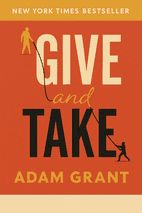
You will find a collection of lines that challenge how you think about success, generosity, and human nature at work. Some of them are provocative, others are counterintuitive, and a few might even sting a little. They come from a book that digs into research and real stories to show why giving can be a powerful strategy, not just a nice idea.
What makes this book so quotable is how it turns conventional wisdom on its head. It takes complex ideas about reciprocity, empathy, and motivation and boils them down into sentences you want to underline and share. Each quote here captures a piece of that bigger argument, ready to spark a conversation or change a perspective.
Top Quotes from Give and Take
“Every time we interact with another person at work, we have a choice to make: do we try to claim as much value as we can, or contribute value without worrying about what we receive in return?”
Adam Grant poses the central question of the book about how we approach workplace interactions.
This quote frames success as a fundamental choice between claiming and contributing value, setting up the core tension of the book. It resonates because it challenges readers to reflect on their own reciprocity style.
“The worst performers and the best performers are givers; takers and matchers are more likely to land in the middle.”
Grant summarizes the surprising research finding that givers occupy both extremes of the success ladder.
It overturns the stereotype that givers are pushovers, revealing that they can be the most successful. The paradox is memorable and invites readers to reconsider their assumptions about giving.
“When takers win, there's usually someone else who loses.”
Grant contrasts the outcomes of takers versus givers in terms of their impact on others.
This succinct line highlights the zero-sum nature of taking versus the positive-sum nature of giving. It is quotable because it underscores the broader consequences of our reciprocity choices.
““The true measure of aman is how he treats someone who can do him absolutely no good.””
A quote attributed to Samuel Johnson, cited to illustrate takers' tendency to mistreat subordinates.
This timeless ethical principle resonates as a litmus test for character, especially relevant in distinguishing genuine givers from fakers.
“If we create networks with the sole intention of getting something, we won't succeed. We can't pursue the benefits of networks; the benefits ensue from investments in meaningful activities and relationships.”
Wayne Baker, a networking expert, explaining the futility of purely transactional networking.
This reframes networking from a self-serving activity to one rooted in genuine connection, aligning with the book's argument that givers ultimately build more valuable networks.
“When we treat man as he is, we make him worse than he is; when we treat him as if he already were what he potentially could be, we make him what he should be.”
Attributed to Johann Wolfgang von Goethe at the start of the chapter.
This line captures the book's central thesis that seeing potential in others can transform them, and it resonates as a timeless insight into human development.
“Givers don’t burn out when they devote too much time and energy to giving. They burn out when they're working with people in need but are unable to help effectively.”
The author's conclusion after analyzing research on caregiver burnout and the experiences of teachers at Overbrook High School.
This reframes a common misconception about burnout, offering a powerful insight that the key driver is not overwork but a perceived lack of efficacy, which resonates deeply with anyone in helping professions.
Themes Behind the Quotes
One major theme is that giving is not a weakness but a path to success, though only for those who give strategically. The quotes show that extreme givers can be both the worst and best performers, and that burnout comes not from giving too much but from giving without impact. Another theme is the tension between self interest and caring for others, with the most successful people often blending the two rather than choosing one side.
A second thread is about perception and vulnerability. Several quotes highlight how showing your real self, asking questions, or treating others as capable can build trust and prestige. The book also argues that true generosity is not about being nice or selfless; it is about genuinely looking out for others while still keeping your own goals in sight. These themes challenge the reader to rethink what it means to be both effective and humane.
Quotes by Chapter
1 — Good Returns
“I had no right to deprive the country of their services.”
Abraham Lincoln explaining why he invited his defeated rivals to join his cabinet instead of choosing allies.
This line captures Lincoln's selfless commitment to the greater good, putting national interest above personal ego, and it resonates as a powerful example of principled leadership.
2 — The Peacock and the Panda
“Respect... the golden rule... Absolute integrity ... Everyone knows that I personally have a very strict code of personal conduct that I live by.”
Ken Lay, former Enron CEO, describing the principles behind his success.
This statement is deeply ironic in light of Lay's later conviction for fraud, highlighting the gap between self-presentation and actual behavior.
“I want to improve the world, and I want to smell good while doing it.”
This is Adam Rifkin's motto on his LinkedIn page.
It captures his giving spirit with humor and humility, making the giver philosophy both memorable and relatable.
3 — The Ripple Effect
“Even the highly creative scientists themselves agreed with statements like “I tend to slight the contribution of others and take undue credit for myself” and “I tend to be sarcastic and disparaging in describing the worth of other researchers.””
The author describes research on creative scientists, revealing that they often acknowledge their own taker behaviors.
This line is striking because it shows that even highly creative individuals are aware of their tendency to take credit from others, highlighting a dark side of creativity that many readers can relate to or recognize.
“It was a taker's mind-set, it seems, that gave Wright the gall to develop a truly original vision and sell it to a client.”
The author analyzes Frank Lloyd Wright's success with Fallingwater, attributing his boldness to a taker approach.
This sentence captures the paradox of takers: their confidence and disregard for norms can drive groundbreaking innovation, yet the same traits can lead to isolation and failure.
“The surgeons couldn't take their performance with them.”
The author summarizes a study showing that cardiac surgeons' success depends on familiarity with specific hospital teams, not just individual skill.
This brief, memorable line encapsulates the central insight that even highly skilled knowledge workers are deeply reliant on collaborators, challenging the myth of the lone genius.
“Hiring stars is advantageous neither to stars themselves, in terms of their performance, nor to hiring companies in terms of their market value.”
The author presents the conclusion from research on star security analysts who switched firms.
This data-driven statement overturns conventional wisdom about talent acquisition, emphasizing that individual success is often tied to context and relationships rather than portable talent.
4 — Finding the Diamond in the Rough
“Your husband, family, and friends love you because of the beautiful person you have made yourself—not because of a performance on an examination.”
From a letter C. J. Skender wrote to student Marie Arcuri after she failed the CPA exam.
It powerfully reframes success in terms of character and relationships rather than test scores, offering a deeply human and encouraging perspective.
“Success doesn’t measure a human being, effort does.”
Also from Skender's letter to Marie Arcuri.
A succinct, memorable reminder that effort and perseverance define a person's worth more than external achievements.
“By default, givers start by viewing people as bloomers.”
Summarizing C. J. Skender's approach to teaching and the general mindset of givers.
This line crystallizes the key difference between givers and other reciprocity styles, showing how optimism and trust can unlock hidden potential.
5 — The Power of Powerless Communication
“It was an epiphany—my stutter could be an advantage.”
Dave Walton reflects on the moment jurors told him they admired his courage for being a trial lawyer despite his stutter.
This line crystallizes the chapter's central counterintuitive insight: a trait often seen as a weakness can become a source of strength. It inspires readers to reconsider their own perceived flaws as potential assets in building connection.
“By making themselves vulnerable, givers can actually build prestige.”
The author summarizes a key lesson from the Air Force colonel training and the pratfall effect.
It directly challenges the conventional emphasis on dominance and power, offering a memorable anchor for the idea that vulnerability, when paired with competence, earns lasting respect. This resonates because it reframes a common fear into a strategic advantage.
“People think you have to be this polished, perfect person. Actually, you don't want a lawyer who is too slick. Good trial lawyers aim to be an expert and a regular guy at the same time.”
Dave Walton explains why his stutter humanized him and made him more credible to the jury.
This quote speaks to the universal pressure to appear flawless, and offers relief by validating authenticity over perfection. It helps readers see that relatability and expertise are not mutually exclusive.
“Asking questions opened the door for customers to experience what the psychologist James Pennebaker calls the joy of talking.”
Bill Grumbles, a top salesperson at HBO, describes his humble, question-based approach to selling.
It succinctly captures how givers influence by letting others shine, turning a sales interaction into a mutually enjoyable experience. This reframes asking questions from a sign of weakness to a powerful tool for connection and learning.
6 — The Art of Motivation Maintenance
“Being otherish means being willing to give more than you receive, but still keeping your own interests in sight, using them as a guide for choosing when, where, how, and to whom you give.”
The author's definition of 'otherish' givers, who balance self-interest and other-interest, as opposed to selfless givers.
This concise definition provides a practical and empowering alternative to the extremes of selfless giving and selfish taking, offering a sustainable approach that readers can apply to their own lives.
“As Bill Gates argued at the World Economic Forum, “there are two great forces of human nature: self-interest, and caring for others,” and people are most successful when they are driven by a “hybrid engine” of the two.”
The author cites Bill Gates to support the idea that successful givers integrate self-interest and other-interest rather than treating them as opposites.
This memorable quote from a highly respected figure reinforces the chapter's central message that success comes from combining ambition with altruism, making the concept more credible and inspiring.
“Attaching a single patient's photo to a CT exam increased diagnostic accuracy by 46 percent.”
A study of radiologists where patient photos were attached to CT exams.
This statistic vividly demonstrates how human connection can dramatically improve performance, making it a memorable call to humanize work.
7 — Chump Change
“If I err on one side, it's probably being too generous: putting others first, before myself.”
Lillian Bauer reflecting on why her giving behavior delayed her promotion to partner.
This line captures the painful trade-off many givers face when selflessness backfires, making it relatable for anyone who has been criticized for being too generous.
“Being generous is what has made me successful here.”
Jason Geller, Deloitte partner, acknowledging the role of generosity in his rapid rise.
It offers a counterpoint to Bauer's experience, showing that giving can be a strength when done wisely, inspiring readers to rethink the value of generosity.
“Whether you're nice or not nice is separate from whether you're self-focused or other-focused. They're independent, not opposites.”
Serial entrepreneur Danny Shader explaining the difference between agreeableness and giving.
This insight helps readers avoid stereotyping people by their demeanor, a crucial lesson for recognizing genuine givers versus fakers.
“It would have been hard for anybody, but I think it was harder because Peter is a giver. He knew what was at the other side of it for Rich, and he wanted to save him from it.”
A colleague describing Peter Audet's struggle to confront a taker business partner.
It highlights the empathy trap that makes givers vulnerable to exploitation, resonating with anyone who has struggled to set boundaries with someone they care about.
8 — The Scrooge Shift
“When we empathize with a person, we focus our energy and attention on helping him or her—not because it will make us feel good but because we genuinely care.”
C. Daniel Batson's definition of pure altruism in the altruism debate.
This line captures the essence of empathetic giving, distilling Batson’s argument that true altruism arises from genuine concern rather than self-interest.
“The selfish/unselfish divide may be a red herring. Why try to extract the self from the other, or the other from the self, if the merging of the two is the secret behind our cooperative nature?”
Frans de Waal's insight quoted by the author to resolve the altruism debate.
This quote powerfully reframes giving as a blend of self and other, offering a practical and philosophically satisfying middle ground between selfishness and pure altruism.