Give and Take Key Takeaways
by Adam Grant
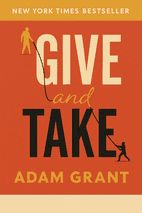
5 Main Takeaways from Give and Take
Givers achieve long-term success by building trust and mutual value.
Contrary to the fear that generosity leads to exploitation, givers like David Hornik demonstrate that helping others first fosters respect and meaningful relationships, leading to professional rewards. This approach transforms success from a zero-sum game to a sustainable path where everyone benefits.
Effective networking relies on value creation, not just value claiming.
Givers create energizing networks by offering five-minute favors and reactivating dormant ties, which provide novel perspectives with minimal investment. Consistent giving establishes norms that inspire others to contribute, expanding resources and leading to high status and productivity.
Sustainable giving requires balancing generosity with self-protection.
To avoid burnout, givers should adopt an 'otherish' mindset, prioritizing their own needs while helping others. Strategies like 'generous tit for tat' allow givers to cooperate but respond competitively when exploited, ensuring resilience and effective negotiation.
Powerless communication, like advice seeking, enhances influence and collaboration.
By genuinely seeking advice, givers foster learning, perspective-taking, and commitment, which builds trust and strengthens relationships. This approach outperforms traditional influence tactics of takers and matchers, especially in collaborative settings.
Cultivating a giver mindset transforms organizations and personal fulfillment.
When individuals shift toward giving, it creates ripple effects that elevate others' careers and foster innovation. Public giving systems like Reciprocity Rings can motivate even takers to contribute, leading to lasting cultural change and more meaningful success.
Executive Analysis
The five takeaways collectively argue that generosity is not a weakness but a sustainable engine for achievement. By building trust through value-creating networks, givers establish reputations that open doors and foster collaboration. However, to thrive, they must balance altruism with self-care and assertive protection, using strategies like advice-seeking to influence effectively. Ultimately, this mindset shift can transform entire cultures, proving that success is amplified when it is shared.
'Give and Take' matters because it challenges conventional wisdom about competition and self-interest, providing evidence-based tactics for integrating generosity into daily life. It sits at the intersection of psychology, business, and self-help, offering practical tools for professionals to enhance their careers while contributing to others' well-being. The book's insights are crucial for anyone seeking to build meaningful relationships and achieve lasting impact without burnout.
Chapter-by-Chapter Key Takeaways
1 — Good Returns (Chapter 1)
Fear of exploitation in competitive environments often pushes people toward taking behaviors, but givers like David Hornik demonstrate that success can be achieved through generosity and creating mutual value.
Giving involves risks, such as increased competition or lack of reciprocity, but it can lead to professional rewards, including respect, meaningful relationships, and a more fulfilling career.
The book "Give and Take" will explore how givers excel in networking, collaboration, evaluation, and influence, while also addressing how to manage the downsides of giving to avoid burnout and exploitation.
Embracing a giver mindset can transform success paradigms, suggesting that helping others first may be a more sustainable path to achievement than prioritizing self-interest.
Try this: Challenge the fear of exploitation by proactively offering help in competitive environments, focusing on creating mutual value rather than just personal gain.
2 — The Peacock and the Panda (Chapter 2)
Dormant ties provide unexpected value through novel perspectives and require less investment than new relationships
Givers create energizing networks that function like solar systems, with themselves as the sun
The five-minute favor transforms networking from value-claiming to value-creation
Consistent giving establishes norms that inspire others to contribute, expanding resources for everyone
Frequent givers achieve both high status and high productivity by building deep trust across their networks
Try this: Revitalize old connections and practice the five-minute favor to build a solar system network where you are the central, energizing sun.
3 — The Ripple Effect (Chapter 3)
Responsibility Bias Adjustment: Givers naturally focus on collective achievements, reducing overestimation of personal contributions by prioritizing others' efforts.
Psychological Safety: Creating environments where risks are encouraged without penalty fosters innovation and loyalty, as seen in Meyer's supportive writers' room.
Empathy Through Perspective-Taking: Successfully bridging the perspective gap involves recalling personal experiences of feedback to deliver constructive criticism with care.
Multiplicative Impact: Generosity in collaboration ripples outward, elevating others' careers and sustaining long-term influence, as Meyer's legacy shows with The Simpsons and beyond.
Try this: Create environments where team members feel safe to take risks by prioritizing collective achievements and delivering feedback with empathy.
4 — Finding the Diamond in the Rough (Chapter 4)
Givers excel by accepting criticism and adapting, while takers often escalate poor decisions to protect their pride.
Valuing psychological traits like grit and selflessness can uncover hidden talent that physical metrics miss.
Embracing external expertise and feedback leads to better talent evaluation and team success.
Letting go of bad investments quickly, as givers do, prevents long-term failures and fosters resilience.
The most impactful leaders focus on developing others’ potential, often without seeking credit, creating lasting legacies.
Try this: Look beyond resumes to assess grit and selflessness in candidates, and swiftly cut losses on underperformers to focus on developing potential.
5 — The Power of Powerless Communication (Chapter 5)
Advice seeking is a highly effective form of powerless communication that fosters learning, perspective taking, commitment, and flattery.
It works best when genuine, as authenticity prevents perceptions of manipulation and builds trust.
Givers naturally excel at this approach, using vulnerability to strengthen relationships and achieve outcomes without traditional negotiation.
Research across various fields confirms that seeking advice outperforms common influence tactics of takers and matchers, especially in collaborative settings.
Try this: Incorporate authentic advice-seeking into your interactions to foster commitment and flattery, strengthening relationships without manipulation.
6 — The Art of Motivation Maintenance (Chapter 6)
Strategic giving prevents burnout: Otherish givers balance generosity with self-care, using approaches like "tend and befriend" to build support networks without depleting energy.
Willpower grows with generosity: Regularly helping others strengthens mental resilience, making challenging tasks feel less exhausting over time.
Giving boosts success: Contrary to myth, generosity can increase income and career achievement by enhancing happiness, motivation, and productivity.
Happiness is a byproduct of helping: Acts of giving activate brain rewards that improve mood and meaning, leading to better health and job performance.
Sustainable contribution wins: Otherish givers often outlast selfless givers, takers, and matchers because their approach is energizing, not draining.
Try this: Adopt an 'otherish' approach by regularly helping others in ways that also recharge your own energy, using willpower exercises to build resilience.
7 — Chump Change (Chapter 7)
Successful givers protect themselves by adapting their reciprocity style, shifting toward matching behavior when dealing with takers
"Generous tit for tat"—cooperating unless exploited, then responding competitively about two-thirds of the time—provides optimal balance between trust and self-protection
Givers can overcome negotiation disadvantages by framing requests as advocacy for others' interests
Using "relational accounts" that highlight concern for others allows givers to maintain their identity while being appropriately assertive
Assertiveness, when framed as representing collective interests, often earns respect rather than damaging relationships
Givers can advocate effectively without feeling like takers by framing their actions as protecting others' interests.
Shifting your mindset from self-advocacy to being an agent for a group you care about can unlock assertiveness.
"Otherish" givers, who balance concern for themselves with concern for others, are the most successful negotiators.
Creating value through perspective-taking (expanding the pie) is more effective than haggling over a fixed amount (win-lose).
Scaling generosity through group mentoring and encouraging others to pay it forward maximizes impact without leading to burnout.
Success for givers depends on flexibility—the ability to adapt one's reciprocity style based on the situation and the people involved.
Try this: When dealing with takers, shift toward matching behavior and frame your requests as representing collective interests to negotiate effectively without compromising your giver identity.
8 — The Scrooge Shift (Chapter 8)
People consistently underestimate the willingness of others to give, due to a focus on the perceived costs of helping and cultural norms that discourage overt generosity.
Public, structured giving systems like the Reciprocity Ring can motivate even takers to contribute by leveraging reputational incentives and empathy.
Changing behaviors first—through voluntary, repeated acts of giving—can lead to lasting identity shifts, turning takers into givers over time.
Sustainable giving cultures thrive when participants feel a sense of free choice and develop a common identity, as demonstrated in both Freecycle and corporate Reciprocity Rings.
Try this: Design public giving platforms that leverage reputational incentives to transform takers into givers, starting with voluntary acts that lead to identity shifts.
9 — Out of the Shadows (Chapter 9)
Giving in professional contexts often leads to stronger relationships and reputations, which can amplify success over time.
Intelligent negotiators frequently achieve better outcomes by prioritizing their counterparts' interests, creating win-win scenarios.
Embracing giver values at work can transform success into a more meaningful, collective achievement rather than a zero-sum game.
Reputation is crucial; being known as a giver can open doors and foster trust, even in competitive environments.
Shifting toward a giver mindset doesn't require changing core values but applying them consistently across all aspects of life.
Try this: Build a reputation as a giver by prioritizing others' interests in negotiations, which fosters trust and amplifies success over time.
Actions For Impact (Chapter 10)
Self-awareness through tools like the Giver Quotient survey is the first step toward meaningful change.
Organizational practices, such as Reciprocity Rings and job crafting, can transform workplace dynamics by aligning tasks with personal values.
Daily habits, including five-minute favors and powerless communication, build resilience and connection without overwhelming effort.
Engaging with communities and personal experiments amplifies impact, while seeking help fosters a cycle of reciprocity.
Financial support through crowdfunding platforms extends giving beyond immediate circles, creating lasting legacies.
Try this: Conduct a self-assessment of your giving style and establish daily habits like five-minute favors to align your actions with giver values.
Acknowledgments (Chapter 11)
Success is deeply interconnected with the support of others, emphasizing that giving and receiving help are essential to achievement.
Mentorship and collaboration can transform ideas into impactful work, as seen in the author's journey from inspiration to publication.
Personal relationships, from family to professional networks, provide the emotional and intellectual fuel for creative endeavors, reinforcing the book's core theme that generosity enriches both givers and receivers.
Try this: Recognize and appreciate the support network that fuels your achievements, and actively seek mentorship to transform ideas into impact.
References (Chapter 12)
Giving enhances well-being, reducing depression and extending life expectancy, while happiness fuels success in personal and professional realms.
Gender affects negotiation outcomes, with women often achieving better results when advocating for others, and empathy can lead to more cooperative interactions.
Prosocial behaviors are motivated by both altruism and self-interest, with sustainable giving arising from intrinsic values rather than external rewards.
Shared identities and emotional experiences like elevation significantly increase helping behaviors, emphasizing the importance of common ground.
Social norms can encourage giving, but public commitments may undermine long-term prosociality if not integrated into one's identity.
Try this: Leverage scientific findings linking giving to reduced depression and increased happiness to motivate sustainable prosocial behaviors in your community.
Index (Chapter 13)
Givers frequently opt for lower-paying jobs in government and nonprofits due to value alignment.
People express willingness to accept substantial salary reductions for roles in socially responsible organizations.
Gender influences salary sacrifice, with women more predisposed to it than men.
Real-world hiring scenarios, like desperate needs, can create openings that givers might fill.
Try this: When career planning, weigh salary against organizational social responsibility, as givers often find greater fulfillment in roles that align with their values.
Continue Exploring
- Read the full chapter-by-chapter summary →
- Best quotes from Give and Take → (coming soon)
- Explore more book summaries →