Burn Quotes
by Herman Pontzer
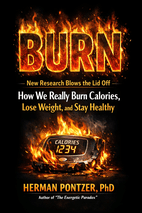
These quotes come straight from Herman Pontzer's "Burn," a book that rewrites what we thought we knew about metabolism. You'll find sharp takes on why exercise won't make you lose weight, vivid snapshots of the Hadza hunter gatherers, and evolutionary truths that cut through diet industry nonsense. Pontzer's writing is quotable because he turns dense science into clear, surprising statements that land like punches. Every line here makes you stop and think, whether it's about the hidden limits of your energy budget or the absurdity of modern health myths. It's the kind of book you'll want to underline, dog ear, and send to friends.
Top Quotes from Burn
“Energy is the currency of life; without it, you're dead.”
The author explains the fundamental importance of energy for all living things.
This line is a crisp, memorable distillation of the book's core theme—that energy expenditure underpins everything from survival to health.
“If humans lived like a typical mammal our size, we'd hit puberty before age two and be dead by twenty-five.”
The author contrasts human life history with that of other mammals to highlight our unusual pace of life.
The vivid, startling comparison makes readers immediately grasp how extraordinary human biology is, setting up the mystery that metabolism helps solve.
“You are what you eat isn't just a well-worn cliché, it's how life actually works.”
After discussing the movie Soylent Green, the author ties it back to the literal truth of diet.
It transforms a familiar saying into a profound biological fact, reminding us that our bodies are literally constructed from what we consume.
“Evolution is a heartless accountant: the only thing that matters, at the end of a life, is how many surviving offspring an organism has produced.”
The author describes how natural selection shapes energy allocation strategies.
It captures the ruthless efficiency of evolution in a vivid, almost poetic way, forcing readers to confront the stark logic of reproductive success.
“Exercise will keep you healthy and alive. It just won't do much for your weight.”
Author summarizing the take-home message about exercise and weight loss.
It's a memorable, counterintuitive statement that challenges common assumptions about exercise's role in weight management.
“Life is short. Make babies. The immune system is optional.”
The author summarizes the evolved metabolic strategy of mice from a calorie-restriction study.
The dark humor and stark simplicity vividly illustrate how evolution prioritizes reproduction over other functions under energy constraints.
“Exercise doesn't change the number of calories you burn each day, but it does change how you spend them—and that makes all the difference.”
The author explains the constrained model of daily energy expenditure.
This line reframes the purpose of exercise beyond weight loss, highlighting its role in metabolic reallocation and overall health.
Themes Behind the Quotes
A central theme is that our bodies run on a fixed energy budget, not a simple fuel gauge. Pontzer challenges the common belief that more activity automatically burns more calories. Instead, the body adapts by shifting energy away from other systems like immunity or reproduction, keeping total daily expenditure surprisingly stable. This constrained model explains why extreme exercise often fails to produce weight loss and why hunter gatherers who walk all day burn the same calories as sedentary office workers.
Another major thread is evolution as a ruthless accountant that cares only about reproductive success. Pontzer shows how human traits like long childhoods, big brains, and our strange compulsion to exercise all emerged from ancient trade offs in energy use. The Hadza people serve as a living demonstration of our evolutionary past, highlighting that many modern health problems arise from mismatches between our ancient biology and today's calorie rich, sedentary world. The book ultimately argues that health and longevity depend less on how many calories we burn and more on where those calories go.
Quotes by Chapter
Chapter 1: The Invisible Hand
“The Hadza are hunter-gatherers: they have no agriculture, no domesticated animals, no machines or guns or electricity. Each day they wrest their food from the wild landscape around them, using nothing but their own hard work and guile.”
The author introduces the Hadza people and their traditional lifestyle.
This passage paints a clear, respectful picture of the Hadza's way of life, grounding the scientific inquiry in a tangible, human reality.
“Our bodies don't work like simple fuel-burning machines because they aren't products of engineering, they're products of evolution.”
The author challenges the common 'armchair engineer' view of metabolism.
This line encapsulates the book's central scientific argument—that evolution has made metabolism dynamic and counterintuitive, not a simple calorie-in-calorie-out equation.
Chapter 2: What Is Metabolism Anyway?
“We are all walking chimeras, part human and part other, performing the ordinary miracle of turning dead food into living people every day without a moment's thought.”
The author explains how our bodies are composed of human cells along with mitochondria and gut bacteria.
It vividly captures the astonishing reality that our lives depend on symbiotic organisms, transforming mundane eating into a profound miracle.
“Your metabolic rate is the full force of your cellular orchestra, 37 trillion microscopic musicians, blending together in an intricate symphony.”
The author describes metabolic rate as the sum of all cellular activity.
The metaphor of a cellular orchestra makes the abstract concept of metabolism feel alive and harmonious, emphasizing the immense complexity within us.
“It took nearly a billion years—untold trillions of generations, quadrillions of false starts and dead ends—for the basic framework of today’s simplest single-cell metabolic systems to evolve on this planet, an eternity of trial and (mostly) error.”
The author reflects on the immense timescale of metabolic evolution.
This quote instills a deep appreciation for the ancient, painstaking process that led to our biological machinery, highlighting the rarity and preciousness of life.
Chapter 3: What Is This Going to Cost Me?
“In the economics of life, calories are the currency.”
The author explains the fundamental principle of energy as a resource for all living organisms.
This concise metaphor frames the entire chapter's theme, making an abstract concept instantly relatable and memorable.
“It was hard some days to tell the difference between immersion learning and drowning.”
The author recalls his overwhelming first weeks at the Harvard field station.
This relatable metaphor perfectly expresses the intensity of learning a complex new field, resonating with anyone who has felt in over their head.
“To be Hadza is to walk. And walk. And walk. Every day.”
The author describes his observation of Hadza women during a foraging follow.
The repetition underscores the central, almost monotonous role of walking in Hadza life, while also capturing the author's dawning awareness of a fundamental cultural truth.
Chapter 4: How Humans Evolved to Be the Nicest, Fittest, and Fattest Apes
“The entire landscape was a layer-cake monument to our impermanence.”
The author describes the view from the dig house at Dmanisi, with layers of ruins and fossils.
It powerfully captures the fleeting nature of human achievements across deep time, making readers reflect on their own place in history.
“With battery acid breath I mouthed the silent prayer of idiots everywhere: Next time will be different.”
The author, hungover after a night of drinking, vows to reform.
The vivid, self-deprecating humor resonates with anyone who has made and broken the same promise to themselves.
“And the secret sauce that made it all work were changes in the way we acquired food and burned calories—changes we're still grappling with today.”
The author summarizes the evolutionary advantage that fueled early human expansion.
It encapsulates the book's central thesis in a memorable, colloquial phrase, connecting our ancient past to modern metabolic struggles.
“He owed his life, I believe, to the quintessential human adaptation, the trait that most sets us apart from our ape relatives. It’s a behavior so ingrained that we rarely give it a second thought. Yet it revolutionized the human lineage, changing the way we get our food and altering the way our bodies burn energy. The Dmanisi hominins shared.”
The author explains how a toothless Homo erectus survived, crediting cooperation.
This passage reveals that sharing—not just tools or brains—was the key human innovation, challenging common assumptions and highlighting our social nature.
Chapter 5: The Metabolic Magician: Energy Compensation and Constraint
“Somehow the Hadza, who get more physical activity in a day than the typical American gets in a week, were nonetheless burning the same number of calories as everyone else.”
The author Herman Pontzer describing the surprising result from the doubly labeled water measurements on the Hadza.
This line encapsulates the central paradox of the chapter – that extreme physical activity does not lead to higher energy expenditure – challenging conventional wisdom and sparking the concept of energy compensation.
“She had gotten the important stuff—clothing, her family's few belongings—out of the house long before the fire got to it. Sure, it was annoying to lose your house in a fire, but no reason to get upset. There was always more grass to build another one. Hamna shida.”
The author recounting his conversation with Halima, a Hadza woman who lost her house in a bushfire.
This poignant anecdote exemplifies the Hadza's remarkable resilience and 'hamna shida' attitude, showing how cultural mindset complements physiological adaptation.
“These women went from never exercising to running 25 miles per week, fit enough to run a half-marathon, and their daily energy expenditure was essentially the same as when they started (Figure 5.2).”
Describing results of a year-long half-marathon training study by Westerterp and colleagues.
This finding vividly illustrates the constrained energy expenditure model, showing that even extreme increases in exercise do not raise total daily energy expenditure.
Chapter 6: The Real Hunger Games: Diet, Metabolism, and Human Evolution
“It's an ancient partnership, far older than our species.”
Describing the relationship between humans and the greater honeyguide bird.
This line captures the profound, deep evolutionary history of cooperation between species, making it memorable and thought-provoking.
“The people most certain about diets our hunter-gatherer ancestors ate are people with little training or expertise.”
Criticizing the overconfident claims of paleo diet advocates.
It neatly exposes the Dunning-Kruger effect in nutrition debates, resonating with anyone frustrated by authoritative but uninformed opinions.
“If carbs—especially sugar— were particularly bad for you, these high-carb cultures should all have diabetes and heart disease.”
Discussing the Hadza and other hunter-gatherer populations that consume large amounts of carbohydrates.
This challenges a common dietary assumption with empirical evidence, making readers reconsider the vilification of carbs and sugar.
“That makes as much sense as arguing there is one “true” human height, and anyone who deviates from it is pathological.”
Arguing against the idea of a single natural human diet.
The analogy is simple and powerful, highlighting the absurdity of one-size-fits-all dietary prescriptions.
Chapter 7: Run for Your Life!
“The division in my mind between human and animal was still there, but the chimps had crossed over to our side of the fence.”
The author describes a moment of realization after chimpanzees pass close by him in the Ugandan rainforest.
This line powerfully captures the blurring of the human-animal boundary and the visceral emotional impact of recognizing our kinship with apes.
“Our need to exercise is peculiar. It sets us apart.”
The author contrasts the idleness of apes with the human requirement to be active for health.
It succinctly states the central paradox of human exercise—an evolutionary anomaly that defines our species.
Chapter 8: Energetics at the Extreme: The Limits of Human Endurance
“When you collapse from exhaustion, it's your brain that shuts you down.”
This sentence appears in the discussion of neural control of fatigue, explaining that the brain integrates signals from the body to regulate performance.
It flips the common intuition that fatigue is purely physical, revealing the brain as the ultimate gatekeeper of endurance—a powerful, counterintuitive insight.
“Even when we feel like we've reached our absolute limits, there's still plenty of ATP in our tired muscles and glucose and fatty acids circulating in our blood.”
This is from the same section, providing evidence that exhaustion is not simply a fuel shortage.
It surprises readers with the fact that the body still has energy reserves at the point of collapse, underscoring the psychological and neural dimensions of endurance.