All We Say Quotes
by Ben Rhodes
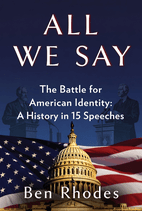
These quotes pull from speeches, letters, and debates that span American history. You will find lines from presidents, activists, and ordinary people, each wrestling with what this country means and who it belongs to. Some are stirring, some are bitter, but all cut to the heart of a nation always in argument.
The book is so quotable because Ben Rhodes lets the voices speak for themselves. He does not flatten the contradictions. Instead he shows how the same words that inspired freedom also justified oppression, and how that tension still shapes our politics today.
Top Quotes from All We Say
“America is not just an idea, we're a particular place with a particular people and a particular set of beliefs and way of life.”
JD Vance, accepting the Claremont Institute's Statesman of the Year award in 2025, defines American identity in opposition to a creed-based definition.
This line crystallizes the exclusionary, blood-and-soil nationalism that has long competed with the inclusive ideal of the Declaration, making it a potent summary of one side of America's core argument.
“For two hundred and fifty years, we have been having an argument in this country.”
The author reflects on the enduring conflict over American identity that began with the compromises of the Constitution.
It elegantly frames the entire book's premise—that America's identity is not settled but perpetually contested—and invites readers to see history as a living debate.
“We have always been both stories: coexisting, competing, and sometimes in conflict with each other about who we are in ways that remade the entire world.”
The author summarizes his thesis that America has always been two opposing narratives—exclusionary and egalitarian—that shape its history.
It captures the complexity and dynamism of American identity, rejecting any single narrative and acknowledging the ongoing struggle that defines the nation.
“We the people only referred to some of the people.”
The author reflects on the limitations of the Constitution's framing, noting it excluded women, the poor, indigenous people, and the enslaved.
This concise, devastating observation lays bare the foundational hypocrisy of American democracy, forcing readers to confront the gap between ideals and reality.
“Our new government is founded upon exactly the opposite idea; its foundations are laid, its corner-stone rests, upon the great truth that the negro is not equal to the white man; that slavery subordination to the superior race is his natural and normal condition.”
Alexander Stephens, Vice President of the Confederacy, in his Cornerstone Speech on March 21, 1861, explaining the foundational principle of the new Confederate government.
This line is the most direct and infamous statement of white supremacy as the bedrock of the Confederacy, exposing the raw ideology behind secession.
“Yet, if God wills that it continue until all the wealth piled by the bondsman’s two hundred and fifty years of unrequited toil shall be sunk and until every drop of blood drawn with the lash shall be paid by another drawn with the sword as was said three thousand years ago so still it must be said ‘the judgments of the Lord are true and righteous altogether.”
Abraham Lincoln in his second inaugural address, speaking about the war continuing until full justice is served for slavery.
This passage powerfully frames the Civil War as divine retribution for the sin of slavery, using biblical language to assert that the suffering is a just payment for centuries of injustice.
“With malice toward none with charity for all with firmness in the right as God gives us to see the right let us strive on to finish the work we are in to bind up the nation’s wounds, to care for him who shall have borne the battle and for his widow and his orphan ~ to do all which may achieve and cherish a just and lasting peace among ourselves and with all nations.”
Closing words of Lincoln's second inaugural address
It combines a call for reconciliation with a firm moral stance, encapsulating Lincoln's vision for post-war America.
Themes Behind the Quotes
A central theme is the unfinished promise of equality. From the founding to the Civil War to today, these quotes reveal a recurring gap between American ideals and American realities. The language of liberty is used by both sides, but often to exclude or to resist change. Another thread is the struggle for self determination. Native Americans, enslaved people, women, and others demand to be heard and to shape their own fate, even as powerful forces try to silence them.
A third theme is the role of government and collective judgment. Some quotes celebrate democracy's ability to adapt, while others warn of its failures and hypocrisies. Throughout, there is a persistent call to look beyond skin color, creed, or custom and to base society on universal human rights. Yet each generation must rediscover that call and fight to make it real.
Quotes by Chapter
Chapter 1: Benjamin Franklin: Founding Compromise
“For when you assemble a number of men to have the advantage of their joint wisdom, you inevitably assemble with those men, all their prejudices, their passions, their errors of opinion, their local interests, and their selfish views. From such an assembly can a perfect production be expected?”
Benjamin Franklin's speech at the Constitutional Convention, September 17, 1787.
This line captures Franklin's pragmatic realism about human nature and politics, acknowledging that any collective decision-making body will be flawed, yet still capable of producing something worthwhile.
“I have experienced many instances of being obliged by better information, or fuller consideration, to change opinions even on important subjects, which I once thought right, but found to be otherwise. It is therefore that the older I grow, the more apt I am to doubt my own judgment, and to pay more respect to the judgment of others.”
Benjamin Franklin's speech at the Constitutional Convention, September 17, 1787.
This passage resonates for its humility and wisdom, encouraging openness to changing one's mind and respect for differing viewpoints—a timeless lesson for public debate.
“Much of the strength and efficiency of any Government in procuring and securing happiness to the people, depends, on opinion, on the general opinion of the goodness of the Government, as well as of the wisdom and integrity of its Governors.”
Benjamin Franklin's speech at the Constitutional Convention, September 17, 1787.
This insight underscores the importance of public trust and perception in the legitimacy and effectiveness of government, a principle still relevant today.
Chapter 2: Red Jacket: We Have Always Lived Here
“How shall we know when to believe, being so often deceived by white people?”
Red Jacket asks this during his response to Reverend Cram's attempt to convert the Seneca to Christianity.
This line crystallizes the deep distrust born from centuries of broken promises and exploitation, making it a universal challenge to anyone claiming moral authority.
“Brother, we do not wish to destroy your religion, or take it from you; we only want to enjoy our own.”
Red Jacket addresses Reverend Cram, asserting the Seneca's right to their own spiritual traditions.
It powerfully reframes the encounter as one of mutual respect rather than submission, highlighting the irony of the missionary's aggression.
“We are now a small people, and you are cutting off our lands piece after piece—you are a hard-hearted people, seeking your own advantages.”
Red Jacket speaks during a land negotiation, describing the relentless loss of Seneca territory.
The blunt accusation strips away diplomatic niceties, laying bare the systematic greed driving colonial expansion.
“What kind of human, what kind of species of creature, must Europeans be, that they have to be forced to do good and only refrain from evil because of fear and punishment?”
Huron statesman Kandiaronk challenges Frenchman Lahontan in a published dialogue.
This question cuts to the heart of how European societies relied on coercion, contrasting sharply with indigenous models of communal governance and moral behavior.
Chapter 3: Maria Stewart: Knowledge Is Power
“We have pursued the shadow, they have obtained the substance; we have performed the labor, they have received the profits; we have planted the vines, they have eaten the fruits.”
Opening epigraph from Maria Stewart's 1833 speech, printed at the start of Chapter 3.
This line powerfully condenses the economic exploitation of Black Americans into a series of stark contrasts, making injustice visceral and memorable.
“Come let us plead our cause before the whites: if they save us alive, we shall live—and if they kill us, we shall but die.”
Maria Stewart addressing a mixed-race, mixed-gender audience at Boston's Franklin Hall in 1832.
It captures her fearless willingness to speak truth to power, accepting whatever consequences may come while refusing to remain silent.
“It is not the color of the skin that makes the man, but it is the principles formed within the soul.”
From Stewart's manuscript published in The Liberator, addressing the Black community directly.
This timeless assertion of intrinsic human worth transcends its era and resonates as a foundational idea for civil-rights rhetoric.
“These things have fired my soul with a holy indignation, and compelled me thus to come forward and endeavor to turn their attention to knowledge and improvement, for knowledge is power.”
From Stewart's 1833 speech to the African Masonic Hall in Boston.
It intertwines righteous anger with a call to action, declaring education and self-empowerment as the path to liberation.
Chapter 4: Alexander Stephens: The Cornerstone
“You think slavery is right, and ought to be extended, while we think it is wrong and ought to be restricted.”
Abraham Lincoln writing to Alexander Stephens after the 1860 election, summarizing the irreconcilable difference between them.
It captures the clear moral and political divide that led to war, stated with stark simplicity by Lincoln himself.
“The new constitution has put at rest, forever, all the agitating questions relating to our peculiar institution [of] African slavery as it exists amongst us [and] the proper status of the negro in our form of civilization.”
Stephens in his Cornerstone Speech, presenting the Confederate Constitution's treatment of slavery as its defining improvement over the U.S. Constitution.
This line reveals the Confederacy's explicit goal of eternalizing slavery and racial hierarchy, framing it as a settled matter rather than a moral wrong.
“Our new government is founded upon exactly the opposite idea. Its foundations are laid, its corner-stone rests, upon the great truth that the negro is not equal to the white man; that slavery subordination to the superior race is his natural and normal condition.”
Alexander Stephens in his "Cornerstone Speech" defining the foundational principle of the Confederacy.
This line explicitly states that white supremacy and slavery are the core of the new nation, rejecting the founding fathers' compromises.
Chapter 5: Abraham Lincoln: True and Righteous
“Both read the same Bible and pray to the same God and each invokes His aid against the other.”
Lincoln in his second inaugural address, noting the paradox of both Union and Confederacy praying to the same God for victory.
It captures the tragic irony of a civil war where both sides claim divine support, highlighting Lincoln's humility and the moral complexity of the conflict.
“There is a profound lesson that you learn as a speechwriter if you work for someone who understands how to properly deliver a speech: The ability to quiet an audience is far more powerful than the capacity to excite them.”
The author’s reflection on Lincoln’s speech delivery
It offers a timeless insight into leadership—that commanding silence is more powerful than generating cheers.
Chapter 6: Frederick Douglass: Such Things as Human Rights
“There are such things in the world as human rights. They rest upon no conventional foundation, but are external, universal, and indestructible.”
Opening epigraph of the chapter, attributed to Frederick Douglass in 1869.
It asserts the existence of universal, indestructible human rights, a foundational belief that underpins Douglass's entire activism.
“God speed the hour, the glorious hour, when none on earth shall exercise a lordly power, nor in a tyrant’s presence cower; but all to manhood’s stature tower, by equal birth! That hour will come, to each, to all.”
Closing of Douglass's 1852 speech 'What to the Slave Is the Fourth of July?'
The poetic language and prophetic tone inspire hope for a future where all people stand equal, a vision that remains relevant.
“I know of no rights of race superior to the rights of humanity, and when there is a supposed conflict between human and national rights, it is safe to go to the side of humanity.”
Douglass directly confronting the idea that racial or national interests can override fundamental human rights.
It cuts through all debate by placing humanity itself above any constructed hierarchy, a principle that remains central to modern human rights discourse.
“In whatever else other nations may have been great and grand, our greatness and grandeur will be found in the faithful application of the principle of perfect civil equality to the people of all races and of all creeds, and to men of no creeds.”
Douglass defining America's unique mission as a multiracial democracy based on civil equality.
This passage reimagines national greatness not through power or wealth but through the radical commitment to equality, offering a powerful vision that still challenges America today.
Chapter 7: Anna Dickinson: Celebrity Suffragette
“Why should a government, professing freedom to all, deny it to about one-half of its citizens?”
Anna Dickinson's 1868 lecture "Idiots and Women."
This rhetorical question cuts to the core of democratic hypocrisy, framing women's suffrage as a fundamental contradiction in a nation claiming freedom for all.
“Hem up. A brilliant thinker, by the age of forty-seven she was forcibly detained by a group of family and neighbors who claimed that she was insane.”
The author describes the tragic arc of Anna Dickinson's life.
This stark contrast between her early brilliance and later unjust confinement underscores the theme of women being discarded by society.
“Her story, like her satire, cuts to the quick.”
The author's concluding reflection on Anna Dickinson's life.
This line powerfully encapsulates how Dickinson's personal tragedy reinforces her satirical critique of society's treatment of women.