All We Say Mindmap: Visual Summary of All Chapters | Insta.Page

All We Say — Interactive Mindmaps

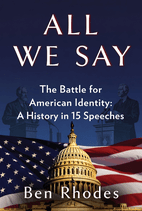
All We Say by Ben Rhodes Book Cover

by Ben Rhodes

Ben Rhodes's All We Say traces the fundamental American struggle between universal principles and blood-and-soil belonging through 15 pivotal speeches, from Benjamin Franklin to Donald Trump. Written for readers seeking to understand today's polarization as a continuation of a long-running historical conflict rather than a recent anomaly.

On Insta.page you also get an Apply This Book tool that lets you combine insights from up to 3 books to solve your specific situation.

Chapter mindmaps

Free preview: chapters 1–4 are fully interactive. Click any node to expand or collapse. Subscribe to unlock the rest.

Chapter 1: Prologue

Key concepts: Prologue

1. Prologue

Vance's Blood-and-Soil Vision

  • Rejects American creed based on Declaration of Independence
  • Defines America by place, people, and way of life
  • Appeals to nativist, ancestral belonging over ideals
  • Demands deference and gratitude to cultural order

Two Competing Stories of America

  • Particularist story: white, Christian, native-born people
  • Creedal story: multiracial democracy striving for equality
  • Neither story has ever fully won the argument
  • Struggle between them defines American history

Speeches as Windows into Identity

  • Book examines fifteen speeches on American identity
  • Each speech analyzed through speaker, movement, and media
  • Speeches must feel authentic to the speaker
  • They emerge from living movements of their time

Urgency of the Present Moment

  • We live in a cynical, fragmented age
  • Algorithms and polarization erode deep listening
  • Words still matter and can tell hard truths
  • No single faction owns the American story

American Identity as Living Argument

  • Fundamental question: What is an American?
  • Identity is not fixed inheritance but ongoing debate
  • Greatest speeches demand both reality and ideals
  • History is still being written by us

Chapter 2: Chapter 1: Benjamin Franklin: Founding Compromise

Key concepts: Chapter 1: Benjamin Franklin: Founding Compromise

2. Chapter 1: Benjamin Franklin: Founding Compromise

Franklin's Path to the Convention

  • Born poor, self-taught through printing and curiosity
  • Became media mogul with Poor Richard's Almanack
  • Learned union from Haudenosaunee and colonial assemblies
  • Evolved from imperial loyalist to radical revolutionary

Philosophy of Gradual Change

  • Revolution as gradual process, not total overthrow
  • Opposed single executive, supported impeachment and term limits
  • Chose union over moral clarity on slavery
  • Believed pushing abolition would shatter the Convention

The Great Compromise

  • Big states wanted population-based House seats
  • Small states demanded equal Senate representation
  • Resulted in proportional House and equal Senate
  • Paper over deeper divides, especially slavery

Intellectual Humility in Closing Speech

  • Confessed doubts about parts of the Constitution
  • Argued no future convention could produce better document
  • Urged delegates to doubt their own infallibility
  • Drew on lifetime of changing his mind

Flawed Legacy and Tool Kit for Reform

  • Constitution excluded women, poor, Indigenous, enslaved
  • Franklin evolved from slaveholder to abolitionist petitioner
  • Founders left a system capable of reform
  • Principles like equality can challenge the system itself

Chapter 3: Chapter 2: Red Jacket: We Have Always Lived Here

Key concepts: Chapter 2: Red Jacket: We Have Always Lived Here

3. Chapter 2: Red Jacket: We Have Always Lived Here

Red Jacket's Encounter with Reverend Cram

  • Jacob Cram arrived in 1805 to convert Haudenosaunee
  • Red Jacket delivered a landmark defense of tradition
  • Power imbalance highlighted by federal official presence
  • Missionaries aimed to replace indigenous ways with Christianity

Haudenosaunee Governance and Great Law of Peace

  • Six Nations confederacy governed by oral constitution
  • Democracy practiced through councils and consensus
  • Women held authority, including nominating chiefs
  • Model influenced Benjamin Franklin's American union

Red Jacket's Life and Contradictions

  • Born 1750s, worked as messenger and diplomat
  • Wore Washington medal while defending Seneca traditions
  • Sometimes yielded to bribes despite resistance
  • Council speaker known as 'He Who Keeps Them Awake'

Post-Revolution Land Loss and Treaties

  • Treaty of Paris granted Haudenosaunee lands to US
  • Canandaigua (1794) created reservation system
  • Big Tree (1797) forced sale of over 3 million acres
  • Red Jacket tried to halt negotiations but failed

Indigenous Critique of European Society

  • Kandiaronk challenged French ideas on law and religion
  • Questioned need for punishment to maintain goodness
  • Haudenosaunee oratory influenced Enlightenment thinkers
  • Franklin echoed chief's advice at Constitutional Convention

Cultural Survival and Assimilation Pressures

  • Alcoholism and depression rampant on shrinking lands
  • Red Jacket's speech used by secularists and abolitionists
  • Seneca legacy contested: sellout or survivalist
  • Seneca Indian Nation still governs near Buffalo today

Unresolved Questions of Land and Justice

  • Museum panel declares 'We have always lived here'
  • Red Jacket's Washington medal rests in museum
  • Chapter asks if US is fair or conquest organism
  • Same issues of land, faith, and survival persist

Chapter 4: Chapter 3: Maria Stewart: Knowledge Is Power

Key concepts: Chapter 3: Maria Stewart: Knowledge Is Power

4. Chapter 3: Maria Stewart: Knowledge Is Power

Prophetic Voice and Jeremiad Tradition

  • First Black woman to address mixed audience in 1832
  • Used jeremiad to blend lamentation with redemption
  • Warned white America of divine judgment
  • Spoke with prophetic fire after devastating losses

Knowledge as Power and Self-Empowerment

  • Declared 'Knowledge is power' as central thesis
  • Advocated for schools and scientific education
  • Urged community self-improvement as divine duty
  • Criticized Black passivity alongside white oppression

Intersectional Vision for Women and Liberation

  • Insisted on educating girls for liberation
  • Recognized intersectionality before the term existed
  • Demanded rights through petitions and action
  • Rejected colonization as false solution

Lifelong Quiet Radicalism in Action

  • Taught children regardless of ability to pay
  • Sheltered freed people during Civil War
  • Served as matron of Freedmen's Hospital
  • Walked streets to find children for school

Enduring Legacy and Historical Challenge

  • Burial site disturbed by systemic injustice
  • Garrison marveled at her unchanged fire in 1879
  • Challenges spotlight on white male abolitionists
  • Embodied unseen work of countless Black women

Chapter 5: Chapter 4: Alexander Stephens: The Cornerstone

Mindmap locked. Subscribe to unlock all chapters of All We Say.

Subscribe to unlock

Chapter 6: Chapter 5: Abraham Lincoln: True and Righteous

Mindmap locked. Subscribe to unlock all chapters of All We Say.

Subscribe to unlock

Chapter 7: Chapter 6: Frederick Douglass: Such Things as Human Rights

Mindmap locked. Subscribe to unlock all chapters of All We Say.

Subscribe to unlock

Chapter 8: Chapter 7: Anna Dickinson: Celebrity Suffragette

Mindmap locked. Subscribe to unlock all chapters of All We Say.

Subscribe to unlock

Chapter 9: Chapter 8: Mary Lease: Wall Street Owns This Country

Mindmap locked. Subscribe to unlock all chapters of All We Say.

Subscribe to unlock

Chapter 10: Chapter 9: Louis Brandeis: Americanism

Mindmap locked. Subscribe to unlock all chapters of All We Say.

Subscribe to unlock

Chapter 11: Chapter 10: Franklin Delano Roosevelt: Four Freedoms

Mindmap locked. Subscribe to unlock all chapters of All We Say.

Subscribe to unlock

Chapter 12: Chapter 11: Martin Luther King and John F. Kennedy: An American Dream

Mindmap locked. Subscribe to unlock all chapters of All We Say.

Subscribe to unlock

Chapter 13: Chapter 12: Dolores Huerta: You Cannot Pretend That We Do Not Exist

Mindmap locked. Subscribe to unlock all chapters of All We Say.

Subscribe to unlock

Chapter 14: Chapter 13: Ronald Reagan: God and Country

Mindmap locked. Subscribe to unlock all chapters of All We Say.

Subscribe to unlock

Chapter 15: Chapter 14: Barack Obama: Breaking the Racial Stalemate

Mindmap locked. Subscribe to unlock all chapters of All We Say.

Subscribe to unlock

Chapter 16: Chapter 15: Donald Trump: I Will Win for You

Mindmap locked. Subscribe to unlock all chapters of All We Say.

Subscribe to unlock

Chapter 17: Epilogue

Mindmap locked. Subscribe to unlock all chapters of All We Say.

Subscribe to unlock

Continue exploring All We Say