All We Say Key Takeaways
by Ben Rhodes
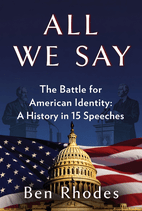
5 Main Takeaways from All We Say
American identity is a perpetual argument, not a fixed inheritance.
Rhodes shows that defining 'American' has always been contested—from Franklin's compromise on slavery to Trump's 'particularist' vision. The book argues that speeches by figures like Douglass, Lincoln, and Huerta reveal this ongoing struggle, urging readers to see the nation as a living debate rather than a settled fact.
Speeches are the battleground where national values are fought over.
The author demonstrates how oratory combines personal authenticity, movement momentum, and media context to shape history. FDR's Four Freedoms reframed WWII as a fight for universal rights, while Stephens' Cornerstone Speech weaponized white supremacy—showing that words can either expand or contract the circle of belonging.
Progress is not inevitable; it requires active moral reckoning.
Lincoln's second inaugural demanded collective penance for slavery, and King's dream cost him everything. Rhodes emphasizes that America's ideals only advance when citizens force confrontation with injustice—as Stewart did through education and Huerta through boycotts—rather than waiting for history to move on its own.
The 'creedal' vs. 'particularist' tension defines American politics.
Prologue frames this clash: the creedal story of equality versus the particularist story of blood and soil. Obama's 'More Perfect Union' tried to bridge them, Trump's inaugural doubled down on the latter, and Stephens openly rejected the creed. Rhodes shows every era reopens this same fault line.
Listen to full arguments in an age of fragmented soundbites.
The book's structure—deep dives into complete speeches—is a corrective to algorithmic polarization. Readers learn to recover the nuance of Dickinson's satire, Brandeis's skepticism of centralization, and Douglass's case for immigration. Only by hearing the full argument can we engage with, rather than dismiss, opposing views.
Executive Analysis
These five takeaways collectively form Rhodes's central argument: American identity is not a static inheritance but a dynamic, contested argument enacted through speeches. Each chapter peels back a moment when a speaker either expanded or narrowed the national creed, showing that the struggle between inclusive and exclusive visions is the nation's true plot. The book insists that progress is never guaranteed—it demands active listening, moral accountability, and the willingness to treat the Declaration's promises as unfinished business.
This book matters because it arms readers with a historical toolkit to understand today's political paralysis. By showing how Franklin, Lincoln, Douglass, and Huerta turned words into movements, Rhodes reminds us that rhetoric still matters. In a genre crowded with commentary on polarization, 'All We Say' stands out by grounding its analysis in original speeches, forcing us to confront the full complexity of figures we often reduce to caricatures. Practical impact: it trains us to become better citizens by becoming better listeners.
Chapter-by-Chapter Key Takeaways
Prologue (Prologue)
The Prologue frames the entire book around a fundamental, unresolved question: What is an American, and who gets to decide?
JD Vance’s 2025 speech exemplifies the “particularist” story of America—blood, soil, heritage, and gratitude—pitted against the “creedal” story of equality and self-criticism.
The author argues that American identity is not a fixed inheritance but a living argument, best understood through the speeches that have shaped it.
Speeches are powerful because they combine the speaker’s authenticity, a movement’s momentum, and the media landscape of their time.
The book aims to restore our ability to listen to full arguments in an age of algorithmic fragmentation and polarized soundbites.
Try this: Practice listening to entire speeches and arguments before reacting, recognizing that American identity is forged in ongoing debate.
Benjamin Franklin: Founding Compromise (Chapter 1)
Franklin’s defense of the Constitution rested on intellectual humility: wisdom meant doubting your own certainty.
He saw dogma as incompatible with both science and democracy—and argued that political experimentation required the same openness to revision as scientific discovery.
The Constitution’s compromises were necessary for union but excluded vast populations, embedding injustices that would require centuries of struggle to address.
Franklin’s own evolution on slavery—from slaveholder to abolitionist petitioner—shows that personal change is possible, but also that the founding generation chose caution over moral clarity.
The founders left behind not a finished project, but a tool kit: a system capable of reform, and a set of principles—like equality—that could be used to challenge the system itself.
Try this: Embrace intellectual humility and openness to revision, just as Franklin applied scientific thinking to political experimentation.
Maria Stewart: Knowledge Is Power (Chapter 3)
Stewart used the jeremiad tradition to blend lamentation with a call for moral improvement and political action.
She argued that self-improvement and community organization were divine imperatives, not just practical strategies.
Her critique of Black passivity and white oppression was unsparing, yet she framed Black Americans as the nation’s truest believers in equality.
Despite poor reception, Stewart persisted as a teacher and writer, ensuring her voice would not be lost to history.
Stewart’s later life in Washington, D.C., focused on education, sheltering freed people, and serving as matron of the Freedmen’s Hospital—a quiet but essential role during the Civil War and Reconstruction.
She never sought fame, but her life embodied the message she had preached decades earlier: self-reliance, education, and dignity.
Testimonials from pastors and community members confirm her relentless dedication to teaching children, regardless of their ability to pay.
Garrison’s reunion with Stewart in 1879 shows that she retained the same fire and purpose into old age.
Her story challenges the narrow historical spotlight on white male abolitionists, revealing the quiet radicalism of countless Black women who shaped the nation through unseen work.
Even her burial site was disturbed by the same systemic injustices she fought against—a poignant reminder that her struggle was never fully finished.
Try this: Invest in education and community self-improvement as acts of resistance, following Stewart's model of quiet radicalism that challenges systemic injustice.
Alexander Stephens: The Cornerstone (Chapter 4)
Stephens rejected defensive arguments for slavery and instead claimed white supremacy as a progressive, scientific, and moral truth
He framed the Confederacy as the true inheritor of the Enlightenment tradition, correcting the compromises of America's founding
The "cornerstone" speech weaponized white identity to unite poor and wealthy Southerners alike
After the war ended, Alexander Stephens was arrested at his home, Liberty Hall, and imprisoned at Fort Warren in Boston Harbor. Rather than confront his own role in the bloodshed, Stephens began rewriting history. He became one of the original architects of the Lost Cause, a deliberate political strategy disguised as romantic grief. In 1868, Stephens published A Constitutional View of the Late War Between the States, a best-selling two-volume work that recast the conflict as a noble struggle over states’ rights. Slavery was demoted to a secondary issue, portrayed as a civilizing institution for Black people. Stephens never changed his core beliefs—he simply changed the packaging. He knew the Cornerstone Speech could expose his lie, so he claimed he’d been misquoted, without
Try this: Beware of revisionist narratives that recast oppression as heritage; demand honest confrontation with historical injustices rather than comforting myths.
Next chapter: “Abraham Lincoln: True and Righteous” is locked
Keep learning from All We Say — and unlock all 600+ book summaries with audio, mindmaps and AI Q&A.
$0.00 due today · 7 days free, then $89.99/year ($7.49/mo) · Cancel anytime before day 7
plus sales tax where applicable