A Cup of Zen Quotes
by Kai Tsukimi
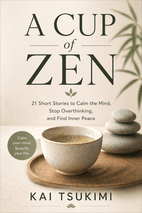
This collection gathers the most striking lines from a modern Zen classic. You'll find koans that challenge your thinking, questions that linger long after reading, and small observations that feel like a pause in a busy day.
What makes these quotes so memorable is their simplicity. Each one is a tiny mirror held up to your own mind. They don't try to teach but rather invite you to notice something you already know but maybe forgot. Perfect for sharing or journaling.
Top Quotes from A Cup of Zen
“What are you carrying that no longer serves you?”
From the Reflection section at the end of the chapter.
It invites direct introspection about personal burdens, making it a universal prompt for self-reflection.
“If you dropped one story, expectation, or fear, how would your step change?”
From the Reflection section, continuing the theme of shedding mental weight.
It powerfully connects emotional baggage to physical movement, urging readers to imagine liberation in concrete terms.
“Outside, the storm raged. Inside, a single drop fell.”
The final narration after the scholar drinks and the cup is empty.
This stark contrast between external chaos and inner stillness captures a moment of clarity, reminding readers that peace can arise when we let go.
“Which is heavier—the weight of not knowing or the weight of needing to know?”
From the Reflection section following the story.
It poses a profound philosophical dilemma about the burden of ignorance versus the burden of curiosity.
“He touched the rough wood of the temple gate. The sun crept over the eaves, casting long shadows on the stone. “Strange,” he murmured. “It feels like my first day.””
The master touches the temple gate, observes the morning light, and murmurs that it feels like his first day.
This passage captures the essence of mindful presence—seeing the familiar with fresh eyes—and resonates with anyone seeking to break free from routine.
“IN THE BEGINNER'S MIND THERE ARE MANY. POSSIBILITIES, BUT IN THE EXPERT'S MIND THERE ARE FEW.”
Attributed to Shunryu Suzuki at the end of the chapter.
This line contrasts the open possibilities of a beginner's mind with the limited view of an expert, urging readers to embrace a mindset of openness and curiosity.
“Leave something unfinished today. Let it be.”
From the 'A Moment of Zen' section at the end.
It offers a practical, mindful instruction that embraces imperfection and openness in daily life.
Themes Behind the Quotes
A central theme is the art of letting go. Many quotes explore what happens when you release attachments to stories, expectations, and even your own name. This act of dropping weight is not about loss, but about making space for something clearer and lighter.
Another thread is the value of emptiness and the beginner's mind. The book suggests that not knowing is a powerful starting point. It contrasts the burden of expertise with the freedom of curiosity. Alongside this runs a quiet meditation on impermanence, where ripples fade, steam vanishes, and unfinished things are allowed to simply be.
Quotes by Chapter
1
“Hold a stone. Drop it. Feel the difference.”
From the 'A Moment of Zen' exercise in the chapter.
A simple, visceral metaphor for letting go—short, actionable, and instantly memorable.
“Think of a past event. Choose to let it go. Did it leave, or was it never there?”
From the 'A Moment of Zen' exercise, prompting reflection on attachment.
It challenges the permanence of memory and encourages a shift in perspective about holding onto the past.
2
“I have read the sutras,” he said. “Debated with monks. Memorized countless verses,” he exhaled. “And yet, something is missing.”
The scholar speaks to the tea master, expressing his frustration after years of study.
This line resonates with anyone who has accumulated knowledge yet still feels an inner void, capturing the universal search for deeper meaning.
“The tea master poured until the scholar's cup was full. Then he kept pouring. Tea spilled over the rim, streaming across the table, soaking the scholar’s scrolls.”
The tea master's silent response to the scholar's question about the essence of Zen.
It powerfully illustrates the Zen lesson of knowing when to stop, showing that overfilling—whether with knowledge, worry, or plans—leads to loss.
“What quiet overflow have you been ignoring?”
A reflective question posed to the reader in the chapter's reflection section.
It invites introspection about unnoticed excess in life—emotions, thoughts, or habits—and prompts a mindful pause before the spill.
3
“The fisherman pulled in the net. This time, it was full. Silver flickered in the moonlight. He said nothing.”
After the boy's repeated questions, the fisherman finally pulls in a full net of fish.
This moment shows that wisdom is often conveyed through silence and action rather than words.
“If you cast your net into the unknown, what do you pull back? Do you pull in truth, illusion, or only the movement of the water?”
Also from the Reflection section.
This invites readers to question the nature of their own search for meaning and what they truly find.
“Drop a pebble into water. Watch the ripples fade. What remains?”
From the 'A Moment of Zen' section.
A simple, meditative image that reminds us of impermanence and the quiet that follows disturbance.
4
“This man may hold power, but he wouldn't recognize Zen if it smacked him in the face.”
Master Kaito scoffs at the governor after Master Renji praises him.
This sharp insult jolts the governor out of complacency and becomes the catalyst for his genuine learning.
“He did not build a temple for Renji. He built one for Kaito.”
The governor's decision the day after the insult.
It illustrates the counterintuitive wisdom of choosing a teacher who challenges rather than flatters.
“Do you seek truth, or do you seek comfort?”
The Reflection section poses this question directly to the reader.
It forces an honest self-assessment about one's motivations in learning and life.
“When challenged, pause—are you resisting growth?”
A Moment of Zen offers this practical advice.
It provides a simple yet profound mindfulness prompt to transform discomfort into growth.
5
“Tell me,” he said, “Where is the master's hall?”
The new master, upon arriving at the monastery, asks where the master's hall is, despite having lived there for years.
This line challenges the assumption that familiarity equals knowledge, inviting readers to question their own automatic perceptions.
“If knowledge fades but the wind still moves, which is real?”
A reflective question from the chapter's meditation prompt.
This philosophical question urges readers to consider whether remembered knowledge or direct experience holds greater truth, a core theme of Zen practice.
II. Beginner’s Mind
“If every path vanishes, do you keep walking?”
From the Reflection section after the desert nomad story.
This question challenges the reader to consider whether the absence of a clear path is a loss or an opportunity for presence.
“Walk without direction. Let your feet decide.”
From the 'A Moment of Zen' section following the story.
This simple instruction encourages letting go of intentional direction and trusting instinct, embodying the beginner's mind.
7
“LL once had a name,” the old man said, almost to himself. “But I seem to have forgotten it.”
The old calligrapher, who may himself be the lost teacher, reveals he has forgotten his own name.
This line captures the Zen paradox of identity—letting go of labels to find a deeper self. The typo 'lL' adds a surreal, almost poetic flaw that mirrors the imperfect nature of memory.
“Reflection If a name fades, what remains? When ink vanishes and voices quiet, what is left of who we are? Do you carry your name, or does it carry you? If no one called you by it, would it still be yours?”
The chapter's reflection section, inviting the reader to contemplate the nature of identity beyond names.
These questions strip away the comfort of labels, forcing a direct encounter with the essence of self. The repetition of rhetorical questions creates a meditative rhythm that lingers long after reading.
“Put hot water in a cup. Watch steam rise. See it vanish. Listen to a stranger say your name. Notice how it feels. Hold a blank page. Notice what is there before ink touches it.”
The 'Moment of Zen' exercise at the end of the chapter, guiding the reader to experience presence directly.
Each simple instruction is a mini-koan, turning everyday actions into portals of awareness. The final line about the blank page beautifully echoes the story's central image of erased ink and forgotten names.
8
“Astroke too many, a word too much—when does the masterpiece vanish?”
From the 'Reflection' section of the chapter.
It challenges the reader to consider when perfection becomes destructive, a universal truth in art and life.
“What is missing, and is it truly absent?”
From the 'Reflection' section of the chapter.
It provokes introspection about perceived gaps, encouraging a shift in perspective from lack to potential.
“A gap in the ink, a pause in the music—does emptiness complete the whole?”
From the 'Reflection' section of the chapter.
It uses vivid imagery to question the role of emptiness and silence, suggesting that absence can be meaningful.
9
“I thought so too. But I realized—! do not know what will happen.”
The farmer says this to the girl when she asks why his field is empty.
It captures the paralysis of uncertainty and the honest admission of ignorance, a profound moment that resonates with anyone facing an unknown future.