A Cup of Zen: 21 Short Stories to Calm the Mind, Stop Overthinking, and Find Inner Peace - Includes Reflections for Beginners Key Takeaways
by Tsukimi, Kai
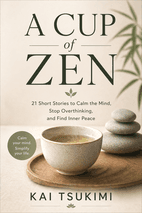
5 Main Takeaways from A Cup of Zen: 21 Short Stories to Calm the Mind, Stop Overthinking, and Find Inner Peace - Includes Reflections for Beginners
Letting Go Is a Conscious Act, Not a Passive Release
The book repeatedly shows that releasing burdens—whether physical objects, worries, or past grievances—is an active choice. The traveler’s wisdom came when he lightened his load, and the monk’s discipline was in deliberately setting down each irritation. You must choose to open your hand, not just hope the weight falls away.
Act Before You Know—Certainty Is Not Required
Overthinking paralyzes, but the farmer plants without guarantee of rain, and Jiro pulls the reins with intention, not force. You can take meaningful steps without knowing the outcome; the attempt itself teaches more than waiting for perfect clarity. Embrace the unknown as part of the process.
See the World Afresh with Beginner’s Mind
True expertise includes the ability to set aside what you think you know. By touching something familiar as if for the first time or walking a known route as a stranger, you break the trance of habit and open yourself to direct experience. Identity is fluid; the teacher may appear ordinary.
Find Enlightenment in Everyday Tasks
Awakening doesn’t erase responsibilities—it transforms how you meet them. The deepest wisdom lives in washing dishes, sweeping, or returning to simple work with grace. Attention, not novelty, turns the mundane into a source of calm and insight.
Let Go of Attachment to Results and Embrace Process
The potter’s return to the wheel matters more than the jar’s survival; loss is part of creation, not its interruption. Meaning lives in what is not done, and silence holds possibility. By sitting in the dark or erasing and redrawing, you learn to see impermanence as material, not obstacle.
Executive Analysis
The five takeaways form a cohesive thesis: inner peace is not achieved by accumulating knowledge or reaching a destination, but by actively letting go of attachments, embracing uncertainty, and returning to direct experience. Each story dismantles a different illusion—that we need certainty, that mastery is permanent, or that we are separate from our environment. Together, they guide the reader toward a practical Zen that lives in everyday choices, not abstract philosophy.
This book matters because it offers concrete, embodied exercises over theoretical advice, making it ideal for overthinkers and beginners. In a genre crowded with mindfulness guides, “A Cup of Zen” stands out with its short-story format and post-story reflections that invite immediate application. It’s an accessible entry point into Zen that doesn’t demand years of study—just a willingness to pause, drop a stone, and notice what’s already here.
Chapter-by-Chapter Key Takeaways
1 (Chapter 1)
Wisdom isn’t at the peak—it’s in the shedding. The traveler’s real discovery came when he lightened his load, not when he arrived.
The things we “may need” often keep us from moving freely. Most of what we carry is security theater, not genuine necessity.
The mountain doesn’t confirm your journey—you do. The old man was already there because he never carried the weight in the first place.
Letting go is an active choice, not a passive release. The stone-dropping exercise makes it tactile: you have to choose to open your hand.
Try this: Lighten your load by actively choosing to set down one possession or worry today, then notice how it changes your movement.
2 (Chapter 2)
Fullness is not the same as readiness. A cup must be emptied before it can receive anything new. The scholar’s cup of knowledge was already full, leaving no room for insight.
The tea master’s silence teaches louder than words. The best lessons often bypass explanation and land directly in experience.
Pay attention to the spill. Overflow in your life—whether in anxiety, busyness, or information-gathering—is a sign that you have stopped drinking what you already have.
Wisdom comes from pausing, not adding. The empty cup is not a lack; it is a space for something real to arrive.
Try this: Empty your cup of preconceptions before approaching any new experience by consciously pausing and acknowledging what you already think you know.
3 (Chapter 3)
Certainty is not a prerequisite for action; you can act without knowing the outcome.
The heavy weight is often the need to know, not the not-knowing itself.
What you pull back from an attempt may not be a clear answer—but the attempt still matters.
Practice letting go: drop a stone, write in sand, stand in the wind. The doing teaches more than the waiting.
Try this: Act without needing to know the outcome—drop a stone into a river, write in sand, or take a small step toward a goal and observe what arises.
4 (Chapter 4)
Truth often arrives wrapped in discomfort. Flattery feels good but teaches little.
The governor's pause—his choice to breathe before reacting—was the moment he actually began learning Zen.
Challenge yourself to welcome the people who make you uncomfortable; they may be your best teachers.
A Moment of Zen: When someone pushes your buttons, pause. Ask yourself: Am I resisting growth or protecting my ego?
Try this: When someone pushes your buttons, pause and breathe before reacting; ask whether you are protecting your ego or resisting growth.
5 (Chapter 5)
Mastery includes the ability to set aside mastery. True expertise is not a permanent title but a flexible relationship with the present.
Familiarity can be a form of ignorance. Assuming we already know a situation prevents us from genuinely seeing it.
The path beneath your feet is more real than the path you remember. Direct sensory experience is the ground of wisdom, not memory or reputation.
Practice beginner’s mind deliberately. This chapter offers a concrete ritual: at dawn, touch something familiar as if for the first time, and walk a known route as a stranger. This small shift can break the trance of habit.
Try this: Touch something familiar (like a doorknob or a cup) as if for the first time, and walk a known route as a stranger to break the trance of habit.
II. Beginner’s Mind (Chapter 6)
Certainty and fixed plans can be swept away by forces beyond our control; being lost may be a more honest and productive state than we think.
The practice of beginner’s mind is experiential, not intellectual—stand still, turn around, feel the wind, and notice what arises without judgment.
An expert clings to a single path; a beginner remains open to all possibilities, even when the horizon seems to disappear.
Try this: Stand still, turn around, and feel the wind without labeling it; allow yourself to be lost and open to all possibilities.
7 (Chapter 7)
Identity is fluid; a name is a temporary label, not a fixed essence.
The teacher may appear ordinary and unattached to roles.
True presence exists beyond words and titles.
Practical mindfulness—not abstract philosophy—is how we taste this lesson.
Try this: Let go of your attachment to titles and roles by introducing yourself without a label today, then notice the freedom in simply being present.
8 (Chapter 8)
Completion is not always the goal; sometimes adding more destroys the essence.
A deliberate omission can be more powerful than a fully rendered form—it invites the viewer or listener to participate.
The “unfinished” isn’t broken; it’s a conscious choice that honors the space necessary for meaning.
Try the exercise: leave something incomplete today as a small act of mindful restraint.
Try this: Leave something incomplete today—a sentence, a task, a drawing—as a deliberate act of mindful restraint that honors space for meaning.
9 (Chapter 9)
Action and uncertainty are inseparable – Planting does not guarantee rain; waiting does not guarantee the right moment. The farmer’s question reveals that we often act only when we pretend certainty exists, but true action embraces the unknown.
Patience can hide fear – The chapter challenges readers to examine whether their waiting comes from respect or from fear.
The field itself holds wisdom – Whether empty or full, the land is never truly barren. “Sense what is already growing, seen or unseen” reframes emptiness not as absence but as potential presence.
The choice is not between planting and waiting, but between accepting the unknown or demanding answers before moving. The farmer doesn’t condemn action—he simply refuses to pretend he knows the outcome.
Try this: Choose to plant a seed (take an action) without demanding a guarantee of rain; accept the unknown as part of the process.
10 (Chapter 10)
Solid barriers can dissolve when we question our assumptions about them.
The cat’s effortless passage isn’t an invitation to mimic it, but an invitation to wonder: what other “walls” do we treat as absolute?
The Zen practice encourages us to deliberately re-examine everyday spaces and actions—sometimes the path through is not the one we’ve always taken.
Awareness itself can be a kind of gate: noticing what we usually ignore opens new possibilities.
Try this: Question a wall you treat as absolute—re-examine a habitual route or assumption and see if a new path emerges through awareness.
11 (Chapter 11)
Awakening doesn’t erase everyday responsibilities; it changes how you meet them.
The deepest wisdom is often found in the mundane tasks you’ve always done.
The measure of insight is whether you can return to simple work with grace.
Attention, not novelty, is what transforms ordinary experience.
Try this: Return to a simple, mundane task with full attention; let the act of washing dishes or sweeping become your meditation.
III. The Habit of Habit (Chapter 12)
The most important skill is not any single habit, but the ability to build habits themselves.
Copying what successful people do is less valuable than understanding why they do it.
Treating each habit as a separate project leads to failure; focus on the system behind them.
A personal architecture for adopting new behaviors makes the process nearly automatic.
Shift from consuming advice to actively designing your own habit-building approach.
Try this: Design your own habit-building system rather than copying others—focus on the architecture behind behaviors, not just the behaviors themselves.
12 (Chapter 13)
The horse is your autopilot. Jiro’s horse represents the unconscious routines and impulses that carry you through life. You may feel swept along, but that doesn’t mean you’re powerless.
The farmer’s question is a mirror. “Where are you going?” forces a pause. If you can’t answer honestly, you’re likely not the one steering.
Control isn’t about force—it’s about intention. Jiro didn’t yank the reins; he pulled with clarity. Slowing down requires a deliberate choice, not more effort.
Real agency begins when you stop letting momentum decide. The first step is noticing you’re on a path you didn’t choose. The second is choosing to pull the reins.
Try this: When you feel swept along by momentum, pull the reins gently by asking yourself 'Where am I going?' and pause to set a conscious intention.
13 (Chapter 14)
The very place you think you need to escape might already hold what you’re seeking—the problem is often in the frame, not the situation.
A frantic search for solutions can blind you to the fact that you’ve already arrived; stillness can reveal what frantic movement cannot.
When you catch yourself thinking “Once I get there,” pause and honestly ask, “Where am I right now?” That question alone can dissolve the river.
Try this: Instead of seeking a new destination, pause and ask 'Where am I right now?'—the answer may reveal you have already arrived.
14 (Chapter 15)
The real barrier isn’t the temple’s missing door; it’s the assumption that you’re on the outside at all. The voice forces a radical reframe—you were never separate, only convinced you were.
Searching for a door implies there’s an inside and an outside. The practice of Zen invites you to notice that the distinction is an idea, not a truth.
The physical ritual (touching the wall, stepping through a doorway, turning around) breaks the mental loop of seeking. It turns philosophy into embodied awareness.
The story’s structure—parable, questions, then an action—models the teaching: don’t just think about it; do it. Enlightenment isn’t found at the end of a search; it’s recognized in the middle of the search, when the search itself is seen as already complete.
Try this: Touch a wall, step through a doorway, and turn around—embody the realization that you were never separate or outside; the search itself is complete.
15 (Chapter 16)
The act of letting go is a choice, not a forgetting. The older monk helped when needed and released the situation immediately. His discipline was in the release, not in avoidance.
Anger and judgment often outlive their cause. The younger monk’s outrage was about the past, but his grip on it kept the past alive in the present.
Small, daily habits of release build mental freedom. The chapter encourages noticing when you’re still “carrying” something—a criticism, a worry, an irritation—and consciously setting it down.
Try this: Notice when you are still carrying a past irritation or criticism, and consciously set it down as if placing a stone on the ground.
16 (Chapter 17)
The horizon is not a destination—it’s a relationship between you and the world. Move, and it moves. Stop, and it stops. The chase itself defines the distance.
Turning around doesn’t mean failure. It’s the first chance to see what you’ve been walking away from—your own path, your own history, the ground that has carried you.
The Moment of Zen teaches that presence, not pursuit, might be the real point. Instead of forever reaching, try noticing what’s already here: the place where sky and earth meet, right now, all around you.
Try this: Stop chasing the horizon and instead turn around to see what you have been walking away from—your own path is already here.
17 (Chapter 18)
Loss can be part of the creative process, not its interruption.
Paying attention to what remains after something is undone reveals new forms.
Surrendering control—moving with change rather than against it—can open doors we didn’t know existed.
The exercise of drawing and erasing repeatedly trains us to see impermanence as material, not obstacle.
What we call “mistakes” or “ruined work” might simply be the next version of the same creation.
Try this: Draw something, then erase it and redraw; embrace impermanence as material and see what new forms emerge from loss.
18 (Chapter 19)
Meaning can live in what is not done, not only in what is done.
The choice not to act carries its own weight and presence.
Silence, when chosen, is not empty—it is full of possibility.
A simple practice of holding back can reveal the texture of intention and awareness.
Try this: Hold back from speaking or acting today—choose silence and observe the texture of intention and the presence of what is not done.
19 (Chapter 20)
We often mistake our small, artificial lights for true illumination, forgetting that the world is never entirely dark.
When what we rely on is taken away, we can discover a deeper, quieter way of seeing.
The questions we ask about light and shadow matter more than the answers—they open us to experience.
Practice: sit in the dark, go outside without a flashlight, and let your eyes learn the moon's slow, silent way of lighting things.
Try this: Sit in the dark without artificial light, let your eyes adjust, and discover how the world is never entirely dark when seen by moonlight.
20 (Chapter 21)
The worth of creation is not in its durability; the potter’s return to the wheel matters more than the jar’s survival.
Destruction can be understood as part of the cycle of making, not its undoing.
Letting go of attachment to final form opens a deeper engagement with the process itself.
Small, mindful actions—sifting ashes, crumpling paper—can reveal how loss and creation intertwine.
Try this: Sift ashes or crumple paper as a small ritual to connect with the cycle of creation and destruction; value the return to the wheel over the final product.
21 (Chapter 22)
A burden can feel heavy even when it is empty; attachment, memory, and habit create their own weight.
Carrying itself—the posture, the bracing, the repetition—often adds more weight than the thing carried.
Letting go is not only about releasing the object but also about noticing and releasing the lingering sensation of having held it.
The Zen exercise of holding and setting down an object offers a direct, bodily way to observe this truth.
True lightness comes when you stop bracing for a weight that is no longer yours to carry.
Try this: Hold an object in your hand, then set it down and notice the lingering sensation of having held it—release both the object and the bracing.
Message From The Author (Chapter 23)
Zen teachings are best received as stepping stones, not destination points—each story can anchor a moment of calm.
Sharing honest feedback helps these accessible teachings reach more people; the QR code is a direct, friction-free bridge.
The reference list is a curated door into deeper Zen study, signaling that the book is an entry point, not an endpoint.
The author’s gratitude is genuine and quietly transforms the reader from passive recipient into active participant in a larger, ongoing journey.
Try this: Use this book as a stepping stone—pick one story that resonated and practice its exercise today; then share feedback via the QR code to continue the journey.
Continue Exploring
- Read the full chapter-by-chapter summary →
- Best quotes from A Cup of Zen: 21 Short Stories to Calm the Mind, Stop Overthinking, and Find Inner Peace - Includes Reflections for Beginners → (coming soon)
- Explore more book summaries →