What's the Point? Quotes
by Tom Rath
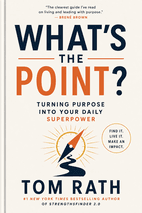
These quotes from Tom Rath's book land like a punch to the gut. They strip away the comfortable stories we tell ourselves about our careers and lives. Each line forces you to ask hard questions about whether you are truly living or just going through the motions. The book's power comes from its refusal to let you stay stuck in old patterns.
The reason these quotes stick with you is that they combine raw personal confession with universal truths. Rath does not offer easy answers. Instead, he hands you a mirror and says look closely. Every sentence is a seed for change, planted deep in the soil of everyday experience. You will find yourself returning to these lines long after you first read them.
Top Quotes from What's the Point?
“Then I turned 40 — the age I wasn't supposed to reach. And standing in that moment, I had a brutal realization: I'd spent decades living someone else's definition of success.”
The author reaches the age doctors said he wouldn't survive, leading to a sudden awakening about his life's direction.
This line captures the shock of realizing we've been chasing others' expectations instead of our own values. It resonates because many people can relate to the moment of questioning whether their achievements are truly meaningful.
“We're dying in installments, one meaningless day at a time, and we don’t even realize it because everyone around us is doing the same thing.”
The author describes how people waste their lives by never questioning the purpose of their daily activities.
The metaphor of 'dying in installments' is stark and unforgettable, making the reader confront the cost of unexamined routines. It resonates because it names a pervasive but often unspoken experience of modern life.
“The question isn't whether you have enough time. It’s whether you're done wasting it.”
The author concludes his challenge to the reader, urging an immediate decision about how to live.
This short, punchy statement reframes the problem from scarcity of time to personal choice and responsibility. It resonates because it empowers the reader to stop making excuses and take action now.
“Stop asking what you're passionate about, and start asking who you can help. That shift changes everything.”
The author gives direct advice to those feeling lost in their careers.
The simple pivot from self-centered to other-centered thinking is immediately implementable and promises a transformative perspective.
“If you're just punching a clock, waiting for 5 p.m., living for the weekend, you're not only wasting time; you're wasting your life in eight-hour increments.”
The author criticizes a mindset of mere survival at work.
The stark arithmetic of wasted hours creates a visceral sense of urgency, challenging readers to evaluate how they spend the bulk of their waking lives.
“The more time you spend chasing happiness, the less likely you are to find it.”
The author states this as an uncomfortable truth learned from studying happiness.
It succinctly captures the central paradox of the chapter, challenging the reader's instinctive pursuit of happiness.
“When you try to be like someone else, you become no one.”
Author's insight on the dangers of imitation.
A powerfully concise warning that resonates because it states a universal truth: authenticity is the only path to being seen and valued as an individual.
Themes Behind the Quotes
A core theme is that purpose is not something you discover through introspection; it is built through daily acts of helping others. The book argues that chasing happiness or passion often leads to emptiness, while a focus on serving people creates lasting meaning. This outward shift is the foundation for a worthwhile life.
Another major theme is the danger of living by default. Many people drift through life following inherited expectations or comparing themselves to others. The quotes warn against status seeking and trying to replicate someone else's path. They emphasize that struggle and friction are essential for growth, and that your unique combination of traits is your most valuable asset.
Quotes by Chapter
Introduction: What’s the Point?—Your Daily Wake-Up Call
“Purpose isn’t some mountain to climb or treasure to find. It’s fuel for today, right now, at this moment.”
The author redefines purpose as something immediate rather than a grand, distant goal.
This line relieves the anxiety of needing to find a lifelong mission by making purpose accessible in the present. It resonates because it shifts focus from overwhelming quests to actionable clarity in daily life.
Chapter 1: Why Passion Is Overrated
“Passion is cotton candy — sweet, enticing, and gone the moment reality hits.”
The author uses this metaphor to describe why passion is an unreliable foundation for a career.
The vivid and relatable imagery instantly captures how passion fades when faced with difficulty, making the critique memorable.
“You don't find your purpose wandering through some mystical journey of self-discovery. You build it, brick by brick, through the daily act of making things better for other people.”
The author contrasts the passive search for passion with an active construction of purpose.
This line reframes purpose as something actionable and within anyone's control, empowering readers to stop waiting and start contributing.
Chapter 2: Your Childhood Dreams Are Anchors, Not Wings
“It took years for me to realize my earliest career aspirations weren't wings helping me soar; they were anchors holding me in place.”
The author reflects on his own experience after being diagnosed with a genetic condition.
This line vividly captures the paradox of having a reason to break free yet still being trapped by inherited expectations, making it deeply relatable.
“If someone with every reason to forge their own path couldn't escape this trap, what chance do you have?”
The author challenges the reader after describing his own struggle.
It's a direct, provocative challenge that forces self-reflection on whether we have really chosen our own paths.
“One hundred and thirty-six times more likely. Not because you're genetically predisposed to hanging drywall. Not because you discovered a passion for it. But because that’s what you saw growing up, and your brain literally cannot imagine alternatives it has never witnessed.”
The author presents staggering statistics about occupational inheritance.
The repetition and specificity of '136 times more likely' makes the invisible influence of parental paths shockingly tangible.
“Your childhood dreams were never really yours. They were an amalgamation of parental expectations, social influences, and limited exposure to what's possible.”
The author discusses the origins of childhood dreams.
This succinctly dismantles the notion that our earliest dreams are pure self-expression, revealing them as products of external forces.
Chapter 3: Superpowers You Fail to See
“It is impossible to aspire to a career that your brain has never seen as a possibility.”
The author explains how the exposure gap constrains career choices.
This line crystallizes a profound psychological truth—that aspiration is bounded by experience—and forces readers to recognize how unseen opportunities limit their potential.
“The most successful people I’ve studied share one fundamental habit: they strategically diversify their exposure to expand their sense of possibility.”
The author contrasts passive blindness with the deliberate practice of high achievers.
This actionable insight empowers readers to take control of their own vision, showing that success is less about innate talent and more about intentionally seeking new perspectives.
“Every person you help see a new possibility is a potential life transformed, a contribution to the world that might otherwise never exist.”
The author concludes the chapter by urging readers to expand others' horizons, especially for children and colleagues.
It reframes helping others as a moral imperative and a multiplier of human potential, leaving readers with a sense of responsibility and hope.
Chapter 4: The Search for Happiness is a Decoy
“People with the highest levels of wellbeing aren't those who focus on improving their own happiness. They are those who focus on improving other people's happiness.”
The author contrasts the outcomes of happiness hunters with those who aim their efforts outward.
This quote flips the self-help narrative, offering a compelling, evidence-based reframe that prioritizes contribution over self-focus.
“But I would argue that it is the pursuit of meaning, not happiness, that makes life worth living.”
The author critiques the Declaration of Independence's emphasis on the pursuit of happiness.
It delivers a clear, memorable thesis that reorients the reader from a superficial goal to a deeper, more fulfilling one.
“A life without struggle is a life without growth, without depth, without the very friction that creates meaning.”
The author explains why a permanent vacation from the human condition is undesirable.
It reframes struggle as essential and beautiful, giving readers permission to embrace life's challenges as sources of meaning.
Chapter 5: Aim Your Strengths Outward
“The strengths had become a mirror rather than a window.”
The author describes Karen's inward focus on her own strengths.
This metaphor succinctly captures the trap of using strengths for self-reflection instead of outward service, making it memorable and easy to recall.
“The most successful people I’ve studied don't lead with their strengths; they lead with curiosity about others’ needs.”
The author contrasts strength-led self-promotion with need-led curiosity.
It offers a clear, actionable principle that flips the typical self-help narrative, resonating with anyone seeking genuine impact over recognition.
“If discovering your strengths leads you to focus more on yourself, you've missed the entire point.”
The author warns against the unintended consequence of self-focused strengths discovery.
This blunt, direct statement cuts to the heart of the chapter's message, making it a powerful reminder to redirect focus outward.
“The best path to self-improvement might be to stop focusing on self-improvement.”
The author concludes a discussion on neuroplasticity and outward focus.
The ironic twist challenges conventional self-help wisdom and sticks in the reader's mind as a counterintuitive but profound insight.
Chapter 6: When Gaining Status Sinks Careers
“Status-seeking becomes career quicksand: the harder you struggle for validation, the deeper you sink into work that feels meaningless.”
The author describes how comparing ourselves to others leads to destructive career decisions.
The metaphor of quicksand powerfully conveys how chasing status traps you in a cycle that undermines purpose and fulfillment.
“You're comparing your complete reality, with all its struggles and setbacks, to everyone else's highlight reel.”
The author explains the subtle distortion caused by social media and career comparisons.
It articulates a universal psychological trap in a memorable, relatable way, highlighting the unfairness of self-comparison.
“Your most valuable contributions will likely emerge from your unique combination of skills, perspectives, and experiences, not from trying to duplicate someone else’s path.”
The author advises breaking free from comparison thinking to focus on authentic impact.
It offers an empowering and liberating reframe, encouraging readers to embrace their individuality rather than follow others' blueprints.
Chapter 7: Never Go With the Flow
“Most people, without realizing it, float downstream, occasionally paddling to avoid obvious rocks but fundamentally surrendering to wherever the water takes them.”
Author's general observation about passive career behavior.
The vivid water metaphor perfectly captures how thoughtlessly most people drift through their careers, making the critique both memorable and instantly relatable.
“I've spent twenty years perfecting someone else's vision.”
A Fortune 500 executive reflecting on his accidental career path.
This single sentence distills the haunting regret of achieving success on someone else's terms, a wake-up call for anyone who has never questioned whose goals they are pursuing.
“Your most valuable career asset isn't your experience, education, or network. It's your differentiation.”
From the section on aggressive authenticity.
This reframes career value in a stark, memorable statement that challenges conventional wisdom and gives readers a clear, actionable focus for their professional growth.