What's the Point? — Interactive Mindmaps

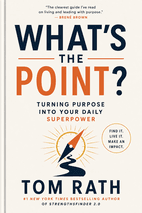
What's the Point? by Tom Rath Book Cover

by Tom Rath

Tom Rath's What's the Point? dismantles conventional success myths by arguing that genuine purpose comes from outward contribution, not passion or happiness. Written for anyone feeling stuck or unfulfilled, it provides a practical framework for filtering decisions through the daily question of what truly matters.

On Insta.page you also get an Apply This Book tool that lets you combine insights from up to 3 books to solve your specific situation.

Chapter mindmaps

Free preview: chapters 1–4 are fully interactive. Click any node to expand or collapse. Subscribe to unlock the rest.

Chapter 1: Introduction: What’s the Point?—Your Daily Wake-Up Call

Key concepts: Introduction: What’s the Point?—Your Daily Wake-Up Call

1. Introduction: What’s the Point?—Your Daily Wake-Up Call

The Wake-Up Call: A Diagnosis That Brought Clarity

  • Genetic cancer diagnosis gave author an expiration date at 40
  • He built success chasing others' definitions of achievement
  • Turning 40 revealed he lived by expectation, not conviction
  • The question 'What’s the point?' became his daily compass

The Real Problem: Dying in Installments

  • Most people are busy being busy on autopilot
  • Tasks completed today won't matter next week or year
  • We treat 57,600 seconds daily as if infinite
  • Tragedy is never learning to ask the right question

Purpose Redefined: A Daily Check-In, Not a Grand Quest

  • Purpose is knowing why you're doing what you do today
  • It's fuel for the current moment, not a lifetime mission
  • Be willing to change direction when answer is 'I don't know'
  • Pay attention to your actual life, not a distant dream

A Necessary Warning: Provocative, Not Prescriptive

  • Author is not a guru—just someone who paid attention
  • Ideas may spark or fizzle; lean into discomfort
  • Resistance often points to the growth you need most
  • Book challenges everything about work, success, and life

Key Takeaways: Start Now with What You're Doing Next

  • Stop waiting for a crisis to ask the hard questions
  • Purpose is a daily check-in: 'Why am I doing this?'
  • Consciously question each habit and expectation
  • Discomfort is a signal to redirect your life

Chapter 2: Chapter 1: Why Passion Is Overrated

Key concepts: Chapter 1: Why Passion Is Overrated

2. Chapter 1: Why Passion Is Overrated

The Passion Mirage

  • Passion is unreliable and vanishes when work gets hard
  • 9-year study: purpose predicts earnings, not passion
  • Fulfillment follows competence, not the other way around
  • Fixed mindset makes people quit at first challenge

The Contribution Path

  • Jason found meaning by asking 'How can I help?'
  • Purpose emerged from visible impact on real people
  • Seeing faces of those helped drives motivation
  • Contribution beats chasing pre-existing dreams

Redefining Work

  • Shift from 'What do you do?' to 'Who do you help?'
  • Work-self vs real-self split erodes self-worth
  • Résumé obituary: dry titles miss true contribution
  • You are more than a collection of skills to consume

The Faces You Ignore

  • Seeing beneficiaries skyrockets motivation and performance
  • Most people already help others but miss the connection
  • Ask: 'Who benefits from my work?' explicitly
  • Every job can improve lives when you see the impact

Don't Wait for Permission

  • Nobody hands you purpose—you build it daily
  • Connect daily tasks to someone else's better day
  • Meaning is manufactured in daily choices
  • Stop chasing passion; start building what the world needs

Chapter 3: Chapter 2: Your Childhood Dreams Are Anchors, Not Wings

Key concepts: Chapter 2: Your Childhood Dreams Are Anchors, Not Wings

3. Chapter 2: Your Childhood Dreams Are Anchors, Not Wings

Childhood Dreams as Anchors

  • Dreams formed with child's limited worldview
  • Unrealistic goals pull at adult decisions
  • Anchors holding you, not wings lifting you

Inherited Expectations Trap

  • Sons 2.7x more likely to share father's occupation
  • Brain cannot imagine alternatives never witnessed
  • Parental expectations stuck in 1920s economy

Ditch Those Childhood Dreams

  • Dreams are amalgamation of parental pressures
  • Parents live vicariously through child's achievement
  • Need exposure to possibilities parents never imagined

When Success Feels Like Prison

  • Living parents' dreams and calling them our own
  • Lawyer example: seven years fulfilling father's expectation
  • Letting go of who you should be reveals who you are

Career Caste System

  • Familiarity trap shapes entire professions
  • Doctors raise doctors, service workers raise service workers
  • Homogeneity from exposure, not ability

Let Your Dreams Die Already

  • Aspirations should change as you do
  • Unmet childhood dreams cause early unhappiness
  • Ask kids what they want now, not when grown up

Liberation Through Authenticity

  • Liberation is creation, not destruction
  • Makes space for dreams reflecting who you've become
  • Deepened relationships through authenticity

Chapter 4: Chapter 3: Superpowers You Fail to See

Key concepts: Chapter 3: Superpowers You Fail to See

4. Chapter 3: Superpowers You Fail to See

The Tragedy of Unseen Potential

  • Neural pathways wither from disuse
  • Most end careers without finding their best field
  • Author discovered investing talent too late
  • Health crisis revealed potential in biomedical research

You Can't Be What You Can't See

  • Brain can't imagine unseen possibilities
  • Children eliminate careers by age six
  • Gender stereotypes narrow options early
  • Limited exposure constrains potential

The Exposure Gap

  • 40% of students unclear about career expectations
  • 49% say education didn't prepare them for life
  • Only 45% visited a workplace by age 15-16
  • 75% of US graduates feel unprepared

Actively Choosing Blindness

  • Confirmation bias filters out alternatives
  • Social media algorithms narrow vision
  • Friends and news sources reinforce views
  • Hidden options remain forever unselected

Poverty of Exposure

  • Affects all socioeconomic groups
  • Even privileged live in homogeneous circles
  • Sara Blakely's ignorance of limits enabled innovation
  • Lack of exposure can be an advantage

Start Your Exposure Revolution

  • Diversify inputs beyond your demographic
  • Read outside your industry regularly
  • Require cross-disciplinary perspectives
  • Blindness prevention for accelerating change

Breaking the Generational Cycle

  • Children see only 2% of career options
  • Need exposure to 5-10 careers minimum
  • 50 jobs needed to grasp half the options
  • Parents must actively broaden horizons

Continue exploring What's the Point?