What to Make of a Life Quotes
by Jim Collins
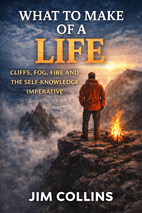
What to Make of a Life is packed with lines that stick with you long after you close the book. You will find reflections on purpose, resilience, and the quiet joy of doing what you love. Some quotes offer hard won wisdom from careers and adventures. Others capture simple moments of clarity that feel universal. What makes this book so quotable is how it blends personal stories with big ideas, all written in a voice that feels honest and grounded. These are not just clever words. They are truths earned through living, and they land like good advice from a trusted friend.
Top Quotes from What to Make of a Life
“What to make of a life? That is the question.”
The author poses the central existential question that drives the entire book.
Succinctly encapsulates the universal inquiry about purpose and meaning, immediately drawing readers into the reflective core of the work.
“Life is not linear; it is unfolding, layered, and organic.”
The author explains that the book's structure mirrors the non-linear nature of life.
Rejects oversimplified narratives and offers a liberating perspective that life's unpredictability and complexity are normal and meaningful.
“Instead of work being a means to money, money became a means to work.”
The author explains the core concept of the chapter.
This line succinctly captures the chapter's central philosophy, flipping the conventional relationship between money and meaningful work.
“The preparation was the cake, the Olympics only the icing.”
The author reflecting on Albright's years of training versus her gold medal moment.
This metaphor vividly emphasizes that the daily process of doing what you love is far more important than the rare peak moments.
“Do all things not for glory, but for joy.”
Tenley Albright's lesson to her children, reflecting her lifelong philosophy.
This succinctly encapsulates the chapter's core message: sustainable inner fire comes from joy, not external recognition.
“Courage, the saying goes, is not the absence of fear but the ability to act in the presence of fear.”
The author's reflection on Graham's leadership amidst fear and anxiety.
This is a classic, powerful redefinition of courage that resonates universally, especially in the context of Graham's fearful yet determined leadership.
“When lost in the fog, simply take what looks like the next best step. Not a big step, but a small step.”
The author describing the pattern of simplex stepping when lost in fog.
It offers a simple, actionable mantra for navigating uncertainty without needing a full plan.
Themes Behind the Quotes
A central theme is that life is not a straight path but something layered and unpredictable. Many quotes highlight the importance of defining success on your own terms, whether through service, mastery, or pure love for the work itself. Another recurring idea is that setbacks and difficult periods, called cliffs in the book, can reveal hidden strengths and reshape our understanding of ourselves. The book also emphasizes the power of small, steady actions over grand gestures, especially when you feel lost or afraid. Finally, there is a strong current of letting go of rigid expectations about purpose. Instead of searching for one singular calling, the book suggests that meaning emerges from how you engage with the moments and people in front of you.
Quotes by Chapter
1. A Life Transformed
“I knew once and for all, “There will never be a father there.””
The author reflects on boarding the bus back from visiting his father in New Mexico, realizing he would never have a fatherly relationship.
This line captures the definitive moment of loss and acceptance of a painful truth, resonating with anyone who has faced a broken or absent parental bond.
“The sign of good research is that you end up in places you never expected.”
The author reflects on the transformative power of his research process.
Affirms the value of open-minded inquiry and the insight that true discovery challenges preconceptions, inspiring curiosity and humility.
2. One Big Thing
“In the interim I was not invited to give lectures or seminars, except on rare occasions, or to serve on committees or panels, or to perform other scientists’ duties. Instead of causing personal difficulties, this long interval proved to be a delight.”
From McClintock's Nobel Banquet speech, reflecting on the decades when her work was ignored.
It demonstrates how perceived setbacks can be reframed as opportunities for uninterrupted passion and freedom.
“It might seem unfair, however, to reward a person for having so much pleasure over the years.”
McClintock's response to the Nobel Prize, emphasizing her intrinsic joy in the work.
It beautifully illustrates the idea that the greatest reward is the work itself, not external recognition.
“I've already received the highest award I'll ever receive, no matter how long I live, no matter how many more jobs I may have, and that has been the privilege and the responsibility of serving very proudly in the United States Navy.”
Grace Hopper, when an interviewer noted that she could have become wealthy as an entrepreneur.
This line encapsulates Hopper's prioritization of service over wealth, showing a profound sense of purpose and pride in her naval career.
“I've had a wonderful time. I've had tremendous opportunities. I've had tremendous luck. Just think, if the Navy had not ordered me to that first computer, I might not have had anything of what I have today.”
Hopper reflecting on her life in an interview late in her life.
It highlights her gratitude and the serendipity that shaped her career, reminding readers to appreciate chance and opportunity.
3. A Constellation of Encodings
“Life worked best for the people in our study when they deployed themselves into activities that aligned with a big bright set of their encodings.”
The author summarizes a key finding from the study.
It succinctly captures the core principle that alignment with one's innate encodings leads to fulfillment and success.
“Even the most exceptional people can get sidetracked by going out of frame. They can also be revitalized by coming back in frame.”
The author reflects on the possibility of deviation and recovery.
This line offers hope and realism, reminding readers that even the best can stray but can also return to their true path.
“If you're in a situation where you might die at any moment, and you have to perform with precision to lower the odds of getting killed, and where making a single mistake might result in your instant death, getting anxious about that fact only increases the chances that you will make a mistake and die.”
The author explains John Glenn's calm under extreme danger.
It presents a paradoxical but rational insight about managing anxiety in high-stakes situations, which many find compelling.
“I served 23 years in the United States Marine Corps. I served through two wars. I flew 149 missions. My plane was hit by anti-aircraft fire on 12 different occasions. I was in the space program. It wasn’t my checkbook; it was my life on the line.”
John Glenn responds to opponent Howard Metzenbaum's criticism that he never held a real job during a Senate debate.
This impassioned defense of military and public service transforms a political attack into a powerful testament to sacrifice and duty, making it an unforgettable rebuttal.
4. Flipping the Arrow of Money
“If you want to play for the Tuareg you've got to get there. You've got to do it in order to have the experience.”
Robert Plant describes the effort required to perform at the Festival in the Desert in Timbuktu.
It reveals Plant's deep commitment to musical adventure, showing that the journey itself is essential to the reward.
“My daughter's dream is to be an Olympic champion, and that would be my wish for her, to make her happy, to at least try... . Can you, with all your money, can you give me my good health back and make me better?”
Carol Heiss's mother, terminally ill, responds to a promoter offering money for Heiss to turn professional.
This line powerfully contrasts the value of a dream against material wealth, showing a mother's selfless love and unwavering support for her daughter's ambition, even in the face of her own mortality.
“When work is defined as the pursuit of excellence in a hedgehog, then doing one’s work becomes not just a means to an end but an end in itself.”
The author's concluding reflection on the nature of meaningful work.
It reframes the purpose of work from a mere income source to a fulfilling activity, inspiring readers to seek work that is intrinsically rewarding.
5. Focus the Fire
“I thought it was in my head,” said Albright, “but I suddenly realized that the audience was humming the music. I was close to the boards and I could hear them. That was the most uplifting thing. It was such an amazing feeling of connection.”
Tenley Albright describing the moment the audience hummed along during her Olympic routine.
This captures the rare and profound connection between performer and audience, a transcendent highlight that fuels lifelong memory.
“You do it because you love what you are doing.”
Tenley Albright explaining her intrinsic motivation for skating.
A simple, timeless statement about the power of passion over external rewards, central to the chapter's theme.
7. Fog
“She'd not only won a world championship, she'd also won something even more important: the self-respect that comes from knowing deep down that she could not have run one step faster.”
The author reflects on Joanne's Ironman victory and the deeper meaning of her achievement.
It redefines winning not as an external prize but as an internal measure of effort and integrity, a universally resonant truth.
“Cliffs, as terrible as they can be to live through, can also reveal encodings you never knew you had.”
The author's reflection after describing how Cardiss Collins discovered unexpected strengths in Congress.
This offers a hopeful reframing of life's hardest moments, suggesting they can uncover hidden capabilities and new paths.
“Jim Allen, what have you done to me? You've gone off and left me with the whole damned State of Alabama going wild crazy with grief over you, and I don’t know what in the hell to do about it.”
Maryon Pittman Allen, alone in a closet, screaming into her deceased husband's suit after his sudden death.
This heartbreaking, raw cry captures the disorientation and overwhelming pressure of sudden loss and forced decision-making.
“If your life is knocked sideways or torn asunder by a cliff, and especially if that cliff comes with mourning a loss and/or feeling the deep pain of grief, you can find yourself lost in thick, murky fog for a very long time.”
The author describes the experience of being in the fog after a major life cliff.
This line vividly captures the disorientation and prolonged struggle that follows a devastating loss, validating the difficulty of recovery.
8. Simplex Stepping
“Go ahead, go ahead, go ahead. Let's go. Let’s publish.”
Katharine Graham's decisive response when asked whether to publish the Pentagon Papers.
This line captures the moment of decisive action after years of cautious stepping, showing her emerging clarity and fierce resolve.
“Raising the bar, gently but relentlessly—now that is a powerful leadership encoding.”
Bob Woodward's description of Graham's managerial style, quoted by the author.
This phrase succinctly captures a leadership principle of combining high standards with persistent encouragement, making it memorable and applicable.
9. The Roulette Wheel of Life
“I don’t know how that guitar got there, and I don’t know where it went... . But that guitar was like an intervention.”
Jimmy Page recalls the mysterious guitar left in his childhood home that launched his musical journey.
This line captures the serendipitous luck that sparked his legendary career and the sense of fate that pervades the chapter's exploration of chance.
“There is no one single purpose to find, no one single thing you are beautifully made for.”
The author summarizes a key insight about the multitude of potential life paths available to each person.
It reframes the existential search for a single purpose into a liberating view of multiple possibilities, reducing anxiety about finding 'the one'.