What to Make of a Life Key Takeaways
by Collins, Jim
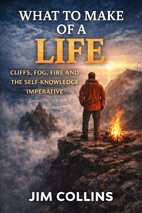
5 Main Takeaways from What to Make of a Life
Embrace life's disruptive cliffs as opportunities for reinvention.
Life is not a straight line but a series of sudden fractures and confusing fog, as shown in studies of resilience. By understanding how others navigate these challenges, you can find patterns to discover meaningful paths where your ability, passion, and economic reality align.
Align your unique encoding with economic reality to fuel your passion.
Your 'One Big Thing' emerges at the intersection of natural ability, passion, and economic necessity. Creative funding strategies, like the 12 economic streams, can support your pursuit while avoiding the Curse of Competence that pulls you away from your true calling.
Sustainable focus springs from love, not sheer discipline alone.
Enduring motivation comes from work you are encoded for and genuinely love, creating a self-sustaining cycle of effort. This intrinsic drive allows for focused achievement without eliminating other passions or relationships, as seen in the contrast between monomaniacal and integrated approaches.
Navigate fog with small steps and sustain growth through exploration and return.
When lost in uncertainty, use simplex stepping—taking logical small actions to build momentum. For long-term vitality, adopt the 'Extend Out/Circle Back' loop, periodically exploring new challenges while returning to core strengths to defy pigeonholing and maintain excellence.
Choose outward responsibilities to ignite purpose and achieve late-life excellence.
Focusing on responsibilities beyond yourself provides sustained motivation that individual achievement cannot. This outward focus, combined with self-knowledge, fuels an un-diminishing inner fire, enabling great work and profound satisfaction even in later years, as highlighted in studies of lifelong contributors.
Executive Analysis
The book's central thesis is that a meaningful life is not linear but forged through navigating inevitable disruptions—'cliffs' and 'fog'—by aligning innate passions with practical economic pathways. It argues that self-knowledge, iterative action, and dynamic cycles of exploration and return allow individuals to discover their 'One Big Thing' and sustain it with intrinsic motivation, regardless of age or circumstance.
This work matters because it provides evidence-based frameworks for personal and professional renewal, drawing from diverse biographical research. It transcends typical self-help by offering actionable tools to transform fractures into fuel for a purpose-driven life, positioning itself as a vital resource in the genres of leadership, psychology, and lifelong development.
Chapter-by-Chapter Key Takeaways
1. A Life Transformed (Chapter 1)
The urgent question "What to make of a life?" often comes from personal fractures, or "cliffs."
Studying how different people handle similar cliffs reveals powerful, useful patterns about resilience and starting over.
Life is not a straight line. It is often broken up by disruptive cliffs and confusing fog.
Meaningful paths are found where your natural ability, economic reality, and passion meet.
The potential for growth, creativity, and a strong sense of purpose can last—and even grow—late in life.
Understanding other people's journeys can deeply change your own life.
Try this: Reflect on past life fractures to identify your resilience patterns and where your ability, passion, and economic reality intersect.
2. One Big Thing (Chapter 2)
A meaningful pursuit, or "One Big Thing," rests on three elements: your unique **enc
Try this: Define your 'One Big Thing' by assessing the trio of your unique encoding, deep passion, and viable economic model.
4. Flipping the Arrow of Money (Chapter 4)
Exceptional achievement can be funded through multiple, often creative economic pathways, not just a direct salary.
The research identifies 12 economic streams that individuals combine to support their core pursuits.
A matched-pair analysis shows that similar greatness can emerge from radically different economic starting points. The key is maximizing the "luck" you are given.
Beware the Curse of Competence Doom Loop, where becoming good at something lucrative but misaligned can pull you permanently away from your true calling.
The ultimate reward for aligning your work with your inner fire is the profound satisfaction of doing the work itself. The goal is to flip the arrow of money to enable that work to continue.
Try this: Audit your income streams to ensure they enable, not hinder, your core pursuit and avoid the Curse of Competence Doom Loop.
5. Focus the Fire (Chapter 5)
There is no single "right" way to channel your fire. The dedicated, monomaniacal focus of an Alice Paul is not inherently superior to the integrated, multi-faceted focus of a Lucy Burns. A meaningful life can take many shapes.
Focus does not require the complete elimination of other passions. Most people who achieve great focus in one area still cultivate invigorating side passions and value deep personal relationships, which can fuel rather than detract from their primary mission.
Sustained motivation springs from love, not just discipline. The most powerful and enduring drive comes from finding work you are encoded for and genuinely love to do. This intrinsic love creates a self-sustaining cycle of effort and improvement.
Try this: Cultivate focus by pursuing work you love, allowing side passions to energize rather than fragment your primary mission.
Next chapter: “7. Fog” is locked
Keep learning from What to Make of a Life — and unlock all 600+ book summaries with audio, mindmaps and AI Q&A.
$0.00 due today · 7 days free, then $89.99/year ($7.49/mo) · Cancel anytime before day 7
plus sales tax where applicable