We the Women Quotes
by Norah O'Donnell
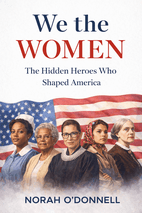
This page gathers the most striking lines from We the Women by Norah O'Donnell. You will find quotes that range from the Revolutionary era to the suffrage movement, spoken by women who shaped American history. Some are fiery demands for justice, others are quiet acts of defiance. What makes this book quotable is how each line carries the weight of a life lived in the margins of the official record.
These words are not just history. They are reminders that the fight for equality has always been personal and urgent. Whether written in secret letters or spoken at public hearings, the quotes in this collection reveal the courage, wit, and determination of women who refused to be silent. They are meant to be shared, remembered, and passed on.
Top Quotes from We the Women
“We ask justice, we ask equality, we ask that all the civil and political rights that belong to citizens of the United States, be guaranteed to us and our daughters forever.”
Susan B. Anthony demanding women's rights from the platform outside Independence Hall on July 4, 1876.
It captures the suffragists' demand for full citizenship and the promise of equality for future generations. The repetition of 'we ask' and the inclusive 'our daughters forever' make it a timeless call.
“Women are the real architects of society.”
Harriet Beecher Stowe's famous line, quoted by the author.
It succinctly asserts women's foundational role in building society. The metaphor of architects elevates women's contributions beyond traditional domestic spheres.
“Women have bled for their country during every war in our nation’s history. Some women took a bullet for America when they didn’t even have the right to vote.”
The author reflects on women's military sacrifices despite being denied the vote.
It highlights the profound irony of women fighting and dying for a country that denied them basic rights. The visceral image of taking a bullet underscores their loyalty and the injustice.
“Any time while I was a slave,” she reportedly later said, “if one minute's freedom had been offered to me, and I had been told I must die at the end of that minute, I would have taken it—just to stand one minute on God's earth a free woman.”
Elizabeth Freeman (formerly Bett) reportedly said this about her yearning for freedom after hearing the Massachusetts Constitution.
This line captures the profound desperation and depth of her desire for freedom, illustrating that even a single minute of liberty was worth dying for. It resonates because it transforms abstract ideals into a visceral, human longing.
“Sir,” she said, “I heard that paper read yesterday that says ‘all men are born equal—&, that every man has a right to freedom’—I am not a dumb Critter, wont the law give me my freedom?”
Elizabeth Freeman said this to attorney Theodore Sedgwick when she walked miles to ask him to represent her in court.
This quote shows Elizabeth using the language of the revolution to assert her own humanity and demand legal recognition. Its raw challenge to hypocrisy and her clever, defiant tone make it unforgettable.
“I ask no favors for my sex. I surrender not our claim to equality. All I ask of our brethren, is that they will take their feet from off our necks.”
Sarah Grimké declared this in her Letters on the Equality of the Sexes, responding to critics of women's public speaking.
The vivid imagery of oppression and the defiant demand for equal standing make this a timeless rallying cry for gender justice, later invoked by Justice Ruth Bader Ginsburg.
“Are we aliens, because we are women? Are we bereft of citizenship, because we are the mothers, wives, and daughters of a mighty people? Have women no country...no partnership in a nation’s guilt and shame?”
Angelina Grimké asked these questions in 1838 while addressing the Massachusetts state legislature, the first woman to do so.
The rhetorical force challenges the exclusion of women from political life, asserting their rightful place in the nation's civic identity.
Themes Behind the Quotes
A central theme running through these quotes is the relentless demand for full citizenship and equality. Women across centuries insisted that the promises of the Declaration apply to everyone, not just a select few. They challenged laws, customs, and leaders who tried to confine them to a limited sphere. Another theme is the hidden labor and sacrifice behind America's founding and progress. The quotes highlight women who risked their lives, fought in wars, and built the nation in ways that were often erased from textbooks.
The interplay of race and gender also emerges strongly. Many of the quoted voices come from enslaved women, Black poets, and activists who faced compounded oppression. Their words expose the hypocrisy of a country that celebrated liberty while denying it to so many. Finally, there is a thread of resilience and creativity. Women used writing, sculpture, and everyday acts of resistance to claim their place in history, refusing to be forgotten.
Quotes by Chapter
Introduction
“As you'll learn in this book, women have never given up the fight to realize a more perfect union.”
The author introducing the book's theme of women's persistent struggle.
It encapsulates the unwavering determination of women throughout American history. The phrase 'never given up the fight' emphasizes resilience and the ongoing pursuit of a more perfect union.
Chapter 1: Mary Katherine Goddard: The Printer
“How ironic that Mary Katherine's work was meant to be remembered forever, yet she herself has largely been forgotten.”
Narrator reflecting on the Goddard Broadside's purpose and Mary Katherine Goddard's historical obscurity.
This line encapsulates the central tragedy of Goddard's story: her contribution to preserving the Declaration contrasts sharply with her own erasure from history, resonating with anyone who values recognition for unsung contributors.
“Including her full name opened her up to the risk of being imprisoned by the British.”
Explanation of why Mary Katherine Goddard used her full name on the Goddard Broadside rather than initials.
It highlights her personal courage and defiance, showing that signing her name was a deliberate act of bravery during a war when signers faced real danger.
“She wrote, “What think ye of Congress now? That day... evidenced that Americans would rather die than live [as] slaves!””
Mary Katherine Goddard's editorial after the battles of Lexington and Concord in 1775.
This fiery declaration captures her passionate patriotism and her role as a wartime journalist, inspiring readers with the revolutionary spirit of resistance.
“Postmaster General Samuel Osgood claimed that in the role, “more travelling might be necessary than a Woman could undertake.””
The stated reason for Mary Katherine Goddard's dismissal as postmaster in 1789, as recounted in the chapter.
This quote exposes the sexist double standard that ended her career, making readers angry on her behalf and highlighting a barrier women faced then—and still face today.
Chapter 2: Phillis Wheatley: The Poet
“Remember Christians, Negros, black as Cain, May be refin’d, and join th’ angelic train.”
Phillis Wheatley's poem "On Being Brought from Africa to America" uses Christian imagery to rebuke enslavers who view Black people with scorn.
This couplet boldly challenges racial prejudice through the language of faith, insisting on the spiritual equality of Black people and their inclusion in salvation.
“Whenever I feel unable to write, I remember that Thomas Jefferson singled out young black poetess Phillis Wheatley with shallow disdain.... Then I crack my knuckles and get to work.”
Amanda Gorman, the first National Youth Poet Laureate, describes how Wheatley's treatment by Jefferson inspires her own writing.
This quote shows the enduring power of Wheatley's legacy, transforming historical dismissal into a source of creative resilience and defiance.
“She believed that freedom was an intrinsic human right, clearly enshrined in the Declaration of Independence, but not in practice in the new nation.”
The author summarizes Phillis Wheatley's hope that the Revolution would bring freedom for all, not just white colonists.
This line captures the central contradiction of America's founding—proclaiming liberty while maintaining slavery—and Wheatley's role in exposing that hypocrisy.
“By writing this poem and others like it over the next eight years, Wheatley as much as Patrick Henry or any other American patriot was risking her liberty and her life.”
Scholar James G. Basker describes the danger Phillis Wheatley faced by publishing patriotic poems as a Black woman.
It reframes Wheatley's contribution as an act of profound courage, equal to that of better-known revolutionaries, and highlights the personal stakes she bore.
Chapter 3: Mercy Otis Warren: The Intellectual
“The origin of all power is in the people, and that they have an incontestable right to check the creatures of their own creation.”
Mercy Otis Warren wrote this in her 1788 pamphlet 'Observations on the New Constitution,' arguing against ratification without a Bill of Rights.
This statement is a timeless assertion of popular sovereignty and the people's right to hold government accountable, directly influencing the push for the Bill of Rights.
“For Mercy, principles always came before personalities, even when it cost her dearly.”
This is the author's reflection on Mercy's refusal to back down from her criticisms of John Adams, which ended their longtime friendship.
It highlights her unwavering integrity and courage, making her a model of principled political engagement even at great personal cost.
Chapter 4: Elizabeth Ellet: The Historian
“It is because of her meticulous work that we know the hopes, fears, and challenges faced by Revolutionary-era women.”
The author describes Elizabeth Ellet's legacy.
This sentence underscores the crucial role of her research in preserving the experiences of Revolutionary-era women.
“These “patriotic mothers,” Elizabeth eloquently wrote, “nursed the infancy of freedom.””
Elizabeth's own words about the women of the American Revolution.
The metaphor 'nursed the infancy of freedom' powerfully redefines women's foundational contribution to the nation.
“The apparent dearth of information was at first almost disheartening.”
Elizabeth Ellet in the preface to her book, acknowledging the difficulty of her research.
This line captures the challenge of recovering women's history and the perseverance required to overcome it.
“A woman's sphere, on the other hand, is secluded, and in very few instances does her personal history, even though she may fill a conspicuous position, afford sufficient incident to; throw a strong light upon her character.”
Elizabeth Ellet explaining why women's history is harder to document than men's.
It highlights the systemic erasure of women from the historical record and the need for dedicated recovery work.
Chapter 5: Elizabeth Freeman: The Freedom Seeker
“She never covered it, and when visitors to the house asked her what happened, she said simply, “Ask Madam.””
Describing how Elizabeth displayed the scar from a beating by her enslaver Hannah Ashley.
This brief, powerful directive exposes her enslaver's cruelty without elaboration, forcing others to confront the truth. It epitomizes quiet resistance and the refusal to hide injustice.
“She was born a slave and remained a slave for nearly thirty years; she could neither read nor write, yet in her own sphere she had no superior or equal.”
This is part of the epitaph on Elizabeth Freeman's gravestone, written by Catharine Sedgwick.
It honors Elizabeth's extraordinary character and accomplishments despite her lack of formal education and early enslavement. The line elevates her legacy, reminding readers that true worth transcends literacy or social status.
Chapter 7: Patience Lovell Wright: The Sculptor
“Women are always useful in grand Events.”
Patience Lovell Wright wrote this in a letter, observing that people don't expect women to be spies.
This line succinctly captures the theme of women's hidden contributions to history and their underestimated power in pivotal moments.
“I most sincerely wish not only to make the likeness of Washington, but of those five gentlemen, who assisted at the signing the treaty of peace, that put an end to so bloody and dreadful a war.”
Patience wrote this in a letter to Thomas Jefferson shortly before her death, expressing her desire to honor the founding fathers through her art.
It reveals her patriotic fervor and artistic ambition, showing her deep commitment to memorializing the nation's founders.
“As soon as a general was appointed, or a squadron begun to be fitted out, the old lady found means of access to some family where she could gain information, and thus without being at all suspected, she continued to transmit an account of the number of troops and the place of their destination to her political friends abroad.”
Benjamin Franklin's grandson William Temple Franklin described Patience's espionage methods.
This passage highlights her ingenuity and the invaluable intelligence she provided, demonstrating how she used her social position to aid the patriot cause.
“She was not merely one of America's first professional sculptors but a woman who molded history itself, a revolutionary artist whose greatest masterpiece may have been her own extraordinary life.”
The author concludes the chapter on Patience Lovell Wright.
This poetic summary encapsulates her dual legacy as both an artist and a spy, celebrating her as a transformative figure who shaped history through her unique life.
Chapter 8: The Grimké Sisters: The Truth Tellers
“Slavery is contrary to the declaration of our independence.”
Angelina Grimké wrote this in her 1836 pamphlet 'Appeal to the Christian Women of the South.'
It succinctly exposes the hypocrisy of a nation founded on liberty while permitting slavery, a challenge that resonates through ongoing struggles for equality.
“It is my deep, solemn, deliberate conviction, that this is a cause worth dying for.”
Angelina Grimké wrote this in an 1835 letter to abolitionist William Lloyd Garrison, published in The Liberator.
This line captures her absolute moral commitment and willingness to sacrifice everything for abolition, inspiring readers to stand firm in their convictions.