The Thinking Machine Quotes
by Stephen Witt
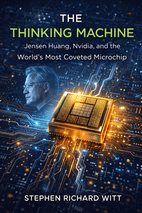
These quotes come from Stephen Witt's deep look into the people behind modern computing. You'll find lines from engineers, executives, and entrepreneurs at their most honest moments. The book covers everything from chip design battles to the rise of neural networks, and the quotes reflect the high stakes and relentless pace.
Witt's subjects speak with unusual candor. They don't sugarcoat the difficulty of building hardware or the agony of near failure. That directness makes the book highly quotable. Readers get terse insights about strategy, survival, and the strange psychology of innovators who thrive under pressure.
Top Quotes from The Thinking Machine
“I find that I think best when I’m under adversity. When the world is just falling apart, I actually think my heart rate goes down,” he later said. “Maybe it’s Denny's. As a waiter, you've got to deal with rush hour. Anyone who's dealt with rush hour in a restaurant knows what I'm talking about.”
Huang explaining his ability to perform under pressure, using his waitressing experience as an example.
This quote reveals his unique mindset—thriving in chaos—and connects his humble job to his later success.
“The reason we backed these dudes is because they were world-class computer scientists,” Coxe said. “The average CEO will try to listen to the customer, but in computing, that's a big mistake, because customers just don’t know what's possible. They just don't know what can be done!”
Investor Tench Coxe explains why Sequoia Capital funded Nvidia despite the crowded market.
This quote highlights the importance of visionary engineering over market feedback, a key insight into why Nvidia succeeded where others failed.
“Desperation, not inspiration, was the mother of victory.”
The author's observation following Nvidia's desperate gamble with the NV3 chip.
It flips the common belief that inspiration is key, instead crediting desperation. The line resonates as a raw truth about innovation under extreme pressure.
“Instead of a dumb machine which can calculate things much faster than humans such as the chess playing computers, you have built a smart machine which learns from experience pretty much the same way humans do.”
Kit Woolsey praises Tesauro's TD-Gammon in a letter, contrasting it with chess-playing computers.
This quote sharply distinguishes between brute-force calculation and genuine learning, foreshadowing the paradigm shift toward neural networks.
“That was the power of neural structures: all it took to conquer backgammon, or survive for half a billion years in a dangerous marine ecosystem, or maybe even fend off the Soviets, was a hundred little cells.”
The author reflects on Fredrik Dahl's comment that his Jellyfish program had about a hundred brain cells, like a jellyfish.
It poetically expresses the astonishing efficiency of neural networks, showing that immense complexity can emerge from minimal components.
“The way I see it now, tech debt is the battle scar of the survivor.”
Garlick describing Nvidia's chaotic but effective coding culture.
It reframes a technical flaw as a badge of resilience, capturing the trade-offs in high-speed innovation.
“It was not a book about how to succeed; it was a book about how not to fail.”
The narrator reflects on the real lesson of Clayton Christensen's 'The Innovator's Dilemma'.
This line distills a profound and counterintuitive insight about disruptive innovation: that for established firms, avoiding failure can be more critical than chasing success.
Themes Behind the Quotes
One dominant theme is that innovation often springs from crisis. Many speakers describe how desperation, not inspiration, fueled their greatest victories. They talk about near bankruptcy, brutal competition, and the constant pressure to reinvent. This creates a culture where failure is expected and survival is the real achievement.
Another theme is the conflict between listening to customers and pursuing radical ideas. Several quotes argue that customers cannot envision what is possible, so true breakthroughs require ignoring market feedback. At the same time, the quotes reveal a deep respect for learning and adaptation, whether through neural networks or personal resilience. The book also emphasizes the human side of tech: the emotional toll, the loyalty inspired by demanding leaders, and the strange beauty of a perfectly designed machine.
Quotes by Chapter
Chapter One: The Bridge
“His path led down a sloping hillside to a floodplain situated among forested hills, and across a rickety pedestrian footbridge, which was suspended by ropes and missing many planks, through which could be seen the frigid and rushing waters of the river below.”
Describing ten-year-old Jensen Huang's route to school in rural Kentucky.
This vivid imagery of a perilous bridge symbolizes the challenges Huang faced and his determination to cross them.
“The way you described Chinese people back then was ‘Chinks,’" Huang told me, fifty years later in a sterile conference room during our first conversation."”
Huang recalling the racial slurs he endured from classmates.
The stark delivery shows the lasting impact of racism, yet his emotionless face reveals his resilience.
“Back then, there wasn’t a counselor to talk to,” Huang said. “Back then, you just had to toughen up and move on.”
Huang reflecting on his time at Oneida Baptist Institute.
This quote distills his philosophy of self-reliance and grit, a recurring theme in his life story.
Chapter Two: Large-Scale Integration
“Jensen is an excellent employee. I look forward to working for him some day.”
A manager wrote this on Huang's employee evaluation at LSI Logic.
This line foreshadows Huang's future leadership and shows how his potential was recognized early.
“When he said he was going to do something, there was a reasonable likelihood that he would actually do it, y'know?”
Chris Malachowsky, a future Nvidia co-founder, describing Huang's reliability.
It underscores the trust Huang inspired in his colleagues, a key trait for his later success.
“By this, I mean we were not only doing work for our customers, but we were turning these orders into tools, and turning those tools into methodologies.”
Horstmann elaborating on Huang's ability to turn customer orders into reusable tools and methodologies.
This illustrates Huang's innovative thinking that multiplied the value of his work, a core reason for his impact.
“He knew that start-ups were difficult, hardware start-ups were more difficult, and consumer-hardware start-ups were the most difficult of all.”
The narrator describes Huang's awareness of the challenges facing a new venture.
This escalating triplicate captures the harsh reality of entrepreneurial risk, making readers feel the weight of Huang's calculated decision.
Chapter Three: New Venture
“Take a good look at that window,” he said in a controlled whisper. “It's full of bullet holes! I think people are going up to that overpass to shoot at the cops!”
Chris Malachowsky discovers bullet holes in the Denny's window where the founders were meeting.
This dramatic moment adds a gritty, real-world danger to the founding story, illustrating the unexpected challenges and the absurdity of the setting that later became legend.
Chapter Five: Going Parallel
“Our company is thirty days from going out of business.”
Jensen Huang's corporate mantra, repeated to employees to maintain urgency.
It captures the high-stakes environment and relentless pressure that drove Nvidia's success. This memorable phrase defines the company's culture of constant crisis.
“It's kind of like on a battlefield, where the gun is shooting at something and you stand up and say, ‘Hey, stop shooting!’ Well, then the gun turns and starts shooting at you.”
David Kirk explaining the consequences of trying to stop Jensen Huang from berating an employee.
The battlefield metaphor vividly illustrates the danger of confronting a powerful, angry leader. It is both relatable and darkly humorous.
“I hired him within a few days—and that killed that company, right?”
David Kirk recounting how he hired a key engineer from a competitor, effectively destroying that company.
It reveals the ruthless, strategic mindset of Nvidia's leadership. The blunt confession is both shocking and memorable.
Chapter Six: Jellyfish
“It was this unheralded competition in Dallas, not Kasparov's defeat in New York City, that marked the dawn of the new machine age.”
The narrator reflects on the significance of the backgammon match between humans and the Jellyfish program.
This line reframes a pivotal moment in AI history, arguing that a quiet backgammon match—not the famous chess defeat—heralded the true arrival of machine intelligence.
“Unencumbered by received wisdom, TD-Gammon discovered a new approach to backgammon.”
Describing how Gerald Tesauro's neural net learned to play backgammon by playing against itself.
It captures the revolutionary idea that a machine could surpass human knowledge by ignoring tradition and innovating on its own.
Chapter Seven: Deathmatch
“The thing is, if you win just one tournament, you'll be forgotten, right?”
Wendel referencing his hero Tiger Woods while discussing his competitive drive.
It captures the relentless pressure and fear of obscurity that drives elite performers in any field.
“We were in a death struggle with 3dfx, and one of us had to die.”
Kirk describing the zero-sum competition between Nvidia and 3dfx.
It encapsulates the brutal, winner-take-all mentality of the graphics industry during that era.
“The microchip industry was more like the fashion business—if your product today resembled your product from yesterday, you had made a terrible mistake.”
The author compares the microchip industry to the fashion business to highlight the need for constant innovation.
This analogy vividly illustrates the relentless pressure to innovate in the tech sector, contrasting it with more stable industries.
Chapter Eight: The Compulsion Loop
“Dad,” the note read, “I think you need to kick it up a notch.”
Jensen Huang's thirteen-year-old son Spencer leaves a Post-it note on a harsh gaming magazine review of the GeForce FX.
This blunt, almost taunting line from a child perfectly captures the relentless pressure and high standards that define Huang's world, both at home and at work.
“You felt like you couldn’t let him down,” Clay said. “You just couldn’t.”
Nvidia quality-control engineer Sharon Clay describes the motivating effect of Huang's leadership after the GeForce FX debacle.
The double affirmation and the weight of the word 'couldn't' convey the intense emotional bond and fear of failure that Huang instills, making it a powerful summary of his management style.
“He is very warm, very engaging,” Romanosky said. “He's not at all a superstar executive when he and I sit down. I feel like he’s very authentic.”
Jensen Huang's old friend Joe Romanosky describes the side of Huang he sees in private, away from his business persona.
This contradicts the public image of Huang as an obsessive, tyrannical CEO, revealing a deeply human and unpretentious character that makes his complexity more compelling.
Chapter Nine: CUDA
“It was the first gaming rig in 8K resolution, and it took up an entire wall,” Buck said. “It was beautiful.”
Ian Buck describes his array of 32 GeForce units rendering Quake across eight projectors.
This line captures the wonder and audacity of early GPU hacking, turning gaming hardware into a groundbreaking visual spectacle.
“Few inventions will have the impact on the world that CUDA will ultimately have," he would say."”
John Nickolls asserts the potential of CUDA despite its uncertain early market.
This statement of faith foreshadows CUDA's transformative role in AI and scientific computing, lending it prophetic weight.
“After that, you will never want to leave,” Aarts said. “It's vendor lock. There is no out.”
Bas Aarts explains the strategic lock-in effect of CUDA's ecosystem.
It reveals the calculated business motive behind CUDA's design, showing how technical excellence can create irresistible dependency.
“I just don’t want the consumers to fight the process,” he said in a relaxed and patient voice. “It's a little bit messy because the competition wants to stir it up, but it’s not really that complicated.”
Huang explaining Bumpgate during a Q&A with the press.
This quote captures Huang's ability to project calm while masking deep frustration, and his framing of corporate crises as simple affairs complicated by rivals—a recurring theme in his leadership.