The Thinking Machine Key Takeaways
by Stephen Witt
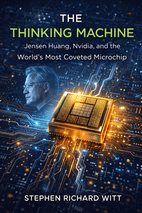
5 Main Takeaways from The Thinking Machine
Resilience forged in adversity is the foundation of transformative leadership.
Jensen Huang's early experiences with isolation and manual labor built a pragmatic toughness that enabled him to lead Nvidia through near-fatal crises like the NV1 failure and Bumpgate. This resilience, combined with a focus on fundamentals and strategic adaptation, allowed him to make bold long-term bets while maintaining operational rigor.
Bet on technological resonance, not just roadmaps, to capture future waves.
Nvidia's success with CUDA and AI came from Huang's intuitive feel for 'resonance'—engaging with niche research communities to spot disruptive trends like neural networks before they were mainstream. This approach, rather than rigid planning, allowed Nvidia to pivot from graphics to dominating the AI hardware revolution.
Build unshakable ecosystems through software to create lasting competitive moats.
Nvidia's free CUDA toolkit and domain-specific software like cuDNN locked in developers and researchers, making switching costs prohibitive. This ecosystem strategy, combined with hardware-software co-design and strategic acquisitions like Mellanox, turned Nvidia into the indispensable infrastructure for AI.
Embrace paranoia and continuous reinvention to survive fast-obsoleting industries.
In semiconductors, past success guarantees nothing; Nvidia survived by constantly betting big on next-gen tech, learning from failures, and fostering a culture of fear and loyalty. Huang's 'speed of light' philosophy and crisis-driven leadership drove operational excellence and rapid adaptation to market shifts.
The AI revolution is a physical race for scale, power, and computational supremacy.
AI's progress hinges on massive compute power, energy consumption, and hardware integration, as seen in Nvidia's hyperscale data centers and the transformer architecture's demand for scale. This underscores the material constraints and economic realities behind advancements in intelligence, from power grid strains to capital intensity.
Executive Analysis
The book argues that Nvidia's ascent from a struggling graphics startup to the backbone of the AI revolution was driven by Jensen Huang's unique blend of personal resilience, strategic intuition, and relentless execution. His ability to forge resilience from adversity enabled navigation through crises, while his focus on technological 'resonance' allowed Nvidia to pivot towards parallel computing and AI. By building a deep software ecosystem and fostering a culture of paranoia and reinvention, Nvidia created an unassailable moat that turned it into critical infrastructure.
'The Thinking Machine' matters because it demystifies the hardware and leadership behind the AI boom, offering practical lessons on building durable tech companies in volatile markets. For readers, it underscores the importance of ecosystem strategy, long-term bets, and the physical realities of digital innovation, positioning it as an essential case study in the intersection of technology, business, and society.
Chapter-by-Chapter Key Takeaways
The Bridge (Chapter 1)
Forged in Adversity: Huang's early experiences with isolation, bullying, and manual labor in Kentucky built an exceptional resilience and a pragmatic ability to "toughen up and move on."
The Power of Focus: Whether in academics, table tennis, or circuit design, Huang demonstrated a unique capacity for deep, patient focus on fundamentals, enabling rapid mastery.
Embracing Hard Work: From cleaning toilets to waiting tables, he reframed menial tasks as valuable lessons in discipline and opportunity.
Strategic Adaptation: Huang constantly adapted to new cultures and challenges, from learning English via dictionary drills to assimilating through American diner food, always finding a way to succeed.
Foundational Relationships: Key partnerships, like his friendship with Ben Bays and, most significantly, his study-based courtship of his future wife Lori, were central to his stability and path forward.
Try this: Cultivate resilience by reframing menial tasks as discipline training and building key relationships through shared purpose.
Large-Scale Integration (Chapter 2)
Personal professional setbacks can serve as powerful motivators for entrepreneurial leaps.
Successful ventures are often built on a foundation of ruthless, data-driven analysis rather than optimism.
Treating business challenges as engineering problems allows for decomposition into manageable, testable components.
Thorough market research and customer validation are critical before committing to high-risk start-up endeavors.
Try this: Use personal professional setbacks as fuel for entrepreneurship, but validate ideas through ruthless data analysis before committing.
New Venture (Chapter 3)
Founding Myth vs. Reality: Nvidia's origin story, centered on a bullet-riddled Denny's, encapsulates the gritty, unglamorous reality of many startups, even in Silicon Valley.
The Cost of Technological Divergence: The NV1's failure was a direct result of betting on a proprietary technical path (quadratic mapping) that the broader industry rejected. It was a painful lesson in the importance of standards and ecosystem compatibility.
Resilience from the Start: The chapter establishes the core dynamic of Nvidia's early identity: world-class technical audacity paired with a near-catastrophic capacity for error, requiring immense resilience to survive.
Leadership in Crisis: Huang is portrayed as the "adult in the room" from the beginning, but even his meticulous planning could not prevent a fundamental strategic misstep. The true test of his and Nvidia's leadership was about to begin.
Try this: Balance audacious technical vision with rigorous compatibility checks to avoid betting on proprietary standards that the market rejects.
Going Parallel (Chapter 4)
Nvidia's strategic partnership with TSMC was foundational, surviving a near-fatal manufacturing error to become a pillar of mutual success.
Jensen Huang's personal resilience and connection to Taiwan influenced both business decisions and company culture.
John Carmack's exacting standards as a lead programmer directly drove hardware innovation, highlighting the symbiosis between software and hardware development.
The successful adoption of parallel computing in the Riva TNT chip validated a risky architectural choice, distinguishing Nvidia in the graphics market and setting a new performance standard.
The pursuit of graphical immersion became a core driver, aligning technical progress with a powerful human aspiration and unknowingly planting the seeds for future technological transformations.
Try this: Forge strategic manufacturing partnerships and listen to demanding software developers to drive hardware innovation that aligns with human aspirations.
Jellyfish (Chapter 5)
The 1997 Jellyfish backgammon match was a historic, under-the-radar milestone where a neural net first surpassed human experts at a complex game.
Neural networks endured decades of skepticism and "AI winters" before the backpropagation algorithm provided a viable method for training multi-layer networks.
Reinforcement learning, demonstrated by TD-Gammon, showed that AI could learn and innovate from scratch by playing games against itself, free from human bias.
The release of Jellyfish commercialized this technology and established the crucial divide between the resource-intensive training phase and the efficient inference phase of an AI model.
Despite early success, neural nets of this era were limited by their "black box" nature and an inability to scale with more complex data, leading even pioneers like Dahl to doubt their broader potential.
Try this: Study historical AI breakthroughs to understand that scalable models require both innovative algorithms and the computational infrastructure to train them.
Deathmatch (Chapter 6)
Paranoia as Strategy: In the rapidly obsolete semiconductor industry, past success is no guarantee of future survival. A mindset of constant vigilance and reinvention is mandatory.
The High-Stakes Poker Game: The business model necessitates continuous, all-in bets on next-generation technology, as the cost of participation escalates with each cycle.
Innovate or Be Commoditized: For a design-focused firm like Nvidia, the only durable competitive advantage is intellectual complexity. Without it, manufacturing clones will erase margins and market position.
Market Validation is Everything: A major platform win (like the Xbox and Halo) can transform a risky technological bet into an industry standard and drive extraordinary financial and reputational rewards.
The Fickleness of Success: Even monumental achievements in this sector can be followed by long periods of challenge, underscoring the relentless, cyclical nature of the competition.
Try this: Maintain a mindset of constant vigilance in fast-moving industries, where a single platform win can validate a risky technological bet.
The Compulsion Loop (Chapter 7)
Leadership Through Contrast: Jensen Huang meticulously separates a convivial, warm private life from his intensely demanding and often fearsome professional persona.
Crisis as Crucible: Nvidia survives a confluence of external market disasters and internal product failures, with Huang’s angry, guilt-driven tirades serving as a harsh but effective catalyst for operational improvement.
The Bond of Fear and Loyalty: The company culture is powered by a unique alchemy of Huang’s terrifying outbursts and his deeply personal, caring interventions, creating fierce loyalty.
The Addictive Economy: Nvidia’s recovery is ultimately bankrolled by the rise of hardcore PC gaming, a market built on the “compulsion loop” of addictive gameplay and the enthusiast desire for ever-more-powerful hardware.
Faith in the Founder: By the mid-2000s, Nvidia’s identity and value are inextricably linked to Huang’s appetite for radical, long-term bets, making it a perplexing and volatile proposition for traditional investors.
Try this: Separate personal warmth from professional demands to create a culture where fear of failure and loyalty to the mission drive performance in addictive markets.
CUDA (Chapter 8)
Innovation Carries Trade-offs: The massive investment in CUDA contributed to a dangerous distraction from quality control in Nvidia’s core gaming business, culminating in the devastating “Bumpgate” crisis and the company’s first-ever annual loss.
Huang’s Leadership Paradox: Jensen Huang cultivates a culture that forgives big, innovative risks but exhibits furious, performative intolerance for execution failures. His public calm often masks intense private anger used as a managerial tool.
The "Speed of Light" Philosophy: Huang’s central management doctrine involves benchmarking all processes against their theoretical, perfect-case minimum time ("the speed of light") to set aggressively informed goals and understand the true limits of competition.
Operational Rigor as Salvation: The path out of crisis was paved not by marketing or new products, but by a brutal, data-driven optimization of the global supply chain, led by Deb Shoquist and guided by Huang’s demanding framework.
Try this: Benchmark all processes against theoretical minimums to set aggressive goals, but ensure operational rigor doesn't falter when pursuing disruptive innovation.
Resonance (Chapter 9)
Conviction in the Face of Skepticism: NVIDIA’s commitment to CUDA persisted through years of financial underperformance, investor revolt, and market indifference, driven by Huang’s and Dally’s long-term faith.
The "Mad Scientist" as Disruptive Customer: Huang intentionally cultivated a marginal market of academic and hobbyist researchers, understanding that disruptive innovation often begins in underfunded, niche communities.
Resonance Over Roadmaps: Huang’s strategy was less about a pre-ordained vision and more about feeling for technological "resonance"—an intuitive sense of impending change gleaned from deep, constant engagement with the field's frontiers.
The Parallel Journeys: The chapter draws a parallel between the neglected, foundational research into neural networks (like Pinto’s) and the similarly overlooked ancient trilobite fossil, suggesting that major evolutionary leaps in intelligence—biological or computational—often have humble, ignored origins.
Try this: Intentionally engage with niche research communities to sense technological 'resonance' and have the conviction to invest long-term before market validation.
AlexNet (Chapter 10)
The AlexNet breakthrough was born from the confluence of a brilliant, reclusive programmer (Krizhevsky), visionary mentorship (Hinton), and the repurposing of consumer-grade parallel computing hardware (Nvidia GPUs).
It overcame deep-seated ideological resistance within the AI community, which had long dismissed neural networks as a dead end.
The use of a massive, labeled dataset (ImageNet) and the raw computational speed of GPUs enabled training at a scale and speed previously unimaginable, turning theoretical potential into practical reality.
AlexNet's victory in the 2012 ImageNet competition was a watershed event that immediately and permanently shifted the entire field of AI toward deep learning.
The subsequent multi-million-dollar acquisition by Google demonstrated the immense commercial and strategic value of fundamental AI research, kickstarting the modern AI investment frenzy.
Try this: Repurpose existing consumer hardware for new computational paradigms to overcome ideological resistance and achieve breakthrough scale in research.
O.I.A.L.O. (Chapter 11)
Ryan Catanzaro's unique blend of humanities and engineering insight allowed him to foresee AI as the killer app for parallel computing, despite early skepticism.
Jensen Huang's rapid embrace of AI transformed Nvidia overnight, demonstrating the power of visionary leadership and organizational agility.
The development of cuDNN was a technical triumph that optimized neural networks for Nvidia hardware, creating a loyal ecosystem of AI researchers and companies.
The fusion of neural networks and parallel computing catalyzed the AI revolution, with Nvidia's GPUs becoming essential infrastructure for major tech firms like Google.
Perseverance in the face of internal doubt and external criticism can lead to groundbreaking innovations, as shown by Catanzaro's journey from misfit to key innovator.
Try this: Foster interdisciplinary thinking to identify killer applications for existing technology, and move rapidly to build optimized software that locks in an ecosystem.
Superintelligence (Chapter 12)
Jensen Huang subsumed his entire identity into leading Nvidia through the AI revolution, viewing it as a historic, once-in-a-lifetime opportunity.
Nvidia achieved a de facto monopoly in AI hardware, with its rapid innovation cycle and cloud data center model driving tremendous financial growth and ecosystem expansion.
The AI boom sparked a major philosophical schism between alarmists like Elon Musk, who feared existential risk, and pragmatists like Huang, who focused on capability.
The creation of the DGX-1 supercomputer represented a tangible milestone in AI history, a specialized machine that empowered the very researchers debating its implications.
Try this: View market dominance as a function of rapid innovation cycles and ecosystem expansion, while navigating the philosophical debates your technology enables.
The Good Year (Chapter 13)
Huang's Omniverse platform evolved from a robotics simulator into a leased "digital twin" of reality for industrial design and testing.
By 2017, Nvidia achieved massive financial success ($3B profit, $100B market cap) but was still publicly perceived as a gaming hardware company.
Insiders recognized Nvidia had fundamentally become the dominant infrastructure company for the burgeoning AI revolution.
The chapter positions all prior successes as mere prelude to an imminent and unexpected corporate metamorphosis.
Try this: Leverage simulation platforms as 'digital twins' to test industrial designs, recognizing that true transformation often precedes public perception.
The Transformer (Chapter 14)
The transformer architecture's revolutionary power lies in its simplicity: it uses a "self-attention" mechanism to map relationships between words and predicts only the next word in a sequence.
This design perfectly exploits parallel GPU processing, meaning performance improves directly with more data and computing power.
The model demonstrated unexpected "emergent" capabilities, solving complex linguistic tasks without explicit programming, which hinted at more general intelligence.
Organizational culture proved critical: Google invented the transformer but failed to capitalize on it due to inertia, while the nimble, risk-tolerant OpenAI pivoted to adopt it and drive the AI revolution forward.
The pursuit of scale became paramount, with model size (parameters) and training cost growing exponentially, setting the stage for the large language models that would follow.
Try this: Prioritize simple, scalable architectures that exploit parallel processing, and foster a nimble culture to capitalize on innovations that larger organizations may miss.
Hyperscale (Chapter 15)
规模哲学:黄仁勋将AI纯粹视为一个规模问题,其核心成就在于构建和集成前所未有的计算能力,而非对智能本质的哲学探讨。
软硬协同:Nvidia的统治地位并非仅靠优越的硬件,而是通过软件算法实现的、超越摩尔定律数百倍的性能提升,以及一个庞大、免费、领域专用的软件生态体系。
战略整合:收购Mellanox是一次关键的战略胜利,通过获取高性能网络技术,将数据中心从计算集群转化为高效的统一系统,体现了硬件层面的垂直整合思维。
生态锁死:通过免费且先发制人的软件工具包(CUDA及领域工具),Nvidia成功地锁定了研究者和开发者社区,建立了极高的转换成本,这是其最深的护城河。
文化驱动力:公司内部通过黄仁勋的极端沟通机制和软件团队的“永久冲刺”文化,保持了对技术前沿的快速响应和执行力,确保持续领先。
隐秘革命:本章揭示了在公开进展之前,大型科技公司内部早已在进行远超公众想象的AI技术演示和开发,预示着一场早已开始但尚未完全显露的变革。
Try this: Build dominance through vertical integration of hardware and free, domain-specific software that creates high switching costs and locks in developer communities.
Money (Chapter 16)
The public release of ChatGPT and GPT-4 marked a definitive point where AI transitioned from a research project to a pervasive, world-changing technology.
The AI revolution is incredibly capital-intensive, with continuous and massive costs for both training models and running them ("inference"), creating new economic models.
Nvidia, through its long-term focus on GPU computing, achieved a near-total monopoly on the hardware underpinning this revolution, resulting in unprecedented financial growth and geopolitical power for the company and its leadership.
The proliferation of generative AI tools promises to reshape creative and industrial fields, but is simultaneously enabling new forms of crime, fraud, and social disruption.
Try this: Prepare for the capital-intensive nature of AI by investing in hardware infrastructure that supports both training and inference, as this will drive economic models.
Spaceships (Chapter 17)
Nvidia's culture is one of techno-optimism and reverence for its leadership, set within a breathtaking, highly monitored physical environment.
The company is actively unifying photorealistic graphics and generative AI to create immersive, voice-commanded virtual worlds.
A significant philosophical rift exists: Nvidia's leadership largely dismisses existential risks and ethical concerns about AI, while pioneers like Geoffrey Hinton issue grave warnings.
An alternative, optimistic vision frames advanced AI as the next step in evolution—a cosmic intelligence that would expand beyond Earth rather than conflict with humanity.
Despite grand visions, the immediate, physical constraint on AI progress is the massive and growing demand for electrical power.
Try this: Unify immersive graphics with generative AI to create interactive virtual worlds, but acknowledge the philosophical divides and physical power constraints that will shape development.
Power (Chapter 18)
The AI revolution is fundamentally physical, requiring dangerous and rapid expansion of aging power grids to meet insatiable data center demand.
Energy consumption for AI tasks dwarfs that of traditional computing, with individual user requests and industrial-scale deployments creating an unprecedented drain on global resources.
A deep contradiction exists: the very hardware accelerating climate change through energy use is also essential for modeling and understanding that crisis.
Significant financial and technical risks underlie the AI boom, with many projects failing to deliver, leading to warnings of an overhyped market bubble.
The future of the technology sector rests on an unproven assumption—that today's colossal investments in AI will generate sustainable value and not lead to a severe economic correction.
Try this: Account for the massive energy demands of AI in strategic planning, as sustainability and grid capacity may become critical bottlenecks to growth.
The Most Important Stock on Earth (Chapter 19)
The Ultimate Benchmark: Morris Chang’s perspective carries unique authority, representing a final, distilled appraisal from a titan of industry who has seen it all.
Intellect Over Everything: The chapter concludes by elevating raw, superior intellect as the foundational, non-negotiable core of Huang’s success, overshadowing even his well-documented work ethic and adaptability in the eyes of a consummate judge.
A Simple Truth: After much analysis, the most profound explanation offered is strikingly simple and human: some minds are simply built differently.
Try this: Seek appraisal from industry titans to benchmark success, but recognize that superior intellect and unique cognitive frameworks are foundational to transformative leadership.
One: Jensen (Chapter 20)
Jensen Huang cultivated a prophetic, cult-like leadership style at Nvidia, blending charisma, humor, and psychological tactics to drive employee loyalty and performance.
His public persona is intentionally crafted yet inherently contradictory, with his off-the-cuff remarks often masking deeper, carefully developed convictions that emerge only through repetition.
Despite a personal aversion to public speaking, Jensen is a captivating performer who uses stages to broadcast speculative, visionary ideas about AI and technology, often ahead of their time.
Nvidia's market dominance has transformed Jensen into a tech celebrity, revered by diverse audiences and mobbed by fans, highlighting his cultural impact beyond business.
Immense wealth and success bring personal stress and relentless drive, with Jensen motivated by existential threats and a secretive pursuit of next-generation AI that could redefine reasoning and discovery.
Try this: Cultivate a charismatic yet contradictory public persona to drive loyalty and performance, but balance it with a relentless focus on next-generation technology.
Two: The Fear (Chapter 21)
A profound sense of existential risk regarding AI, dubbed "The Fear," emerged almost simultaneously among several of the field's most foundational researchers following the release of ChatGPT.
The AI community is deeply divided, symbolized by the rift between Yoshua Bengio and Yann LeCun, often quantified by their personal estimate of p(doom)—the probability of AI causing human extinction.
Early attempts to regulate high-stakes AI development through legislation were swiftly overwhelmed by Silicon Valley's commercial and political influence.
Despite the vocal concerns of its pioneers, the development of more powerful and human-like AI models continues to accelerate, driven by immense corporate investment.
The core dilemma remains unresolved: whether to prioritize unprecedented technological benefits or to heed warnings about an unprecedented existential threat from a creation with no biological precedent.
Try this: Engage with the existential risks of AI by quantifying personal stance (e.g., p(doom)), but recognize that commercial forces may outpace regulatory efforts.
Three: The Thinking Machine (Chapter 22)
Jensen Huang’s Core Identity: He fiercely rejects the archetype of the sci-fi visionary, positioning himself instead as a disciplined, serious engineer focused on business logic and first principles. His explosive anger serves to enforce this boundary.
The Nvidia Culture: The company’s intense, detail-obsessed, and speculation-averse culture is a direct reflection of Huang’s personality and expectations, where fearing his disapproval outweighs other concerns.
The Disconnect Between Builder and Creation: Huang’s cold, pragmatic focus on building the technological stack stands in stark contrast to the awe-inspiring, almost spiritual power of the supercomputing intelligence that stack enables.
Humanity at the Threshold: The chapter ends with a visceral sense of human obsolescence in the face of the “thinking machine,” highlighting the profound and unsettling transition driven by the very technology Nvidia has mastered.
Try this: Embrace a disciplined, engineering-first identity to build complex systems, but confront the profound societal implications of creating machines that may surpass human reasoning.
Continue Exploring
- Read the full chapter-by-chapter summary →
- Best quotes from The Thinking Machine → (coming soon)
- Explore more book summaries →