The Talent Code Quotes
by Daniel Coyle
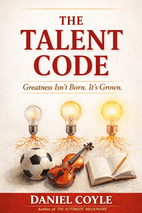
This page gathers the most memorable lines from Daniel Coyle's book on talent and skill. Here you will find insights on how mastery really works, from the biology of myelin to the psychology of deep practice. Each quote offers a fresh perspective on learning and improvement.
What makes The Talent Code so quotable is its ability to turn complex science into clear, actionable truths. Coyle's writing is direct and surprising, often flipping common assumptions about talent and effort. These quotes capture the heart of his message: that skill is built, not born, and that the path to greatness is paved with targeted struggle.
Top Quotes from The Talent Code
“Deep practice is built on a paradox: struggling in certain targeted ways—operating at the edges of your ability, where you make mistakes—makes you smarter.”
The author explains the central concept of deep practice.
This sentence perfectly captures the book's core insight—that the struggle and mistakes we usually avoid are actually the key to accelerated learning.
“It's all about finding the sweet spot,” Bjork said. “There's an optimal gap between what you know and what you're trying to do. When you find that sweet spot, learning takes off.”
Robert Bjork, chair of psychology at UCLA, summarizes the ideal learning condition.
The phrase 'sweet spot' gives readers a memorable, intuitive handle for the precise level of difficulty that maximizes growth, making the concept actionable.
“One real encounter, even for a few seconds, is far more useful than several hundred observations.”
Robert Bjork contrasts passive observation with active engagement.
This line instantly reframes the value of hands-on experience, encouraging readers to prioritize doing over watching in their own skill development.
“Struggle is not an option: it's a biological requirement.”
The author explains why targeted, mistake-focused practice is so effective.
This line reframes struggle as a necessary biological process for skill development, empowering readers to embrace difficulty rather than avoid it.
“The truth is, practice makes myelin, and myelin makes perfect.”
The author sums up the core insight of the myelin theory.
It's a memorable twist on the old maxim that directly links practice to the physical growth of myelin, making the concept stick.
“Myelin doesn't care who you are—it cares what you do.”
Part of the explanation that myelin is universal and meritocratic.
This undercuts the myth of innate talent and emphasizes that consistent, focused action is what truly builds skill.
“It's not how fast you can do it. It's how slow you can do it correctly.”
Football coach Tom Martinez explains the key to effective deep practice.
This line flips the conventional emphasis on speed, reminding readers that precision and error correction are the true drivers of skill growth. It's a simple, actionable mantra that applies to any learning endeavor.
Themes Behind the Quotes
A central theme is that skill is not a matter of innate talent but of targeted practice. The quotes emphasize the importance of struggling at the edge of your ability, where mistakes are not failures but signals for growth. This idea of deep practice, along with the biological role of myelin, forms the foundation of skill acquisition.
Another key theme is the power of ignition and motivation. Many quotes highlight how a clear signal or a compelling example can spark a burst of effort and belief. The book also stresses that confidence is earned through action, not given. Together these ideas show that talent is a process of building both skill and mindset, with each reinforcing the other.
Quotes by Chapter
Introduction: The Girl Who Did a Month's Worth of Practice in Six Minutes
“Every time I watch this, I see new things, incredibly subtle, powerful things. This is how a professional musician would practice on Wednesday for a Saturday performance.”
Music psychologist Gary McPherson observing Clarissa's practice video.
It highlights that the most effective practice mimics professional-level focus and error-correction, even in a novice. This reframes the reader's understanding of what 'good practice' looks like.
“She's got a blueprint in her mind she's constantly comparing herself to. She's working in phrases, complete thoughts. She's not ignoring errors, she's hearing them, fixing them. She's fitting small parts into the whole, drawing the lens in and out all the time, scaffolding herself to a higher level.”
McPherson analyzing Clarissa's deliberate practice techniques.
This vividly describes the key components of deep practice—goal-setting, error detection, and incremental improvement—making the abstract concept concrete and inspiring.
“She goes from worse than normal to brilliant and then back again, and she has no idea she's doing it.”
McPherson contrasting Clarissa's focused practice with her later unfocused playing.
It underscores that extraordinary progress is often unconscious, and that the quality of practice, not innate talent, drives sudden leaps in skill.
“Skill is a cellular insulation that wraps neural circuits and that grows in response to certain signals.”
The author introducing the biological basis of the talent code.
This simple, powerful definition demystifies skill acquisition by grounding it in a tangible biological process, making the concept both accessible and compelling.
Chapter 1 - The Sweet Spot
“The more we generate impulses, encountering and overcoming difficulties, the more scaffolding we build. The more scaffolding we build, the faster we learn.”
Robert Bjork explains how the brain constructs knowledge through struggle.
The metaphor of a scaffold visualizes learning as an active, structural process, reinforcing that effort builds long-term ability rather than just momentary performance.
Chapter 2 - The Deep Practice Cell
“Skill is myelin insulation that wraps neural circuits and that grows according to certain signals.”
The author defines skill in terms of myelin after explaining the mechanism.
It provides a clear, memorable definition that distills complex neuroscience into a single, powerful image.
Chapter 3 - The Brontës, the Z-Boys, and the Renaissance
“If people knew how hard I had to work to gain my mastery,” Michelangelo later said, “it would not seem so wonderful at all.”
Michelangelo's own words after creating the Pietà, as quoted in the chapter.
This humanizes a legendary genius, emphasizing effort over innate gift, and aligns perfectly with the book's thesis that mastery is built through deep practice.
“The truth is, plenty of other Yorkshire girls had lives just as parochial and constricted as the Brontés', just as plenty of other Los Angeles kids were as edgy and cool as the Z-Boys. But myelin doesn't care about who you are. It only cares about what you do.”
The author contrasts the romanticized 'kid from nowhere' myth with the reality of deep practice.
It powerfully dismisses the idea of natural talent and centers the process of practice, making the argument memorable and direct.
“We are myelin beings,” Bartzokis says finally. “It's the way we're built. You can't avoid it.”
George Bartzokis, UCLA neurologist, summarizes the centrality of myelin to human cognition and skill.
This punchy, declarative statement encapsulates the book's core message in a memorable soundbite, reinforcing that myelin is fundamental to who we are.
“The point, rather, is that although talent feels and looks predestined, in fact we have a good deal of control over what skills we develop, and we each have more potential than we might ever presume to guess.”
The author concludes the discussion on the nature of talent and genetic determinism.
It directly challenges the common belief that talent is fixed and predetermined. It offers an empowering message of personal agency and untapped potential.
Chapter 4 - The Three Rules of Deep Practice
“If I skip practice for one day, I notice. If I skip practice for two days, my wife notices. If I skip for three days, the world notices.”
Virtuoso pianist Vladimir Horowitz on the necessity of daily repetition.
The escalating humor and truth of this quote perfectly capture the biological reality that skill erodes without consistent practice, making it both memorable and motivating.
“Skill consists of identifying important elements and grouping them into a meaningful framework.”
The author summarizes the psychological concept of chunking, central to deep practice.
This concise definition demystifies expertise, showing that talent is about organization rather than innate ability. It empowers readers by framing skill as a learnable process of pattern recognition.
“When you depart the deep-practice zone, you might as well quit.”
The author describes how practice duration in talent hotbeds is limited because leaving the deep-practice zone makes further practice ineffective.
This line captures the essence of deep practice—it's not about quantity but quality, and once you lose focus, continuing is pointless.
Chapter 5 - Primal Cues
“The seventeen runners had received a clear signal—-you can do this too—and the four-minute mark, once an insurmountable wall, was instantly recast as a stepping-stone.”
Describing the effect of Roger Bannister breaking the four-minute mile on other runners.
It powerfully illustrates how external signals can redefine perceived limits and ignite widespread achievement.
“Where deep practice is a cool, conscious act, ignition is a hot, mysterious burst, an awakening.”
The author contrasting deep practice and ignition.
It captures the essence of motivation as an emotional, awakening phenomenon distinct from deliberate practice.
“Our unconscious mind is a stingy banker of energy reserves, keeping its wealth locked in a vault.”
John Bargh's explanation of how our unconscious mind conserves energy until triggered by primal cues.
It provides a memorable metaphor for understanding motivation as a response to environmental signals.
“Losing a parent is a primal cue: you are not safe.”
The author discusses how parental loss acts as a motivational trigger by signaling danger.
This line succinctly captures the core concept of primal cues, making it memorable and easy to recall. It connects an emotional event to a fundamental survival mechanism.
Chapter 7 - How to Ignite a Hotbed
“To play ball, you need three things,” he pronounces, touching his body as if doing the sign of the cross. “Heart. Mind. Balls. If you have two, you can play but you will never be great. To be great, all three.”
Frank Curiel, founder of Curacao Little League, explains the essential qualities for baseball greatness while showing the author around his field.
This raw, memorable mantra distills success into three visceral components, blending physicality with mindset in a way that sticks with the reader and underscores the hotbed's gritty culture.
“What skill-building really is, is confidence-building. First they got to earn it, then they got it. And once it gets lit, it stays lit pretty good.”
Skip Engblom, mentor of the Z-Boys skateboarding team, reflects on his role in igniting the team's motivation.
It captures the essence of how sustained ignition works—effort creates confidence, and once that fire starts, it endures—a core lesson for any talent development.
“To be a six-year-old at this field is, motivationally speaking, sort of like standing in the Sistine Chapel. The proof of paradise is right here: all you have to do is open your eyes.”
The author describes how Frank Curiel Field immerses young players in tangible steps of a baseball career, from local all-stars to major leagues.
This vivid metaphor conveys how physical surroundings and visible success stories prime a child's motivation, making distant dreams feel immediate and achievable.
“We are exquisitely attuned to messages telling us what is valued,” Dweck said. “I think we go around all the time looking, looking, trying to understand, ‘Who am I in this setting? Who am I in this framework?’ So that when a clear message comes, it can send a spark.”
Carol Dweck describing why humans are so sensitive to signals about what is valued in their environment.
This passage captures the deep psychological need for identity cues and the power of clarity to ignite motivation. The repetition of 'looking' and the vivid metaphor of a spark make it resonate.
Chapter 8 - The Talent Whisperers
“It's not about recognizing talent, whatever the hell that is. I've never tried to go out and find someone who's talented, First you work on fundamentals, and pretty soon you find out where things are going.”
Robert Lansdorp, tennis coach of former world number-one players Pete Sampras, Tracy Austin, and Lindsay Davenport.
This quote challenges the common obsession with innate talent, arguing instead that skill emerges from focused work on fundamentals—a core message of the book.
“His skill resided in the Gatling-gun rattle of targeted information he fired at his players.”
Describing John Wooden's coaching style as observed by researchers Gallimore and Tharp.
The vivid metaphor captures the essence of great coaching: not pep talks but precise, rapid feedback that builds skill circuit by circuit.