The Talent Code Key Takeaways
by Daniel Coyle
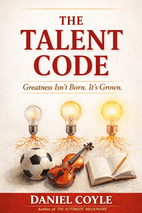
5 Main Takeaways from The Talent Code
Skill Is Built Through Deep, Struggling Practice, Not Mindless Repetition
True expertise comes from deep practice—a focused, error-conscious process where you operate at the edge of your ability, as seen in Brazilian futsal players who master ball control through constrained, repetitive drills. This struggle triggers myelin growth, insulating neural circuits to make skills faster and more automatic, debunking the myth that talent is purely innate.
Myelin Growth Is the Neural Secret to Mastering Any Skill
Myelin acts as insulation for neural circuits, and every time you practice correctly, you wrap more myelin around those circuits, increasing speed and accuracy. This biological process, universal to all humans, explains how skills from violin playing to soccer are physically built in the brain through consistent, targeted effort.
Motivation Ignites from Primal Cues, Not Just Inherent Desire
Sustained effort for deep practice is fueled by ignition—subconscious signals like belonging or urgency that release motivational energy. At KIPP schools, college-themed rituals and high expectations act as primal cues, turning vague potential into a relentless drive to learn and achieve.
Effective Coaching Tailors Methods to Flexible or Precise Skill Circuits
Master coaches adapt their approach based on whether a skill is improvisational (like soccer) or consistent (like violin). For flexible circuits, they provide rich, feedback-filled environments; for precise circuits, they offer corrective guidance to build technical foundations, all to maximize correct circuit firing and myelin growth.
Talent Hotbeds Are Engineered Through Deliberate Design, Not Chance
Extraordinary skill clusters, from Brazilian soccer to KIPP academies, are created by intentionally combining deep practice, ignition, and master coaching. By designing environments with constraints, motivational signals, and expert guidance, anyone can cultivate talent, proving that hotbeds are replicable systems, not random miracles.
Executive Analysis
The five takeaways interconnect to form the book's central thesis: talent is not a genetic gift but a process of neurological development, where deep practice builds myelin, ignition provides motivational fuel, and master coaching optimizes the learning circuit. This framework synthesizes neuroscience with practical examples, from futsal to KIPP schools, offering a universal blueprint for skill acquisition that transcends domains.
The book matters because it provides actionable science-backed strategies for accelerating learning in any field, moving beyond vague notions of 'grit' or '10,000 hours' to explain the biological mechanism—myelin—that underpins expertise. It sits at the intersection of popular psychology, education, and self-help, challenging innate talent myths and empowering readers to systematically cultivate skill through deliberate design.
Chapter-by-Chapter Key Takeaways
The Girl Who Did a Month's Worth of Practice in Six Minutes (Introduction)
Extraordinary talent often emerges from unlikely places, suggesting universal principles at work rather than mere chance or isolated genius.
Deep practice—a struggle-filled, error-conscious, and intensely focused process—is a far more effective learning method than smooth, mindless repetition.
All skill acquisition is rooted in a neural process: the growth of myelin, which insulates neural circuits and makes them faster and more accurate.
Skill is myelin. The more you practice correctly, the more myelin you build, and the more skilled you become.
The talent code is a framework for accelerated learning, combining deep practice, ignition (motivation), and master coaching to optimally trigger myelin growth.
Try this: Embrace deep practice by focusing intensely on errors and operating just beyond your current ability to trigger myelin growth.
The Sweet Spot (Chapter 1)
Futsal is not merely a Brazilian pastime but the nation’s fundamental skill incubator, responsible for the distinctive, improvisational style of its greatest players.
The game’s constraints—less time, less space, more ball touches—create an ideal deep practice environment, forcing accelerated technical and cognitive development.
Famous Brazilian soccer moves and a signature comfort on the ball are directly traceable to futsal origins, not beach soccer.
The success of Simon Clifford’s experiment in Leeds proves futsal’s training effects are transferable and culturally universal, capable of building elite skills anywhere its intensive, repetitive practice is applied.
Try this: Design practice environments with constraints—like less space or time—to force more repetitions and cognitive engagement, as seen in futsal.
The Deep Practice Cell (Chapter 2)
True talent hotbeds create success not just through effort, but through deep, correct practice that builds neural skill.
Anders Ericsson's research demonstrated that skills are not fixed "hardware" but can be radically improved through training.
The 10,000-Hour Rule and the Ten-Year Rule are robust findings showing world-class expertise requires a massive quantity of dedicated, deliberate practice.
So-called "natural genius" or savant ability is typically the product of extreme early exposure and obsessive deep practice, not a unique biological endowment.
Combining myelin science with Ericsson's work provides a universal framework for understanding skill acquisition, applicable to every domain of human achievement.
Try this: Commit to deliberate, focused practice over thousands of hours, understanding that expertise is built through consistent effort, not innate talent.
The Brontës, the Z-Boys, and the Renaissance (Chapter 3)
The traditional nature/nurture model is too vague to meaningfully explain skill acquisition.
Genes build our brains not with prewired talents, but with a flexible, adaptive system centered on myelin.
Myelin acts as "broadband insulation" for neural circuits; the more a circuit is fired through deep practice, the more myelin wraps it, increasing skill and speed.
This system is universal, unconscious, and efficient, allowing all humans the potential to develop high skill in areas they intensely practice.
Talent is not a pre-destined gift but the result of leveraging this innate, practice-driven adaptive mechanism.
Try this: Trust that skill acquisition is a biological process; every correct practice session physically insulates neural circuits with myelin.
The Three Rules of Deep Practice (Chapter 4)
Quality Trumps Quantity: Effective practice is defined by intense focus in the deep-practice zone, not by marathon sessions. Once focus breaks, progress halts.
Develop Error Sensitivity: The core of “feeling it” is training yourself to be acutely aware of mistakes the instant they occur, using that dissatisfaction as fuel for correction.
Embrace the Productive Struggle: Skill is built through a consistent cycle of targeting, reaching, evaluating, and repeating. This happens in the “sweet spot,” where the task is just beyond your current ability.
The Staggering Baby Principle: Learning is inherently clumsy. Willingness to endure failure and discomfort—to “be bad” while attempting a goal—is the fastest path to building the neural circuitry for skill.
Try this: Practice in the 'sweet spot' where you make errors, immediately correct them, and repeat to myelinate the correct circuit.
Primal Cues (Chapter 5)
Primal cues are subconscious signals—like “you are not safe” or “you're behind”—that trigger massive outpourings of motivational energy.
This energy is the fuel for deep practice, enabling the sustained effort required to build skill and myelin over time.
Environmental context often trumps inherent advantage, as seen in the violin programs; structured scarcity and belonging can ignite talent more effectively than resources alone.
Talent hotbeds can be anticipated by identifying groups where breakthrough individuals have activated primal cues for a larger population.
Try this: Identify and leverage primal cues in your environment, such as a sense of urgency or belonging, to fuel sustained motivation for practice.
How to Ignite a Hotbed (Chapter 6)
Ignition can be engineered: While hotbeds like Curaçao were sparked by chance events, KIPP demonstrates that a motivating, talent-growing environment can be consciously constructed from the ground up through clear, consistent signals.
Culture is built on micro-behaviors: Transformative group identity is forged through the relentless practice of small, precise actions—how you stand, hold a binder, or speak. These details train the self-discipline that underpins academic success.
Environment over sermon: Motivation is not sparked by occasional pep talks but by being immersed in a seamless, coherent world that constantly reinforces belonging, high expectations, and the direct link between effort and achievement.
Behavior is a practiced skill: Tools like "stopping the school" apply the principles of deep practice—targeted error correction and repetition—to building prosocial behavior, viewing discipline as a circuit to be constructed.
College as the Guiding Ideal
At KIPP, college isn't just a future goal—it's a living, breathing part of daily life. Classrooms bear the names of teachers' alma maters, turning Berkeley, USC, and Cornell into familiar touchstones. Teachers seamlessly weave college into conversations, like when a social studies instructor chides a student for unnamed homework by invoking future professors' expectations. This constant repetition, as one teacher notes, makes "college" as common as "um" in other schools. The message is reinforced through immersive visits: fifth graders tour California campuses like Stanford, while seventh graders fly east to Yale and Columbia. These trips, where they meet KIPP alumni, transform college from a fuzzy concept into a personal dream. Students begin debating preferences, saying things like, "I'm more of a Cal Poly person," signaling that the ideal has taken root. As co-founder Mike Feinberg observes, connecting that first "dot" of their lives to college creates a new sense of purpose, visible in how students carry themselves afterward.
The Motivational Power of Ritual
Lolita Jackson, a veteran teacher and assistant principal, brings this college-focused mission to life with theatrical flair. In her math class, she clicks off the lights, cues the Star Wars soundtrack, and strides like a rocket captain, asking students to "fasten your seat belts" for a bumpy ride to college. Her performance—complete with giant earrings and galvanic energy—frames the hard work ahead as an epic journey toward a "good life." Jackson, who left the public school system for KIPP, is revered for her near-magical ability to ignite curiosity. By linking algebra to future empowerment, she turns learning into a visceral experience, where every lesson is a step toward that glowing ideal.
Deep Practice in Action
KIPP Heartwood operates as a fortress of deep practice, where students are taught that their brains are muscles strengthened through effort. Two hours of nightly homework, hundreds of worksheets, and stretches of intense, silent work are the norm. Feinberg compares it to a football game's fourth quarter: with students arriving behind, there's no time to waste. This rigor yields tangible results—in 2007, the school ranked in the top 3 percent statewide. But what's striking isn't just the workload; it's how quickly students embrace the KIPP identity that fuels it. They approach visitors with firm handshakes, polite inquiries about college, and a sincere, if sometimes scripted, enthusiasm for self-improvement.
Personal Transformation Through Identity
Sixth-grader Daniel Magana embodies this shift. He recalls his old school, where he "used twenty-five percent of my brain" and was allowed to slide. At KIPP, he gives "one hundred percent," drawn by the lack of special treatment and the clear path to college. The son of a construction worker, Daniel plans to be the first in his family to attend university, eyeing Berkeley for a double major in laser surgery and creative writing. His polished demeanor—the gracious questions about a visitor's children, the timely exit to English class—raises a fascinating question: How much of Daniel is innate, and how much is sculpted by KIPP? His transformation suggests that character isn't static but something being actively built.
Character as a Myelin-Based Skill
This insight reframes character as a skill, ignited by signals and honed through deep practice. Each time a KIPP student imagines themselves on a college campus, it sparks energy akin to South Korean golfers visualizing themselves as Se Ri Pak. Every enforced rule—from hallway silence to homework deadlines—fires and insulates neural circuits, strengthening impulse control like a clarinetist perfecting a phrase through start-stop repetition. Daniel's politeness and discipline aren't just behaviors; they're circuits being myelinated through consistent practice. The environment deliberately crafts these traits, making them contagious as students inspire one another.
Igniting the Switch
Principal Ali encapsulates the process as "lighting a switch"—a highly deliberate design where every detail, from classroom names to teacher cues, pushes in the same direction. When it clicks, the mindset spreads like a virus, with students catching the ethos from peers. This intentionality mirrors systems like Toyota's assembly lines, where consistency drives success. At KIPP, the switch isn't flipped by chance; it's a calculated ignition that turns vague potential into focused trajectory.
College as a Beacon: KIPP embeds the concept of college into daily routines, using it as a relentless signal to motivate and shape student identity.
Ritual Fuels Engagement: Teachers like Lolita Jackson use dramatic, immersive techniques to link hard work to personal empowerment, making learning an exciting journey.
Deep Practice Builds Excellence: Rigorous academic demands—from homework to silent work periods—create a hotbed for skill development, yielding top-tier results.
Character is a Skill: Traits like discipline and politeness are not innate but can be ignited and strengthened through consistent practice, much like myelin insulation in neural circuits.
Intentional Design is Contagious: The KIPP model relies on aligning every detail to send a unified message, creating an environment where transformative mindsets spread rapidly among students.
Try this: Create a talent-hotbed culture by immersing yourself in rituals and signals that reinforce a high-expectation identity, like KIPP's college focus.
The Talent Whisperers (Chapter 7)
The most effective initial teachers master ignition—they captivate students and make early learning a positive, game-like experience that builds intrinsic motivation and love for the skill.
While deep practice (like John Wooden’s coaching) builds skill circuits, ignition (like Miss Mary’s teaching) provides the essential fuel to sustain that difficult practice.
Master coaching is ultimately an art form that lives in the nuanced, emotional exchange between teacher and student, going beyond measurable technique to forge connection and desire.
Try this: Seek or become a teacher who sparks passion and makes early learning enjoyable to build the intrinsic motivation required for deep practice.
The Teaching Circuit: A Blueprint (Chapter 8)
Skills are built on two broad types of neural circuits: flexible, ivy-like circuits for improvisational skills (soccer, comedy) and consistent, oak-like circuits for precision skills (violin, gymnastics).
Effective coaching adapts its method to the circuit type: providing a rich, feedback-driven environment for flexible skills, and offering precise, corrective guidance to build a technical foundation for consistent skills.
The universal principle is that all good coaching seeks to increase correct circuit firing to build myelin and, ultimately, to make the learner self-sufficient.
An overbearing, "no easy days" coaching philosophy can stifle the organic, self-directed discovery that is central to deep practice and circuit-building.
Try this: Tailor your learning or coaching approach based on whether the skill requires flexibility (provide rich feedback) or precision (offer corrective guidance).
Tom Martinez and the $60 Million Bet (Chapter 9)
True coaching starts with connection: Before any technical instruction can be effective, a coach must establish genuine trust and gain access to the learner's individual process.
Master teachers are masters of communication: They translate complex skills into a variety of simple, vivid metaphors and cues (tactile, visual, physical) to reach different learning styles.
Evaluation is holistic: Assessing talent requires looking beyond physical tools to understand character, work ethic, learning ability, and support systems.
The coach's role is foundational but often invisible: Like NASA engineers watching a rocket launch, master coaches build the talent but typically remain behind the scenes, their crucial early work essential for later success.
Try this: Build trust with learners and use vivid metaphors to communicate complex skills, focusing on individual process over generic instruction.
The Myelin World (Epilogue)
The exploration of talent and myelin is a collaborative endeavor, built on the insights and support of a diverse community of experts, editors, and loved ones.
Personal relationships and professional networks are crucial in honing and presenting complex ideas, mirroring the social dimensions of skill development discussed in the book.
The author's personal acknowledgments, especially to his family, ground the scientific concepts in human experience, emphasizing that the pursuit of mastery is deeply interconnected with our connections to others.
Try this: Acknowledge that mastery is social; seek support from communities and mentors to sustain your practice journey and reinforce learning.
Continue Exploring
- Read the full chapter-by-chapter summary →
- Best quotes from The Talent Code → (coming soon)
- Explore more book summaries →