As an Amazon Associate, we earn from qualifying purchases.
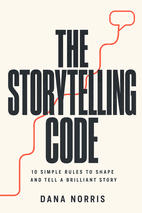
Dana Norris's The Storytelling Code distills her Story Club experience into ten rules for telling true stories aloud, covering goal-setting, plot arcs, editing, and four ending shapes. Written for anyone facing a wedding toast, job interview, or open mic who wants a repeatable process rather than natural charisma.
On Insta.page you also get an Apply This Book tool that lets you combine insights from up to 3 books to solve your specific situation.
Chapter mindmaps
Free preview: chapters 1–4 are fully interactive. Click any node to expand or collapse. Subscribe to unlock the rest.
Chapter 1: Introduction
Key concepts: Introduction
Introduction
The Table and the Stage
Family storytelling at kitchen tables remains unheard by audiences.
Poetry slam reveals power of live storytelling.
Transition from listener to performer requires overcoming fear.
Storytelling as a Skill
Craft can be learned through MFA programs and practice.
Hundreds of performances build confidence and technique.
Story Club provides a platform for true stories told live.
The Ten Rules
Rule #2: Use Plot to structure your story.
Rule #6: Anyone Can Do This—storytelling is accessible.
Rule #8: Respect Your Audience to connect effectively.
Take the Microphone
Perform before you feel ready; technique carries you.
Use material from everyday life—no need for dramatic events.
Assume permission; storytelling is not reserved for professionals.
Beyond the Stage
Storytelling sharpens points in business meetings.
Persuades people to volunteer and take action.
Framework is short enough to keep in your head.
Chapter 2: Rule 1: Know Your Goal
Key concepts: Rule 1: Know Your Goal
Rule 1: Know Your Goal
Start With the Effect
Decide what the story must accomplish before speaking.
Goal is the listener's feeling or action, not plot resolution.
Knowing the goal guides what to include and omit.
Without a goal, listeners lack reason to listen.
Choose One Main Outcome
Same occasion can support different aims; pick one.
Multiple aims create muddled stories that achieve neither.
Commit to the outcome that matters most if only one lands.
Example: wedding toast should simply show love.
Test It Against an Audience
Name audience, their knowledge, desired result, and current stance.
Plan how to move them from where they stand.
Practice with scenarios like persuading a doctor or giving a eulogy.
For your real scenario, list goals and choose the top one.
Key Takeaways
Decide what should change in listener; let that pick material.
Name the single result you'd keep if all else fell away.
Before drafting, write audience, beliefs, and desired change.
Rank objectives and commit to the top one, cutting others.
Chapter 3: Rule 2: Use Plot
Key concepts: Rule 2: Use Plot
Rule 2: Use Plot
The Plot Arc
Every story maps onto a plot arc: beginning, problem, failed attempts, solution, ending.
A story requires a problem and a genuine wish to solve it.
The structure applies to business meetings, interviews, and first dates.
Classic tales like Romeo and Juliet and Star Wars fit the same shape.
End at the Solution
The problem powers the story; once solved, tension disappears.
The ending should arrive quickly after the solution.
A drawn-out ending risks boring listeners and drifting from the goal.
Five Classic Narratives
Origin story: journey of creating something new, useful for explaining a business model.
Started from the bottom: underdog triumphs despite odds, showing adversity overcome.
Starting over: setback followed by perseverance, showing growth.
Overcoming the monster: ingenuity defeats an overwhelming obstacle.
Patterns and Tension
Brains search for patterns; failed attempts are a good place to set one up.
Rule of threes: repeat twice and break on the third beat for the biggest laugh.
Each repetition should escalate in speed, intensity, consequences, or risk.
Five ways to break a pattern: subtly, suddenly, humorously, tragically, callback.
Time and Tension as Separate Tools
A story can open in the middle, then jump backward.
Tension should rise from the first line to the resolution.
Raising stakes (e.g., warning the day before, job at risk) increases suspense.
Chapter 4: Rule 3: Gather Your Best Material
Key concepts: Rule 3: Gather Your Best Material
Rule 3: Gather Your Best Material
Purpose Over Judgment
Ask if story achieves your goal, not if it's good or bad
Create first, judge later; most can't improvise polished tales
No wrong way if it reaches your goal
Prompts and Conflict
Use prompts like 'a time you were wrong' as launching pads
Every prompt contains conflict; adversity makes stories easier
Show why it matters to you; empathy spreads interest
Drafting and Specificity
Draft in timed 30-minute sessions without editing
Replace general labels with fixed, sensory specifics
Specific details make story universal
Truth in the Telling
Cut close to memory; don't invent presence or dialogue
Say when assuming; research unclear details
Audiences assume truth; a detectable lie forfeits it
Practice and Checklist
Tell familiar story in 90 seconds for four audiences
Schedule multiple 30-minute sessions for complete draft
Add concrete sensory details after each session
You've reached the end of the free mindmaps
Next chapter: “Rule 4: Make Your Point” is locked
See every chapter of The Storytelling Code as an interactive mindmap — and unlock all 700+ book summaries with audio and AI Q&A.
$0.00 due today · 7 days free, then $89.99/year ($7.49/mo) · Cancel anytime before day 7