The Storytelling Code Key Takeaways
by Dana Norris
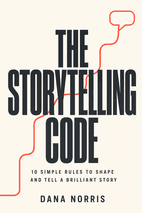
5 Main Takeaways from The Storytelling Code
Decide the One Change Your Listener Should Leave With
Before drafting, name who is listening, what they already believe, and the single shift you want to create; then let that target choose your material. Rank your objectives and cut anything that serves only the lower ones, because a story chasing two outcomes leaves the room unsure how to respond.
Shape Every Story as a Problem to Solve
Frame pitches, interview answers, and personal anecdotes around a problem the audience wants resolved, then stop once it is solved. Pick a plot shape—origin, underdog, starting over, monster, or quest—and use repeated details or a deliberate ending shape to make the resolution mean something.
Use Specific, Truthful, Vulnerable Details From Your Own Life
Mine the family table and road trip rather than waiting for dramatic material, then replace general labels with fixed sensory specifics like the Chicago basement flat and its mold smell. Tell the real version, flag inferences, and keep the flaw or truth you would rather hide, because credibility and recognition come from honesty.
Respect the Room and Fit Your Story to It
Read the audience’s age, relationship to you, energy, schedule, and prior speaker, then shorten, soften, or sharpen the telling to match. Take attention with a grounded opening, borrow the room’s vocabulary without copying it, and name visible distractions before they pull focus.
Rehearse Aloud and Perform Before You Feel Ready
Treat storytelling as a skill built through repetition: rehearse on your feet, lock the opening, closing, and beats, and give each run-through a single job. Use early performances and small audiences as training, then prepare for the actual room rather than running every item on a generic checklist.
Executive Analysis
The book's five takeaways form a single workflow: first choose the change you want in your listener, then build a plot that creates and resolves tension, fill it with specific and vulnerable material you actually own, and deliver it with respect for the particular room you are in. Rehearsal and early performance are what turn that sequence into a repeatable skill rather than a one-off inspiration. In this view, storytelling is not self-expression alone; it is purposeful communication in which every craft decision—opening, shape, detail, ending—serves the audience's experience.
That makes the book unusually practical for a field often dominated by vague charisma advice. Norris gives readers a compact operating system they can use for a pitch, interview answer, toast, or stage set, and she insists that credibility comes from honesty and specificity rather than polish. Its value lies in treating narrative as a learnable discipline—closer to a craft manual than a memoir—so readers can immediately test the rules in real rooms and improve through repetition.
Chapter-by-Chapter Key Takeaways
Introduction (Introduction)
Treat storytelling as a skill you build, not a talent you are born with. Study the craft, then perform for live audiences often enough that technique carries you when nerves hit.
Take the microphone before you feel ready. The performers who first made you want this were strangers with no more certainty than you have.
Use the material already around you: the family table, the road trip, the relative who talks too long. Do not wait for a life dramatic enough to be worth telling.
Assume the permission is yours. The skill is not reserved for professionals, and the framework is short enough to keep in your head while you work.
Try this: Start treating storytelling as a buildable skill: use the material already around you, take the microphone before you feel ready, and assume the framework is yours to practice in front of live audiences.
Rule 1: Know Your Goal (Chapter 1)
Decide what should be different in your listener once you stop talking, and let that target pick your material rather than letting the events of the story pick it for you.
Name the single result you would keep if every other aim fell away, because a story chasing two outcomes at once leaves the room unsure how to respond.
Before drafting, write out who is listening, what they already believe, and the specific change you want to move them toward.
Rank your objectives from the trivial to the serious, then commit to the one at the top and cut whatever serves only the others.
Try this: Choose the one change you want in your listener, rank your objectives, and write out who is listening and what they already believe before you draft or cut material.
Rule 2: Use Plot (Chapter 2)
Frame whatever you need to convey, a pitch, an interview answer, an account of your day, as a problem someone genuinely wants solved. That wish to solve it is what pulls an audience in, and it works the same outside formal storytelling.
Stop talking once the problem is solved. Anything after the resolution kills the tension and pulls attention away from the point you were making.
Pick the shape that fits your material: origin, underdog, starting over, overcoming a monster, or quest. Each one highlights a different strength, so the wrong match makes the story say something you didn't intend.
Plant a repeated detail twice so the third occurrence can break it, escalating speed, intensity, or consequences with each pass, and choose deliberately among a subtle, sudden, humorous, tragic, or callback break.
Treat the order of events and the rise of tension as separate tools. You can open mid-crisis and jump backward, as long as the suspense climbs from the first line to the resolution.
Try this: Frame your material as a problem the audience wants solved, pick the plot shape that fits it, plant and break a repeated detail, and stop as soon as the problem resolves.
Rule 3: Gather Your Best Material (Chapter 3)
Treat "good" and "bad" as the wrong question and ask instead whether a story does the job you chose it for; judge only after a draft exists.
Start from whichever prompt stirs something in you and trust conflict to supply the plot, since trouble is easier to dramatize than success and your own stake in the material is what makes an audience care.
Separate making from fixing: draft in one unbroken timed sitting, tolerate misspellings and dead spots, and reserve revision for later passes.
Replace general labels with fixed specifics, because naming the Chicago basement flat and its mold smell hands listeners the details instead of letting them invent their own.
Say so when you are inferring, check records or witnesses when sequence or someone's presence is uncertain, and keep invented lines out of other people's mouths, since audiences grant you truth by default and a detectable lie forfeits it.
Try this: Draft in one timed sitting from whatever prompt stirs conflict, replace general labels with fixed specifics, and flag inferences or uncertain facts rather than inventing lines for others.
Rule 4: Make Your Point (Chapter 4)
Treat the draft as material to be shaped, cutting anything that does not serve the arc, the audience, or the ending.
Open at the moment the stakes become clear rather than at the background you needed in order to find your way in.
Swap the first phrase or image that comes to mind for one that carries your own senses, voice, and perspective.
Anchor a scene with one precise object or gesture, such as a specific magazine issue, and let the rest of the scene follow from it.
Test the story against quantity, quality, relevance, and clarity so listeners get what they need and nothing more.
Try this: Cut everything that does not serve the arc, open at the moment stakes become clear, swap generic phrases for sensory specifics, and test the draft for quantity, quality, relevance, and clarity.
Rule 5: Wow Them in the End (Chapter 5)
Treat the final beat as the point where the audience decides what the story meant, and build toward the feeling you want them to leave with rather than the last fact of what happened.
Choose the shape to fit the slot: a twist for a short set, an echo of an early image for comedy, a time jump when the ending is changed circumstances, a return to the opening when the ending is growth.
Try your material against more than one shape before committing, since the same events yield different meanings depending on whether the ending surprises, echoes, leaps, or circles back.
Work backward from the ending you pick and make sure everything it depends on is already in place, cutting what does not serve it.
Hold back new information at the ending; anything the audience has to learn in the final moments costs you the landing.
Try this: Work backward from the ending by choosing the shape—twist, echo, time jump, or return—that delivers your intended feeling, and hold back new information so the landing lands.
Rule 6: Anyone Can Do This (Chapter 6)
Treat your first telling as the training ground itself. Waiting until you feel ready reverses how confidence actually develops.
Deliver your own version even alongside more polished tellers. Your perspective and voice are the part no one else can supply.
Try this: Use your first telling as training, deliver your own version even beside polished tellers, and let confidence develop through doing rather than waiting to feel ready.
Rule 7: Vulnerability is Power (Chapter 7)
Tell the real version, including a flaw or moment you would rather hide. That honesty is what earns your credibility and lets listeners find themselves in the story.
Work out why this story matters to you, what still bothers you about it, and what you wish you had said at the time; that stake is what gets you through saying it out loud.
Build the plot around what you want listeners to leave with, so the events have a point of view rather than just a sequence.
Keep the part you're afraid will land badly instead of smoothing it over; a truth some listeners resist can still produce recognition and leave strangers talking to one another after the show.
Try this: Tell the real version with the flaw you would rather hide, articulate why it matters and what still bothers you, and keep the risky truth that creates recognition.
Rule 8: Respect Your Audience (Chapter 8)
Fit the story to the specific people in front of you. Weigh their age and their relationship to you, the noise and formality of the room, what they hope for and what they dread, what your appearance signals, and what they just heard from the previous speaker. Get any one of these wrong and material that would work elsewhere can fall flat.
Use what's right in front of you to decide how to deliver. Notice where they came from, the time of day, their clothing, what's next on their schedule, and whether they want to be entertained or informed. Then shorten, soften, or sharpen the telling to match.
Take attention rather than waiting for it. Then earn it back by standing grounded, stating the situation and stakes without a long intro, and showing your own take on the material. Apologizing or easing in with a preamble costs you the goodwill you need.
Borrow the room's vocabulary and rhythm without copying them. Hold back on profanity or references that may not land. Sounding natural in their language builds trust more reliably than announcing how similar you are.
Name whatever the room can plainly see or hear going wrong, whether it's a car alarm, a failed microphone, or a companion checking a phone. A slip nobody noticed can stay unmentioned, but a visible distraction will pull focus until you deal with it.
Try this: Read the specific room—age, relationship, noise, hopes, schedule, and prior speaker—then take attention with a grounded opening and name visible distractions before they pull focus.
Rule 9: Always be Practicing (Chapter 9)
Rehearse out loud and on your feet, since a silent read-through hides the stumbles and tangles that only a listening ear will catch.
Lock in the opening line, the closing line, and the beats between them, leaving the exact wording loose enough to survive a memory lapse.
Give each run-through a single job, whether that is timing, pacing, or one character's voice, rather than trying to fix everything at once.
Treat a pass that yields no new insight and no worthwhile edit as the finish line, then check the clock and put the story in front of an audience.
Try this: Rehearse aloud and on your feet, lock the opening, closing, and beats, give each run-through one job, and stop when a pass yields no new insight or edit.
Rule 10: Get Ready (Chapter 10)
Match your final preparations to the room and the audience instead of doing every item on the list. Being ready for the wrong room isn't being ready.
Write down an idea the moment it strikes, then set aside at least half an hour to shape it, and keep revising past the first version.
Before you revise again, restate the goal that existed before the story did, and test your opening, your ending, and the attitude you expect from listeners against it.
Rehearse aloud in front of a few friends or coworkers and take their notes. Judge the result by whether your point lands, not by whether every listener approves.
Rehearse the opening, the waiting moments before you start, and any nervous habit you want to control, so your nerves have less room to surprise you.
Try this: Match final prep to the actual room, capture ideas immediately, restate your pre-story goal before revising, and rehearse the opening and waiting moments in front of a few listeners.