The Social Security Money Code Key Takeaways
by Garrett Monroe
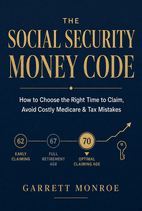
5 Main Takeaways from The Social Security Money Code
Treat Claiming as a Permanent Household-Wide Money Decision.
Your filing age controls every future check and can be reversed only by repaying what you already received. Compare both spouses' claiming ages before anyone files, because an early claim by the higher earner can shrink survivor protection more than it helps cash flow. Factor in taxes and Medicare premiums, not just the headline benefit amount.
Verify Your Earnings Record Before Trusting Any Filing Number.
A benefit estimate is only as good as the W-2s, tax returns, and self-employment records behind it. Even a few missing or underreported years can drag down the 35-year average that determines your check. Correct errors early and check whether the WEP/GPO repeal gives you a larger benefit or back payments.
Delay the Higher Earner's Claim to Protect Survivor Benefits.
In a married household, the larger benefit is what the survivor will keep after the first death, so delaying it until 70 increases every future survivor check. The lower earner can start earlier to produce income, making the stagger a stronger default than both-claim-early. Both-claim-early should exist only as an affordability fallback.
Manage Taxes and Medicare Premiums Inside Your Claiming Strategy.
Social Security benefits can become taxable through combined income, and higher income can trigger IRMAA surcharges on Medicare premiums. Use Roth withdrawals during collection years, spread large traditional IRA distributions over multiple years, and file SSA-44 after a qualifying life event. One dollar over an IRMAA threshold can raise both Part B and Part D premiums.
Sequence Survivor, Retirement, and Withdrawal Benefits on Purpose.
A surviving spouse can often claim one benefit first and switch to a larger one later, like taking the survivor amount at FRA or a retirement benefit at 70. Compare those amounts and start with the smaller eventual benefit, since survivor benefits gain nothing past FRA. Before FRA, watch the earnings test, but understand withheld dollars return as a permanent raise later.
Executive Analysis
The book's central thesis is that Social Security is not a standalone retirement annuity but a permanent, household-level decision that requires sequencing benefits, taxes, and account withdrawals together. Monroe argues that the age you file sets spousal and survivor outcomes, can be tied to an inaccurate earnings record, and interacts with Medicare premiums and tax brackets. He asks readers to verify records, coordinate husbands and wives instead of claiming independently, delay the higher earner's benefit, and treat survivor benefits as a bridge to a later larger stream.
This matters because one claiming mistake can cost six figures, and most decisions are irreversible. The book sits in the retirement-planning genre, but it goes beyond the usual SSA primer by treating Social Security as part of a broader income, tax, and health-insurance system. It is especially useful for married couples, divorced people, surviving spouses, and government pensioners affected by the Social Security Fairness Act of 2025. That combination of technical rule detail and practical household application makes it an actionable field guide rather than a general overview.
Chapter-by-Chapter Key Takeaways
The Claiming Decision You Only Get to Make Once (Chapter 1)
Treat the claiming decision as permanent: the age you set controls every future check, and the only way to reverse it is to repay what you already received.
Run the household comparison before anyone files, since an early claim by the higher earner can shrink the survivor benefit more than it trims the worker’s own check.
Include taxes and income-based Medicare premiums in the math, because a larger monthly benefit can quietly cost you more outside Social Security.
Go to Social Security for your own benefit estimates, not for a final recommendation; only you can fit the numbers to your savings, dependents, and expected lifespan.
Try this: Treat the decision as permanent: run a combined claiming comparison before anyone files, using official SSA estimates plus taxes, Medicare premiums, and survivor effects rather than acting on Social Security's one-size-fits-all figures.
What Will You Really Receive? (Chapter 2)
Since your claiming decision locks in for life, obtain your own official earnings record and compare the amounts it shows at 62, your full retirement age, and 70 before trusting anyone else's number.
Review your annual SSA statement for missing or underreported years, then submit old W-2s or tax returns to correct them; even a few zero years drag down the 35-year earnings average that sets your monthly check.
If any income came from self-employment, confirm that the SSA recorded it correctly, because an underreported year shrinks your benefit just like a missing one and may need a correction before you apply.
Ask whether the repeal of the Windfall Elimination Provision and the Government Pension Offset applies to your situation, since a recalculation could mean a larger benefit and back payments you have not yet claimed.
Try this: Pull your official earnings record from ssa.gov and correct any missing or underreported years now; if you have a government pension, ask whether the WEP/GPO repeal produces a larger benefit and back payments.
When to Claim: The $100,000 Social Security Question (Chapter 3)
Before you choose, verify your earnings record and pull the age-62, FRA, and age-70 amounts from ssa.gov, since one wrong number can lock in a smaller lifetime check.
Weigh claiming at 62 against waiting to 70 as a choice between needing income now and buying a guaranteed, inflation-protected raise for the rest of your life.
Use the break-even age only as a planning benchmark, and judge your expected side of it by your health and family history rather than treating it as a prediction.
For a married couple, coordinate claims so the higher earner delays while the lower earner starts early, making the larger benefit the survivor’s protection.
Reject the idea that insolvency justifies early claiming: the realistic risk is a partial cut to scheduled benefits, not the disappearance of Social Security.
Try this: Compare the exact SSA amounts at 62, full retirement age, and 70 for each spouse against your health and cash-flow needs, and delay the higher earner whenever possible instead of claiming early because of insolvency fear.
Turning Two Benefits Into One Household Strategy (Chapter 4)
Treat your two benefits as one household income stream, and choose claiming ages by what maximizes the couple's combined lifetime income, not each spouse's individual check.
Have the lower earner claim first while the higher earner delays, since a larger benefit later is what protects the survivor after the first death.
Model the stagger and the both-wait scenarios against your own cash flow needs before letting an immediate income squeeze force an early claim.
Remember that the reduction from one spouse's early claim carries over into the survivor benefit, so your claiming decision is effectively a bet on your joint longevity.
Use both-wait or the stagger as your default pair of options, and treat both-claim-early as the fallback for households that truly cannot cover expenses otherwise.
Try this: Model both-wait and the lower-earner-first stagger against your actual household expenses, selecting whichever maximizes the couple's combined lifetime income and survivor protection; reserve both-claim-early for households that can't cover expenses otherwise.
Breaking Down the Spousal Benefit: How Couples Can Make the Right Decisions (Chapter 5)
Start by estimating the benefit on your own work record; if it is lower than what your spouse’s record provides, Social Security pays you only the larger amount, not both checks stacked together.
Treat 50 percent of your spouse’s benefit at their Full Retirement Age as the ceiling for your spousal entitlement, and do not expect their delayed credits from waiting until 70 to increase that ceiling.
Apply for a spousal benefit knowing that deemed filing also puts your own record into play, so the old strategy of taking spousal now and switching to your own benefit later is no longer available.
Choose between a reduced spousal check at 62 and the full check at Full Retirement Age; the early reduction is permanent, and delaying beyond Full Retirement Age adds nothing for spousal purposes.
Try this: Estimate your own worker benefit first and compare it to 50 percent of your spouse's FRA benefit; since deemed filing prevents a spousal-now/own-later switch, make that choice knowing an early spousal reduction is permanent.
Divorced-Spouse Benefits Explained (Chapter 6)
Before you settle for your own retirement benefit, calculate what a divorced-spouse claim would pay if your marriage lasted at least ten years.
Your ex will not learn that you filed on their record, and their own benefit will not shrink, so set aside privacy or retaliation worries.
If a later remarriage ends, your eligibility for divorced-spouse benefits can come back; revisit the decision instead of writing it off for good.
When an ex dies, shift your attention to survivor benefits, which are often far larger than the half-based spousal amount.
Gather the marriage certificate and divorce decree now, and rerun your claiming choice after any divorce, remarriage, death, or retirement involving you or your former spouse.
Try this: Rerun your claiming options after any divorce, remarriage, or ex's death; if a marriage lasted at least ten years, calculate the divorced-spouse benefit, remember your ex isn't notified and their benefit doesn't shrink, and then compare any survivor benefit if they die.
How Survivor Benefits Work After Losing a Current Spouse (Chapter 7)
Don't file the day after the death occurs; an early survivor check is reduced for life and can lock you out of letting your own retirement benefit grow.
Survivor benefits max out at your full retirement age and never earn more after that, so waiting past FRA to claim one simply forfeits payments you could have taken.
The best claiming order comes from comparing the survivor amount at FRA with your own retirement benefit at 70; claim whichever will end up smaller first, then switch to the larger.
Meeting the age-60 and nine-month-marriage minimums only makes you eligible for survivor benefits, not someone who should start them at the first possible moment.
A surviving spouse can move from one benefit to the other later, so treat the decision as sequencing two income streams rather than choosing between them once.
Try this: Avoid filing survivor benefits immediately after a loss; compare the survivor amount at FRA with your own retirement benefit at 70, then claim the smaller eventual benefit first and switch later, keeping in mind survivor benefits gain nothing past FRA.
4 Survivor-Benefit Scenarios That Produce Different Outcomes (Chapter 8)
Compare your survivor benefit against what your own retirement benefit will pay at age 70, since your own benefit can keep earning delayed credits past full retirement age.
Claim the smaller eventual benefit first, even if it is currently the larger amount, and postpone the benefit that will ultimately pay more until it reaches its maximum.
If your own benefit will never catch up to the survivor amount, take that small own benefit early and switch to the full survivor benefit at your full retirement age.
Survivor benefits gain nothing from postponement after full retirement age, so once you are using a survivor benefit as the bridge, do not wait past that point to start it.
Try this: Compare your survivor benefit at FRA with your own age-70 retirement benefit, claim whichever permanent amount will ultimately be smaller first, and switch to the larger at its peak; never postpone a survivor benefit beyond FRA for growth.
Working While Collecting (& What It Does to Your Check) (Chapter 9)
Count only wages and self-employment profit when estimating the earnings test; pensions, investments, rents, and retirement account withdrawals won't reduce your benefit.
Treat any withholding before Full Retirement Age as a forced deferral rather than a loss, since those amounts return at FRA as a permanently larger monthly check.
Let your actual earnings record guide whether delaying is worthwhile: extra high-earning years can replace your weakest of the top 35 years, but if those slots are already filled, the increase may be minimal.
When married, decide claiming jointly by starting with the higher earner's strategy, since spousal, survivor, and divorced-spouse benefits attach to that record, and assess each spouse's pre-FRA earned income separately.
Try this: Estimate each spouse's wages and self-employment income separately before claiming under FRA, because only those earnings trigger the earnings test; use your earnings record to determine whether extra years will replace a low year, and treat withheld dollars as a returned raise at FRA.
The Tax Trap Hidden Inside Social Security (Chapter 10)
Use combined income, not the benefit amount or your after-tax balance, as the number that determines your tax year; the formula counts tax-free interest and half of the Social Security benefit in addition to ordinary income.
Treat the 50% and 85% figures as the ceiling for how much of a benefit counts as taxable income, not as a tax rate, and then apply your marginal bracket to that counted share.
Take traditional IRA and 401(k) withdrawals only after checking which combined-income tier they create, since a large one-off distribution can push a previously untaxed benefit straight into the 85% zone for that single year.
Favor Roth withdrawals during years you collect Social Security, because Roth dollars are left out of the combined-income calculation and therefore cannot increase the taxable share of your payment.
Assume the trap will widen as time passes: the dollar thresholds are fixed by law rather than inflation-adjusted, so a retirement income pattern that once stayed clear of the tax can later cross the line without any real spending increase.
Try this: Project combined income—ordinary income, tax-free interest, plus half of Social Security—before any IRA withdrawal or Roth conversion; favor Roth withdrawals during collection years and spread large distributions to keep benefits from falling into the 85 percent taxable tier.
Keeping More of Your Check With Smart Withdrawals (Chapter 11)
Use your taxable savings to fund the first years of retirement, switch to tax-deferred accounts for the middle stretch, and leave Roth money for the end; that order keeps the income you report low in the early years and lets the tax-deferred balance build without interruption.
Treat that default as only the baseline: many households do better by adding a steady yearly withdrawal from a traditional IRA, sized to stay inside the lowest tax rates, which evens out income and slowly shrinks the balance that required distributions will be based on later.
If a large expense is coming, spread withdrawals from a traditional IRA or 401(k) over two or three tax years instead of taking the full sum in one year, because concentrated income accelerates more of your Social Security benefit into the taxable range.
Convert money gradually rather than in one lump: choose a low-income retirement year to move part of a traditional IRA to a Roth, stopping short of a bracket jump, and you lock in a lower tax rate while giving that money tax-free growth and no required distributions.
Once a year, before the year ends, estimate next year's income and choose which account will fund it; in years that fall into a low bracket, deliberately withdraw more from tax-deferred accounts or convert, and in higher-income years rely on taxable savings and the Roth.
Try this: Set next year's withdrawal plan before year-end by estimating your bracket: use taxable savings in low-income years, add steady traditional IRA withdrawals while staying inside low brackets, and hold Roth money for high-income years or large expenses.
Medicare Without the Headache (Chapter 12)
Time your enrollment around your own coverage status at 65, not around when you file for Social Security, since the two decisions trigger different penalties.
Treat the seven-month initial window and the special employer-coverage window as your only two penalty-free entry points, and confirm in writing that any plan delaying enrollment counts as creditable.
Choose Medigap if you want predictable out-of-pocket costs and access to any Medicare-accepting provider, or Medicare Advantage if a lower monthly premium matters more, but remember that moving back to Medigap later can require medical underwriting.
Plan separately for what Medicare excludes: routine dental, vision, and hearing care and most long-term care, which means you need a separate savings or insurance strategy for those costs.
Try this: Enroll in Medicare during the initial seven-month window or the creditable employer-coverage special window, regardless of when you claim Social Security; choose Medigap or Advantage based on premium, provider access, and future medical underwriting risk, then save separately for dental, vision, and long-term care.
The Medicare Surcharge That Can Raise Your Premiums (Chapter 13)
Before you create a high-income year through a sale, large withdrawal, or Roth conversion, check the current IRMAA table: even one dollar over a threshold raises both Part B and Part D premiums to the full higher step, and that income reaches your premium about two years later.
Do not wait out the two-year lag after retirement, a move to part-time work, divorce, or a spouse’s death; file Form SSA-44 with a lower income estimate and Social Security can recalculate your surcharge right away.
Model spousal, divorced-spouse, and survivor claims around the higher earner’s full-retirement-age benefit, and remember that filing before full retirement age can trigger the earnings test, with withheld amounts returned later.
Plan as if WEP and GPO no longer exist if you earned a government pension outside Social Security, because the Social Security Fairness Act of 2025 ended both offsets; then sign up for Medicare in the seven-month window or rely on a special enrollment period only while you keep creditable employer coverage.
Project provisional income before taking an RMD or converting to a Roth, because the same income that makes more of a Social Security benefit taxable can also push you up the IRMAA staircase.
Try this: Check current IRMAA thresholds before creating income through a sale, withdrawal, or Roth conversion, and file Form SSA-44 after a qualifying life event for an immediate reconsideration; plan as though WEP/GPO no longer apply if you have a government pension.