The Scaling Curve — Interactive Mindmaps

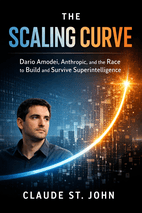
The Scaling Curve by Claude St. John Book Cover

by Claude St. John

Claude St. John's The Scaling Curve provides a granular biography of Dario Amodei and Anthropic, tracing the scaling hypothesis from discovery to deployment and the resulting safety imperative. It details the technical and philosophical evolution of AI safety for readers seeking to understand the principles and pressures defining the race to superintelligence.

On Insta.page you also get an Apply This Book tool that lets you combine insights from up to 3 books to solve your specific situation.
Chapter mindmaps

Free preview: chapters 1–4 are fully interactive. Click any node to expand or collapse. Subscribe to unlock the rest.

Chapter 1: Chapter One

Key concepts: Chapter One

1. Chapter One

Foundational Mindset

  • Childhood refuge in mathematics and objective truth
  • Family environment of moral seriousness and responsibility
  • Shared ambition with sister to 'save the world together'

Scientific Identity

  • Pure scientist uninterested in entrepreneurship
  • Focus on physics and math for definitive answers
  • Influenced by Kurzweil's Singularity concept

Pivot to Intelligence Research

  • Shift from physics to computational neuroscience PhD
  • Research revealed brain's staggering complexity
  • Realization biology might be too complex to fully decipher

Catalyst of Personal Loss

  • Father's death from a soon-curable disease
  • Lesson in moral cost of scientific delay
  • Forged urgency to accelerate discovery

Entry into AI Revolution

  • Joined AI field feeling he missed the boat
  • Physicist's eye for scaling laws became key asset
  • Arrived as deep learning revolution was beginning

Chapter 2: Chapter Two

Key concepts: Chapter Two

2. Chapter Two

The Scaling Pattern Discovery

  • Performance improves smoothly with more data, compute, and parameters
  • Scale proved more important than algorithmic cleverness
  • Pattern observed first in speech recognition at Baidu

Neural Networks as Learning Machines

  • Models 'just want to learn' according to Ilya Sutskever
  • Researcher's role is to remove obstacles, not impose cleverness
  • Optimization machines that find patterns when given resources

Cross-Domain Validation

  • Same scaling pattern held in image recognition and robotics
  • Confirmed at Google Brain across multiple AI domains
  • Demonstrated as a general principle of intelligence

Language as Ultimate Scaling Domain

  • GPT-1 showed emergent abilities from next-word prediction
  • Language provides infinite data and rich structure
  • Revealed scaling could achieve wide cognitive tasks

The Big Blob of Compute Hypothesis

  • Intelligence emerges from correctly balanced scale factors
  • Researcher must remove blockages to let compute flow
  • Both a blueprint for capability and warning about danger

Early AI Safety Concerns

  • Brittleness shown in accent recognition failure
  • Grounded safety in near-term engineering problems
  • Safety work couldn't wait if scaling was real

The Beginner's Mind Approach

  • Insight came from asking simple questions
  • Trusting basic experiments over complex theories
  • Open-mindedness to empirical evidence over skepticism

Chapter 3: Chapter Three

Key concepts: Chapter Three

3. Chapter Three

The Scaling Hypothesis Takes Root

  • Dario Amodei's team converts scaling from a bet to a proven trajectory
  • Informal 'blob' operates within safety team to demonstrate capabilities
  • Language models produce eerily consistent results supporting scaling

GPT-2: Capability and Risk Emerge

  • Model generates coherent multi-paragraph text with reasoning flashes
  • Demonstrates potential for generating plausible fake news
  • Leads to controversial staged release decision

Formalizing Scaling Laws and GPT-3

  • Scaling laws transform intuition into quantitative science
  • GPT-3 demonstrates few-shot learning across diverse tasks
  • Reveals gap between benchmark performance and true understanding

Alignment Problem and RLHF Solution

  • GPT-3 reflects internet's mix of brilliance and toxicity
  • RLHF steers models toward helpful, honest, harmless behavior
  • Technique bridges capability and alignment through human feedback

Philosophical Divergence and Departure

  • Tension emerges between safety as foundation versus add-on
  • Dario believes safety must guide every decision top to bottom
  • Leads to conclusion that new organization is needed

Chapter 4: Chapter Four

Key concepts: Chapter Four

4. Chapter Four

Catalysts for Founding Anthropic

  • Departure from OpenAI over safety disagreements
  • Driven by moral obligation to prevent uncontrollable AI
  • Abandoned prestige for risky venture with no product

Founding Team Composition

  • Thirteen top researchers including GPT architects
  • Seven co-founders with equal equity structure
  • Collective expertise formed strategic blow to OpenAI

Unconventional Founding Principles

  • Public benefit corporation embedding safety in governance
  • The 80% pledge donating most earnings to charity
  • Trust-based structure defying Silicon Valley norms

Leadership and Organizational Culture

  • Dario focused on vision, Daniela on operations/culture
  • Transparent communication avoiding corporate jargon
  • Mission alignment preventing factional team conflicts

Early Challenges and Mission Integrity

  • Secured $124M funding despite no commercial product
  • Dario declined OpenAI CEO offer in 2023 crisis
  • Maintained focus on safety foundations over profit

Continue exploring The Scaling Curve