The Road to Freedom Quotes
by Joseph E. Stiglitz
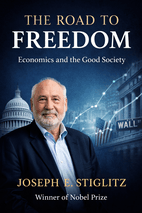
This collection gathers some of the sharpest lines from Joseph E. Stiglitz's book, a work that challenges conventional ideas about freedom and capitalism. You will find statements that cut through decades of economic dogma, often turning familiar slogans upside down. The book is quotable because Stiglitz writes with clarity and conviction, weaving together philosophy, economics, and lived experience into arguments that stick with you.
Each quote here forces a pause. Some will make you nod, others might make you angry. But they all share a refusal to accept easy answers. Whether Stiglitz is talking about coercion, inequality, or the hidden costs of so called liberty, he never lets the reader off the hook. These are lines meant to be shared, debated, and remembered.
Top Quotes from The Road to Freedom
“One person's freedom can often amount to another's unfreedom; or, put another way, the enhancement of one person's freedom often comes at the expense of another's.”
The author introduces this as a central refrain of the book, discussing interdependence in modern society.
This line powerfully captures the inherent trade-offs in freedom, challenging the simplistic notion that more freedom for one doesn't affect others.
“Coercion can enhance everyone's freedom.”
The author introduces this theme after discussing trade-offs, using the example of stoplights as a simple regulation.
This provocative statement forces readers to rethink the conventional opposition between coercion and freedom.
“People of the same trade seldom meet together, even for merriment and diversion, but the conversation ends in a conspiracy against the public, or in some contrivance to raise prices.”
The author quotes Adam Smith to show that even the founder of modern economics warned against anticompetitive behavior.
This classic quotation reminds readers that market skepticism is not new, and that the free-market ideal often collides with real-world collusion.
“Freedom for the gun owners has often meant death to schoolchildren and adults killed in mass shootings.”
The author rephrases Isaiah Berlin's quote to illustrate the externality of gun rights.
This line starkly contrasts an abstract right with concrete, tragic outcomes, making the trade-off between freedoms visceral and impossible to ignore.
“Neoliberal capitalism has created untrustworthy people and has (understandably) eroded not just trust in government but trust in private institutions and trust in each other. It has created a system that devours itself.”
The author concludes the chapter with a critique of neoliberal capitalism's effects on trust and social cohesion.
A powerful indictment that resonates with readers concerned about the social costs of unfettered markets, using vivid language.
“But once we recognize that contracts are social constructs, we recognize that they can be good or bad, and indeed that some contracts, far from being a sanctity, are actually abominations.”
The author discusses why governments should not enforce certain private contracts.
The striking word 'abominations' forces readers to question the moral neutrality of contracts and challenges the idea of contract sanctity.
“He could force me to give up everything to survive. To what extent is this different from being held up at gunpoint?”
The author compares a monopolist's power over a life-saving drug to armed robbery.
This striking analogy forces readers to reconsider the moral equivalence of economic coercion and physical violence.
Themes Behind the Quotes
A central theme is that freedom is not a simple, absolute concept. Stiglitz argues that one person's freedom often restricts another's, and that real freedom sometimes requires collective constraints like regulation or taxation. The quotes repeatedly show how neoliberal ideology has distorted this balance, turning freedom into a justification for exploitation and inequality.
Another major thread is the idea that markets and property rights are human creations, not natural laws. Stiglitz exposes how the rules of capitalism have been written by the powerful, leading to scams, concentrated wealth, and a society that erodes trust. The book calls for a rethinking of what freedom means in an interdependent world, where true liberty depends on fairness and shared opportunity.
Quotes by Chapter
1. Introduction: Freedom in Danger
“As Cicero said some two thousand years ago, “We are slaves of the law so that we may be able to be free.””
The author cites Cicero to support the argument that laws and regulations are necessary for achieving a balance of freedoms.
This ancient paradox still resonates, reminding readers that constraints can enable true liberty.
“Neoliberalism is not self-sustaining. It's self-negating. It has misshaped our society and the people in it.”
The author concludes a critique of neoliberalism's effects on society.
This line is stark and memorable, directly stating that the system destroys itself and corrupts society, which resonates with readers who have witnessed its negative consequences.
2. How Economists Think About Freedom
“It is hard to think of a corner of our capitalist system in which some form of scam or exploitation is not going on.”
The author summarizes the pervasive dark side of capitalism after listing examples like the opioid crisis and cigarette companies.
This line resonates as a sweeping indictment of unchecked capitalism, forcing readers to confront the systemic exploitation embedded in everyday economic life.
“The American Dream had become a myth, with the life prospects of a young American more dependent on the income and education of her parents than in other advanced countries.”
The author discusses the loss of opportunity and hope in the United States after decades of neoliberalism.
It powerfully encapsulates the betrayal of a foundational promise, making abstract inequality visceral and personal for readers.
“Neoliberalism in practice was what can be described as “ersatz capitalism,” in which losses are socialized and gains privatized.”
The author critiques the bank bailouts and the double standard of neoliberal policy.
This pithy phrase exposes the hypocrisy of the system, giving readers a memorable label for a common grievance against corporate welfare.
3. One Person’s Freedom Is Another Person’s Unfreedom
“We reduce the freedom of some because it is necessary if we want a civilized society to function well, for others to have some of the freedoms they want, and for any society that thinks of itself as a free society.”
The author argues that laws and regulations inherently limit certain freedoms to enable a functioning society.
It crystallizes the paradox of freedom: that protecting liberty for all often requires restricting the liberty of some, a necessary compromise for civilized coexistence.
“The absolutist position is absurd and indefensible—it is even incoherent.”
The author dismisses the idea that any infringement on personal liberty is unacceptable.
This blunt declaration challenges a common ideological stance, forcing readers to confront the logical impossibility of absolute freedom in an interdependent world.
“In our complex, interdependent society, where one person's freedom frequently clashes with another's, not all freedoms can be “absolute.””
The author explains the necessity of evaluating trade-offs among conflicting freedoms.
It succinctly summarizes the core tension of the chapter, making the case that freedom must be balanced rather than treated as a zero-sum concept.
4. Freedom Through Coercion: Public Goods and the Free-Rider Problem
“Coercion is required, but the result of the coercion is to “loosen” the budget constraint of citizens, including those who have to be coerced into paying taxes.”
The author explains how coercive taxation for public goods paradoxically expands citizens' economic freedom.
Succinctly captures the central paradox of the chapter: coercion can increase freedom by expanding opportunities.
“In this key arena of public goods, so essential for our well-being, we get the seemingly contradictory result that forcing citizens to pay taxes to provide public goods can expand the options and the individual freedom of everyone, even though it seemingly restricts options.”
The author summarizes the core argument about the free-rider problem and public goods.
This is the thesis of the chapter, clearly articulating the counterintuitive idea that mandatory contributions can enhance collective freedom.
“The regulation solves the prisoner's dilemma, making all the players better off. Each feels coerced and would like to deviate. But the coercion enhances the opportunity set of everyone—it is “freeing.””
The author discusses Sunday closing laws as an example of solving a coordination problem through coercion.
Memorably illustrates how coercion can resolve a collective action problem and expand freedom, despite individual reluctance.
5. Contracts, the Social Contract, and Freedom
“There is, in this sense, a big difference between contracts among parties of roughly equal power and contracts between parties of unequal power.”
The author contrasts voluntary contracts that may be exploitive when power is unequal.
This line succinctly captures a core insight about freedom and exploitation, reminding readers that formal consent does not guarantee fairness.
“Property rights and the rules governing contracts are social constructions, something that we design and specify to advance societal interests.”
The author argues against the Right's view that property rights are natural or sacred.
It challenges a deeply held belief by emphasizing that laws are human-made tools, not immutable truths, opening the door to democratic reform.
“Masters are always and everywhere in a sort of tacit, but constant and uniform combination, not to raise the wages of labour above their actual rate.”
The author quotes Adam Smith to show that even classical economists recognized employer collusion.
This quote is powerful because it reveals that market power imbalances were understood centuries ago, undermining laissez-faire myths.
6. Freedom, a Competitive Economy, and Social Justice
“Property rights are social constructions—that is, they are what they are because we as a society define them to be—and so naturally our notions about which and what kinds of property rights have moral legitimacy are socially constructed.”
The author explains how property rights are not natural but defined by society, influencing the moral legitimacy of wealth.
This passage powerfully challenges the idea that property rights are fixed or inherent, revealing them as products of social agreement and thus open to reexamination.
“It’s not that they don’t work hard or can’t save; it's that they can’t even get to the starting line.”
The author discusses the systemic barriers faced by people in poverty, particularly descendants of enslaved people.
The metaphor of 'the starting line' vividly captures how unequal opportunities rather than personal failings perpetuate poverty, making the argument both memorable and emotionally resonant.
“We cannot divorce the current distributions of income and wealth from the current and historical distribution of power.”
The author summarizes the relationship between power, politics, and economic inequality.
This succinct statement ties together the chapter's central thesis, emphasizing that inequality is not a natural outcome but a product of power dynamics, which invites readers to question the legitimacy of existing distributions.
“Bernard Arnault and his family, owners of the luxury goods conglomerate LVMH (which owns a host of brands like Christian Dior and Moét Hennessy) and one of the richest families in the world, might not be so rich if there were not so much inequality. They have absolutely thrived on it.”
In a thought experiment about redistributing wealth, the author points out how inequality enables extreme fortunes.
This passage starkly illustrates how vast inequality is not a natural byproduct but a condition that directly creates and sustains immense wealth, making the argument for redistribution tangible.
7. The Freedom to Exploit
“When one party exploits another, her income may grow and her freedom expand, but the other person loses and his freedom to choose contracts.”
The author explains the inherent trade-off in exploitation.
It succinctly captures the zero-sum nature of exploitation and challenges the idea that freedom for some justifies harm to others.
“There's no moral justification for such incomes, but there is a moral argument for redistribution, for taking away incomes derived from exploitation.”
The author argues against the moral legitimacy of profits from exploitation.
This passage directly confronts the notion of 'just deserts' and makes a compelling ethical case for redistributive policies.
“While young people are at least temporarily giving up their careers and even their lives, others are profiteering.”
The author criticizes wartime price gouging by oil and gas companies during the Russia-Ukraine war.
This line powerfully contrasts sacrifice and greed, evoking a sense of injustice and national solidarity.
8. Social Coercion and Social Cohesion
“The current form of capitalism—neoliberal, unfettered capitalism—shapes people in ways that not only represent the antithesis of a good society but that actually undermine capitalism.”
The author introduces the chapter's central critique of neoliberal capitalism.
This line succinctly captures a paradoxical indictment of modern capitalism, suggesting it destroys both the good society and its own foundations, which provokes thought and debate.
“Donald Trump illustrates what happens when parents and teachers fail, and an individual does not become socialized.”
The author uses Trump as an example of failed socialization in the discussion of norms and regulations.
It is a provocative and memorable assertion that links a divisive political figure to a broader theory of social formation, making an abstract concept concrete and relatable.