The Risk Worth Taking Key Takeaways — Chapter-by-Chapter Lessons | Insta.Page

The Risk Worth Taking Key Takeaways

by Teri Ijeoma
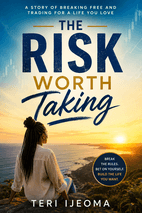
The Risk Worth Taking by Teri Ijeoma Book Cover

5 Main Takeaways from The Risk Worth Taking

Reframe risk as dying with regrets, not failing

Erin's toxic job and suppressed passions were a slow burn—the real danger was staying, not leaping. The book argues that the greatest threat is a life of regret, and embracing the gap between where you are and where you want to be is the only way forward.

Master the four C's: Courage, Clarity, Caution, Confidence

These form the roadmap for any life-changing decision. Courage gets you started, clarity builds competence, caution protects your downside, and confidence is the earned fourth from consistent action. Erin uses this framework to transform from an overachieving teacher into a disciplined trader.

Your side interest may be your real calling

The only time Erin felt alive was when she was trading stocks. What she did for fun was actually training for her future. The book urges readers to examine their hobbies for signals about what work would feel like play and lead to fulfillment.

Expect volatility — in markets and in yourself

Stocks don't go straight up, and emotions won't stay steady. After a devastating loss, Erin learns to step away completely, then rebuild with baby steps—simulator, one share, then small wins. The hardest part of trading is managing your mind, not the mechanics.

Community and mentorship are non-negotiable

Erin's grandmother (her wisdom keeper), friend Sarah, and mother all provide crucial guidance and tough love. The book emphasizes that no meaningful transformation happens in isolation. Find someone who has survived what you're going through and lean on trusted support.

Executive Analysis

The book's central thesis is that true financial and personal freedom comes from embracing calculated risks—guided by emotional healing, disciplined systems, and community support. These five takeaways together form a cyclical path: reframe your view of risk, apply the 4 C's, listen to your side passions, prepare for inevitable volatility, and surround yourself with people who see your potential. Erin's journey from a toxic job to trading mastery illustrates that the risk worth taking is always the one that aligns with your authentic self, backed by a repeatable plan and a resilient mindset.

This book matters because it bridges the gap between dry investing manuals and self-help narratives. It offers both a relatable story and actionable frameworks (budgeting, trading plans, the 4 C's) that any reader can apply immediately—whether they want to change careers, start investing, or simply regain control of their time. In a field crowded with technical guides, 'The Risk Worth Taking' stands out by addressing the emotional and psychological blocks that keep people stuck, making it as much a book about courage as about capital.

Chapter-by-Chapter Key Takeaways

Foreword (Foreword)

  • True financial growth often requires facing past wounds and seeking trusted guidance.

  • The most effective financial teachers combine expertise with empathy and a gift for simplifying complexity.

  • Storytelling can make investing concepts accessible and emotionally resonant, moving readers from fear to action.

  • Investing is as much about mindset and self-trust as it is about technical strategies.

  • No meaningful transformation happens in isolation; community and support are essential.

Try this: Seek a financial teacher who combines expertise with empathy, and use storytelling to transform fear into action.

How Did I Get Here? (Chapter 1)

  • Grief doesn't pause for professional obligations, yet Erin's workplace demands she perform normalcy without empathy or support

  • Toxic leadership manifests in petty micromanagement and public humiliation, not just major conflicts

  • The cost of overachievement can be hollow—accumulating credentials and titles doesn't guarantee fulfillment

  • Erin's bathroom breakdown marks a turning point: she can no longer pretend the system she's trapped in is working

  • The chapter establishes the central question driving the rest of the book: Is there a way out, and what does it take to find it?

Try this: Acknowledge when your workplace demands impossible normalcy; let a moment of breakdown become your turning point.

How Do I Break Free? (Chapter 2)

  • Grief exposes what’s already broken. Erin’s friend’s death didn’t create her unhappiness; it revealed how long she had been tolerating a toxic workplace and a life on hold.

  • The people closest to you often see your potential before you do. Sarah’s honesty stung because it was true—Erin had been fighting for the wrong thing.

  • Trading isn’t just a hobby; it’s a signal. The only time Erin feels alive is when she’s taking control of her own finances. That passion points toward a possible future.

  • “If money were no object” is a dangerous question—and it’s meant to be. Answering it honestly forces you to confront the gap between the life you’re living and the one you actually want.

  • Staying in a burning house because you’re afraid of the cold is still a choice to burn. Erin’s dream makes it literal: she has to decide whether she will run—or sit down and accept the flames.

Try this: Ask yourself honestly: 'If money were no object, what would I do?' Let the gap between that answer and your current life fuel your escape.

The Risk Formula (Chapter 3)

  • Expect fear and doubt (from yourself and others). Their fear reflects their own limitations, not yours.

  • Find your wisdom keeper—someone who sees your potential even when you don’t.

  • Master the 4 C’s: Courage, Clarity, Caution, and the earned fourth.

  • Reframe risk: The real danger isn’t failing—it’s dying with regrets.

  • Your “side interest” might be your real calling in disguise. What you’ve been doing for fun has been training.

Try this: Find a wisdom keeper who sees your potential, and internalize the four C's—Courage, Clarity, Caution, and the earned fourth—before taking any major risk.

Can I Win at This Game? (Chapter 4)

  • The “yes” season requires unlearning the “no” mindset. Erin spent years saving and budgeting, but now she has to give herself permission to spend on experiences that bring fulfillment—even if it means a financial risk.

  • Clarity on costs is non-negotiable. Granny pushed Erin to write a realistic budget, not a wishful one. The honest $3,000 shortfall became the target she needed to hit, not a reason to quit.

  • The four C’s provide a roadmap. Courage gets you started, clarity builds competence, caution protects your downside, and the mystery fourth C (yet unrevealed) represents the deeper payoff of living with intention.

  • Small monthly habits create big buffers. Erin’s four-year habit of saving $500/month gave her a $20,000 runway. Without that discipline, this leap wouldn’t have been possible.

  • Risk worth taking means embracing the gap. Erin didn’t have all the answers or the full budget before boarding. She trusted her community, her grandmother’s wisdom, and her own ability to learn on the fly.

Try this: Create a realistic budget that reveals your true shortfall, then build small monthly habits (like saving $500) to fund your leap.

How to Set Expectations (Chapter 5)

  • Expectation management is crucial. Wanting the outcome without respecting the learning curve leads to burnout and failure.

  • Break big goals into smaller, consistent wins. A $3,000 shortfall feels overwhelming; a $200 gain per day is manageable.

  • A trading plan is non-negotiable. Random gambling and hopeful buying are not strategies—structure and research turn luck into skill.

  • Know the three levels of investing. Savings accounts, passive investing, and active investing each have different return profiles—choose the right tool for your goal.

  • Face your budget gap honestly. Acknowledge the shortfall, define a specific target (like $275 for Jeju), and reverse-engineer the path to meet it.

Try this: Break your financial gap into daily targets (e.g., $200 per day) and build a structured trading plan before risking any money.

How to Place a Trade (Chapter 6)

  • Expect volatility—in the market and in yourself. Stocks don’t go straight up, and your emotions won’t stay steady either. The hardest part isn’t the mechanics; it’s managing your mind.

  • Realize your first win and build on it. Moving profit from your investment account to your checking account makes it real. Celebrating small wins builds confidence for bigger goals.

  • If you can teach it, you understand it. Erin’s simplicity with the pie metaphor showed she had truly internalized the basics. Teaching solidifies your own knowledge and reveals gaps.

  • Use what you already know. Her background in education wasn’t wasted—it became the bridge to explaining trading. Ask yourself how your past skills can serve your new life.

  • One successful trade proves it’s possible. Repeat that process, disciplined and consistent, and the odds shift in your favor.

Try this: Celebrate your first small win by moving profit to your checking account, then teach what you've learned to solidify your understanding.

What Just Happened? (Chapter 7)

  • Impulse trading without research leads to devastating losses – Erin broke her own rules by investing in a penny stock she hadn't researched properly, and she paid for it immediately.

  • Real growth requires facing failure, not running from it – Erin's mother didn't offer sympathy or an escape route; she pushed her daughter to learn from the mistake and keep going.

  • Managing risk means creating systems to protect yourself – Like Erin's parents setting up separate accounts and budgets after their financial crisis, traders need rules and boundaries that prevent emotional decisions.

  • The journey isn't about perfection; it's about getting back up – The Festival of Lights represented letting go of the past and embracing the future, but Erin learned that the future doesn't arrive without effort and resilience.

Try this: After a loss, resist the urge to quit; instead, create systems (separate accounts, stop losses) that prevent emotional decisions and commit to getting back up.

How to Get Over a Big Loss (Chapter 9)

  • Step away completely before trying again. Healing isn’t quitting; your mental state matters more than your strategy. The market will still be there when you’re ready.

  • Immerse yourself in something unrelated. Physical activity and new experiences rewire your brain. You can’t think your way out of despair—you have to live your way out. Find beauty outside your failure to remember life is bigger than one loss.

  • Learn from someone who’s been there. A mentor who has failed and rebuilt is more valuable than one who’s never lost. Ask: Who has survived what I’m going through?

  • Rebuild confidence in baby steps. Start with a simulator (no real money at risk), then trade one share (tiny risk, huge psychological win). Small wins restore belief after big losses.

Try this: Step completely away from trading after a big loss, immerse yourself in a physical or creative activity, then rebuild confidence with a simulator and one-share trades.

How to Read a Stock Chart (Chapter 11)

  • Candlesticks compress an entire trading period (e.g., a day) into a single shape: body shows open-to-close, wicks show extremes.

  • Green candles signal buyer dominance (price up); red candles signal seller dominance (price down).

  • Large green candles mark zones of strong demand (buyer’s level); large red candles mark zones of strong supply (seller’s level).

  • Technical analysis uses this past data to increase the probability of profitable trades—data over luck.

  • Reading charts is a skill: practice drawing candles from price stories until the patterns become intuitive.

Try this: Practice drawing candlestick charts from price stories until the patterns become intuitive, using green and red candles to identify buyer and seller dominance.

Where to Buy and Sell (Chapter 12)

  • Support = buyer’s level (elevator picking up passengers). Resistance = seller’s level (elevator dropping them off).

  • Look for quick reversals in candlestick patterns—valleys/ice cream cones for support, mountains for resistance.

  • These levels reflect the actions of big institutions, not small individual traders.

  • Past price action doesn’t guarantee future results, but it dramatically improves your odds.

  • Build a complete trading plan that includes entry, stop loss, reward-to-risk, and exit before you risk any money.

Try this: Before any trade, define your entry, stop loss, reward-to-risk ratio, and exit—using support and resistance levels to guide your decisions.

How to Trade and Travel (Chapter 13)

  • Freedom isn’t just about money—it’s about time and choice. Erin can care for Granny because she controls her schedule. Trading gave her flexibility, not just income.

  • Success means being able to say yes to what matters. She can say yes to helping family without losing income, and no to travel without regret.

  • The four C’s framework works beyond trading. Courage, clarity, caution, and confidence apply to any risk worth taking.

  • Your edge is discipline, not prediction. A repeatable plan—good companies, charts, stop loss, reward-to-risk, position sizing—creates consistency.

  • Sometimes the right choice isn’t the exciting one. Maturity means knowing when to pause the adventure for what truly matters.

Try this: Use your discipline to create freedom of time and choice, and remember that maturity sometimes means pausing adventure for what truly matters.

Epilogue (Epilogue)

  • Caretaking can be a form of freedom – Trading allowed Erin to pause her travels without pausing her growth, turning an obligation into a gift.

  • Consistency rebuilds confidence – By practicing her plan daily, Erin recovered her portfolio and built savings, proving that small, steady gains compound over time.

  • Prayers are answered in unexpected ways – The path that felt like a detour was actually the direct route to the life she asked for. Gratitude for the journey matters as much as reaching the destination.

Try this: Consistency in your daily plan—not prediction—rebuilds confidence and compounds small gains into significant savings over time.

Continue Exploring