The Resilient Leader Key Takeaways
by John C. Maxwell
As an Amazon Associate, we earn from qualifying purchases.
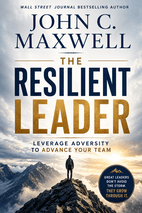
5 Main Takeaways from The Resilient Leader
Resilience is a choice, not a personality trait
John Maxwell argues that resilience isn't something you're born with—it's a decision you make each day. You can choose to learn from failure, reject rejection, and reframe setbacks as feedback, regardless of your natural disposition.
Reframe adversity as fuel for growth and innovation
Instead of resisting hardship, treat it as the price of success. Mistakes are temporary and subjective—relabel them as 'tuition' or 'learning experiences' to unlock creativity and opportunity, just as Home Depot and Kellogg's did after major setbacks.
Separate your identity from your failures completely
You are not your mistakes. Adopt a learner's mindset, change your vocabulary from 'if only' to 'next time,' and avoid internal enemies like negative self-talk and taking failure personally. This protects your self-worth and keeps you resilient.
Build a team culture that normalizes risk and problem-solving
Encourage your team to see problems as normal, not special. Teach them to generate multiple solutions, welcome risk with a 'don't dare miss it' mindset, and celebrate honest reporting of failures to foster collective resilience.
Adversity is the price of success—embrace the uphill climb
Every leader who rises above misfortune does so by accepting that setbacks are part of the journey. The goal isn't to avoid falling; it's to guarantee you bounce back. This mindset turns obstacles into stepping stones and keeps your chances of winning alive.
Executive Analysis
The five takeaways form a single, coherent thesis: resilience is an internal choice that transforms adversity from a threat into a catalyst for growth. Maxwell argues that by reframing setbacks, separating identity from failure, and deliberately choosing to learn from every mistake, leaders can turn even the hardest falls into springboards. This personal resilience then radiates outward, enabling leaders to build teams that embrace risk, solve problems creatively, and champion change—ultimately creating a culture where bouncing back is the norm, not the exception.
This book matters because it moves resilience from an abstract trait to a teachable, daily practice. In a genre crowded with leadership platitudes, Maxwell offers concrete habits—like the twenty‑four‑hour rule for wins and losses, the MISTAKES acronym, and a practical change‑readiness checklist—that readers can apply immediately. Its greatest value lies in normalizing adversity: once failure loses its terror, leaders and their teams can act boldly, innovate freely, and stay in the game longer. For anyone facing constant change or high stakes, "The Resilient Leader" is both a mindset shift and a tactical playbook.
Chapter-by-Chapter Key Takeaways
1. Reframe Your Attitude Toward Adversity (Chapter 1)
Adversity is unavoidable; stop resisting it and start learning from it.
Failure is a process, not a single event—you’re never finished until you stop trying.
How you label a setback is subjective; you have the power to reframe it.
Mistakes are temporary and not signs of weakness; they can be fertilizer for growth.
Resilience means seeing errors as normal, learning from them, and bouncing back.
The greatest leaders rise above misfortune because they treat adversity as the price of success.
Try this: Reframe any current setback as a learning opportunity by asking, 'What is this trying to teach me?' rather than resisting it.
2. Transform Trouble Into Resilience (Chapter 2)
Adversity is normal; the real problem is how rigidly you react to it.
Rigid leaders blow up, cover up, speed up, refuse to back up, and eventually give up.
Resilient leaders start with “I was wrong,” take full responsibility, and use mistakes as feedback.
Reframe mistakes using the MISTAKES acronym—they are messages, signposts, and keys to growth.
Building resilience is an internal battle of character, not talent or opportunity.
Try this: When you make a mistake, start with 'I was wrong,' take full responsibility, and treat the error as feedback to adjust your approach.
3. Avoid the Enemies of Resilience (Chapter 3)
Identify the internal enemies: Expecting failure, taking failure personally, refusing risks, feeling defeated, negative self‑talk, losing humor, failing to learn, and losing perspective all undermine resilience.
Separate identity from events: You are not your failures. Labels like “failure” become self‑fulfilling; instead, adopt a learner’s mindset.
Change your vocabulary: Replace “if only” with “next time.” Call mistakes “tuition” or “learning experiences.”
Keep perspective and humor: Laugh at yourself, enforce a “twenty‑four‑hour rule” for wins and losses, and remember that adversity is part of the path to success.
Try this: Identify one internal enemy (like negative self‑talk or losing humor) you struggle with today and commit to replacing it with a learner's mindset.
4. Embrace the Value of Adversity (Chapter 4)
Repeated failure builds resilience, maturity, and wisdom that easy success never can.
Adversity opens doors to greater opportunities—Home Depot, Kellogg's, and Scott Towels all came from setbacks.
Innovation often springs from forced adaptation; treat failure as a creative starting point.
Look for unexpected benefits in every mistake; resilient leaders search for what's right even when things go wrong.
Adversity is a powerful motivator—use it to sharpen focus and energy.
The successful life is an uphill journey; embrace the climb and the falls that come with it.
Try this: Look for an unexpected benefit in a recent failure—write down one way that adversity opened a door or sharpened your focus.
Next chapter: “5. Harness the Power of Resilience” is locked
Keep learning from The Resilient Leader — and unlock all 700+ book summaries with audio, mindmaps and AI Q&A.
$0.00 due today · 7 days free, then $89.99/year ($7.49/mo) · Cancel anytime before day 7
plus sales tax where applicable