The Price of Becoming Key Takeaways
by Ryan Hawk
As an Amazon Associate, we earn from qualifying purchases.
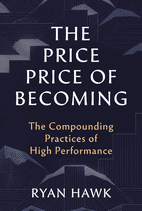
5 Main Takeaways from The Price of Becoming
Imitation is not weakness; it's the fastest path to competence.
Ryan Hawk argues that copying relentlessly accelerates skill development. Your uniqueness emerges at the intersection of what energizes you, what you're good at, and what others will pay for. Don't rush to be original; first master the fundamentals by borrowing from the best.
Use outcome goals for direction, process for daily action.
Many hide behind process to avoid vulnerability. Hawk says outcome goals force commitment and ignite effort, but they need a process to guide daily steps. Write an uncomfortable outcome goal and let the gap fuel you, not paralyze you.
Curiosity compounds like interest – follow it obsessively.
Obsessive curiosity builds a mental toolkit revealing hidden connections. Surround yourself with people who say 'Why not?' and transform conversations by listening for what others genuinely care about. Daily practices like reaching out to admired people and auditing your inner circle amplify growth.
Let your work speak for itself and build trust proactively.
Create something so valuable that the right people seek you out. Master 'good news often, bad news early, never surprises' to manage up. Take ownership of problems before being asked, and develop next-level skills on your own time. Adaptability is your wings.
Teaching reveals true understanding; mentor with loving confrontation.
If you can't explain it simply, you don't know it well enough. Great mentorship requires loving confrontation, not comfortable approval. The learn-teach-give cycle compounds growth for both teacher and student. A teacher's job is to guide, not dictate.
Executive Analysis
These five takeaways form a coherent thesis: becoming a high-value individual requires a deliberate cycle of copying, questioning, communicating, building trust, and teaching. Hawk argues that growth starts with embracing imitation as a learning tool, then balancing ambitious outcome goals with disciplined processes. Curiosity fueled by diverse relationships reveals hidden connections, while creating tangible work and proactive communication earns trust and opportunity. Finally, teaching solidifies knowledge and creates a compounding cycle of growth. Each takeaway builds on the previous, moving from internal development to external influence.
This book matters because it bridges the gap between abstract self-improvement and concrete, daily action. Hawk provides memorable frameworks—like 'good news often, bad news early' and 'learn, teach, give'—that professionals can apply immediately. It stands out in the personal development and leadership genre by rejecting passive inspiration in favor of uncomfortable, systematic work. The book is especially valuable for ambitious individuals who want to accelerate their career without sacrificing relationships, authenticity, or adaptability. It's a manual for becoming the only, not just the best.
Chapter-by-Chapter Key Takeaways
Contemplate, Copy, Create (Chapter 1)
Imitation isn’t a weakness; it’s the fastest route to competence. Copy relentlessly before trying to be original.
Your uniqueness comes from the intersection of what energizes you, what you’re good at, and what others will pay for. Aim to be the only, not just the best.
Growth requires leaving comfort. If you feel like a flower being yanked from its pot, that’s a good sign.
Instead of trying to fix your weaknesses, find a way to make them irrelevant. Create your own “office behind the net.”
Don’t hide your ambition. Admitting you want greatness gives you the fuel to endure the struggle.
Most limitations are mental. Test one belief about what you “can’t do” this week.
Try this: Copy relentlessly by studying and mimicking a role model's work for a month, then reflect on your unique intersection of passions, skills, and market demand to define your 'only' zone.
Curiosity Compounds (Chapter 2)
Curiosity compounds like interest—following it obsessively builds a mental toolkit that reveals hidden connections.
Diverse relationships are the roots that let you grow tall; the Harvard Study proves relationships are the core of flourishing.
Choose a single word for the year to focus your curiosity and actions; then take the first tangible step.
The people you listen to shape your outcomes—surround yourself with those who say "Why not?" instead of "That's too crazy."
Excellence is contagious, but only when combined with high character and the freedom to express it.
The real power lies in daily practices. Commit to obsessive curiosity for thirty days around a topic unrelated to your job. Transform conversations by listening for what someone genuinely cares about, then ask why it matters. Reach out weekly to someone you admire with genuine appreciation. Put yourself in rooms where you are the least experienced. Document observations constantly. Audit your inner circle to ensure they amplify your ambitions. Host one intentional gathering per year that mixes backgrounds. Prioritize your emotional health. Launch a project that forces you to meet new people. When you create value for others, the right people appear to help you succeed.
Try this: Start a 30-day curiosity project on a topic outside your field, transform one weekly conversation by asking 'Why does this matter to you?', and audit your inner circle to ensure they amplify your ambitions.
Question Everything (Chapter 3)
Process-only thinking can be a sophisticated form of self-protection. We avoid outcome goals because they invite vulnerability, fear, and regret. Recognize when you're hiding behind "just focusing on the process."
Outcome goals force a level of commitment that process alone can't generate. The discomfort of a big, ambitious goal is exactly what ignites sustained effort and leads to breakthroughs.
Balance is the real answer. Use outcome goals to give direction and force commitment; rely on the process to provide the daily path. Neither works well in isolation.
Take action: Write one uncomfortable outcome-based goal this week. Share it. Take one small step toward it. Let the gap between where you are and where you want to be become fuel, not paralysis.
Challenge your own beliefs about goal setting. Are you, like the author, protecting yourself from disappointment at the cost of capping your potential? The answer might reveal exactly what you need to pursue.
Try this: Write one uncomfortable outcome-based goal this week, share it with someone, and take one small step—let the gap between where you are and where you want to be fuel your daily process.
Writing and Selling (Chapter 6)
Writing and selling are the same skill: both require turning complex ideas into clear, persuasive language.
Noticing what others miss is the raw material
Try this: Practice turning a complex idea into a clear, persuasive paragraph every day; train yourself to notice what others miss by documenting observations in a running log.
Next chapter: “Trust Your Wings” is locked
Keep learning from The Price of Becoming — and unlock all 700+ book summaries with audio, mindmaps and AI Q&A.
$0.00 due today · 7 days free, then $89.99/year ($7.49/mo) · Cancel anytime before day 7
plus sales tax where applicable