The Power of Pull Quotes
by Rob Snyder
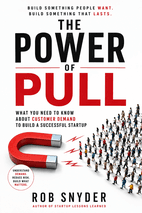
These quotes come from The Power of Pull, a book that shifts how entrepreneurs think about demand. You will find sharp, memorable lines that cut to the chase about sales, customer behavior, and what actually makes a startup succeed. They are not academic or abstract. They are direct and painfully honest.
What makes this book so quotable is its refusal to sugarcoat reality. It strips away common excuses and focuses on what works in practice. Every quote here can be applied immediately to a business problem. They stick with you because they challenge your assumptions and ring true.
Top Quotes from The Power of Pull
“When we find demand, it feels like buyers are pulling the product out of our hands, rather than us pushing the product into theirs.”
The author contrasts the experience of selling with demand versus selling without it.
This vivid metaphor captures the effortless momentum that comes from aligning with what buyers already want, which is far more compelling than the typical pushy sales approach.
“There are many reasons startups fail, but there is only one reason they succeed. New ventures succeed if, and only if, they find and serve customer demand.”
The author summarizes the book's central thesis after analyzing hundreds of startups.
This simple, authoritative statement cuts through the noise of startup advice and establishes the single non-negotiable condition for success.
“It’s easy to take an awful product in which there is strong interest and make it better through iteration. But it’s really hard to take a great product in which there is little/no interest and generate interest.”
Dharmesh Shah, HubSpot's founder, explains why their mediocre product still grew fast.
It powerfully illustrates that demand trumps product quality, urging entrepreneurs to prioritize finding interest over perfecting features.
“Sell and deliver the wrong thing to figure out what the right thing is.”
Author summarizing the accidental process that actually works for startups.
It captures the counterintuitive and humbling reality that entrepreneurs learn by doing and failing, not by perfect planning.
“Anything less than hell yes results in indifference, and indifference is death.”
The author explains the importance of designing for 'hell yes' customers.
This line starkly warns that anything less than enthusiastic customer response leads to failure, emphasizing the need for strong product-market fit.
“Things that work in practice are designed for one real person. If we don’t design it for one real person, it works for zero real people.”
The author states the real-person rule as a core principle of the PULL hypothesis.
It is a memorable, succinct summary that challenges the common tendency to design for abstractions, emphasizing that real-world success comes from serving actual individuals.
“Remember, demand makes supply relevant. If there's no clear demand, it doesn’t matter how pretty and shiny our supply is.”
The author emphasizes that entrepreneurs often overfocus on building supply instead of understanding demand.
It succinctly reframes the priority of demand over supply, a counterintuitive lesson for builders who love creating products. The vivid contrast between 'pretty and shiny' and relevance sticks in the reader's mind.
Themes Behind the Quotes
The central theme is that demand exists independently of any product or company. It is whatever a buyer needs to accomplish right now. Success comes from finding that demand and fitting into it, not from pushing a vision or technology. Many quotes emphasize that buyers do not care about a company's big ideas. They care about their own immediate projects.
Another key theme is the importance of action and iteration. The book advocates selling and delivering the wrong thing to discover the right thing. It warns against building for hypothetical personas. Instead, design for one real person. The process is messy and requires going to where work happens. The only way to know if demand is real is to get payment. Anything less than enthusiastic commitment is indifference, and indifference kills startups.
Quotes by Chapter
Introduction: Demand Is All You Need
“Demand has nothing to do with our product. Instead, the simplest way to think about demand is that it's “the top priority on a buyer's to-do list, right now.””
The author introduces his central definition of demand after describing his own startup struggles.
It reframes demand from a vague concept to a concrete, actionable priority, making it clear why customers ignore products that don't fit their immediate needs.
“Buyers couldn't care less about our vision for how the world should work. They don’t care if we've identified a big market gap. They don't care about our “game-changing” technology.”
The author explains why traditional startup pitches fail to persuade customers.
It strips away common entrepreneurial illusions and forces founders to accept that customers are self-interested, making demand-thinking essential for survival.
1: Demand: What’s on the Buyer’s To-Do List?
“Demand is whatever buyers are trying to accomplish right now.”
The author defines demand in the chapter.
It cuts through complexity by framing demand as a current action, not a vague desire, making it immediately actionable for entrepreneurs.
“There is no such thing as demand for supply. Demand exists as something independent, out there in the world, whether or not our supply exists, and whether or not we exist.”
The author explains a key insight after the Basecamp story.
This reframes demand as an independent force, freeing innovators from the illusion that they must create desire for their product.
“Action, not problems or pain points, is the basis for demand.”
The author contrasts common beliefs with what actually predicts buyer behavior.
This corrects the widespread mistake of equating complaints with buying intent, focusing instead on what people actually do.
2: Supply: What Fits the Buyer’s Demand?
“The customer rarely buys what the company thinks it sells him.”
The author cites Peter Drucker to explain the disconnect between what startups think they are selling and what customers actually buy.
This concise, timeless insight captures the root of many sales failures and forces founders to reframe their perspective from product-centric to demand-centric thinking.
“Without the PULL framework, the buyer's monologue is a tangled mess, what I call a “demand hairball.””
The author introduces the concept of a 'demand hairball' to describe how buyers’ words can be confusing without a structured lens.
The vivid metaphor makes a complex idea instantly memorable, helping readers recognize the need for a clear framework to decode customer needs.
“Even though Sruti’s pitch resonated with buyers intellectually, it actually created a new, scary project in their minds: “Go through a painful migration of all our existing program management tools.””
The author explains why Campground's early sales calls failed despite buyers agreeing with the product's value.
It reveals the counterintuitive danger of a 'good' pitch that inadvertently overwhelms buyers, highlighting the importance of aligning supply with their actual project.
“If it doesn't fit someone's PULL, it's extremely difficult to get anyone to buy it.”
The author summarizes the core challenge startups face when their product or service fails to match a buyer's real demand.
This blunt, zero-filler statement cuts to the heart of why many sales efforts stall, making it a powerful reminder to always start with the buyer's project.
3: The Path to PULL and Hell Yes
“The hardest part was not knowing how far away the light was at the end of the pain cave.”
Ryan describing his emotional struggle during the five-month journey to find PULL.
This metaphor resonates with anyone facing prolonged uncertainty and effort without clear progress; it articulates the psychological challenge of entrepreneurship.
“We confidently run face-first into the wall of customer indifference.”
Author describing the result of conventional approaches that ignore PULL.
Vivid imagery of failure that many founders recognize; it's a memorable warning against pushing products without demand.
4: Earning Your PULL Hypothesis
“No niche or persona has ever bought a product, because they're not real. Only individuals buy products.”
The author explains why focusing on personas or niches fails.
This line cuts through conventional marketing wisdom with a blunt truth, making it clear that only real people have demand.
“In order for something to work for a thousand customers, it has to work for each customer, one at a time, one thousand times over.”
The author describes the scaling fallacy when targeting many customers.
It reframes growth as the repetition of individual successes, reminding entrepreneurs that scale does not change the fundamental requirement of serving one person at a time.
“There's a saying that originated from Japanese manufacturing, “Go to the gemba,” which instructs managers to go solve problems on the factory floor where the machines are (gemba loosely translates to “the place the work happens”) rather than trying to solve problems from the comfort of their desks, data, and second- or thirdhand information.”
The author advocates for firsthand observation by referencing the Japanese manufacturing concept of 'gemba'.
This quote provides a powerful, memorable metaphor for the necessity of direct engagement with customers' real work environments, rejecting detached analysis.
5: How to Sell: The PULL Method
“That's when it clicked: The customer success story sells.”
The author reflects after observing a top sales rep use simple success stories to explain the product.
This line captures the core insight of the chapter in a memorable, punchy way, making it easy for entrepreneurs to remember the central lesson.
“Sales is about listening to prospective customers.”
The author contrasts this with the common misconception that sales is about pitching and persuading.
It reframes sales as a learning activity rather than a manipulative one, which resonates with entrepreneurs who feel uncomfortable with traditional sales tactics.
“If buyers have demand, it is a “help them make progress on their project” call, or a “help them buy” call. If they don’t have demand, it's a “research” call.”
This comes from Varsha's new understanding of sales calls after learning about demand and the success story.
It eliminates the pressure of a high-stakes pitch by redefining the call's purpose based on the buyer's reality, making sales feel natural and low-risk.
“When selling, we need to fill out the PULL framework. Most everything else is noise, at best.”
The author warns against asking irrelevant discovery questions that don't focus on the buyer's PULL.
It's a sharp, actionable principle that cuts through complexity and reminds salespeople to prioritize customer demand over extraneous details.
6: How to Debug: Getting to Hell Yes
“The only thing that separates this “demand mirage” from real demand is payment; we often can’t know if PULL is real until we get the payment notification.”
The author explains that customers expressing interest does not confirm demand; only payment does.
This line cuts through common startup delusion, forcing founders to treat enthusiasm as unproven until money changes hands. It's a brutal but essential truth for validating product-market fit.
“Startups start with a PULL hypothesis and debug, debug, debug.”
The author concludes the 100x example, summarizing the iterative process of finding PULL.
The repetition of 'debug' mirrors the relentless, gritty work required, making the advice both memorable and actionable. It distills the entire chapter into a single, punchy mantra.
“It's our job to determine exactly what they mean, and what we should change.”
The author discusses how customer objections provide the fuel for debugging the PULL hypothesis.
This shifts the mindset from defending a product to actively learning from objections, empowering founders to treat resistance as data. It's a simple but powerful call to curiosity and adaptability.
7: How to Scale: The Success Story Factory
“Early on, we can either have a dirty pipeline or an empty pipeline. We can debug a dirty pipeline based on the conversations we have with potential customers. But debugging an empty pipeline is impossible: When nothing works, there is an infinite number of reasons it might not be working.”
The author explains the importance of generating customer conversations early in a startup's pipeline system.
This captures the fundamental entrepreneurial truth that any data is better than no data; inaction and an empty pipeline are far harder to diagnose than imperfect outreach that generates feedback.
“The impulse to do a bit of everything is just a way to admit that we haven't thought very hard about demand. It winds up being a way to waste a heroic amount of money.”
The author discusses the toll booth mental model for pipeline, arguing against spreading efforts thin.
This line cuts through common startup advice to be everywhere, forcing a disciplined focus on where actual demand exists rather than wasting resources on scattershot tactics.