The Power of Pull Mindmap: Visual Summary of All Chapters | Insta.Page

The Power of Pull — Interactive Mindmaps

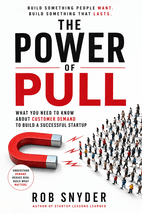
The Power of Pull by Rob Snyder Book Cover

by Rob Snyder

Rob Snyder's The Power of Pull provides a framework for identifying real customer demand by focusing on a buyer's unavoidable project, existing options, and their limitations, rather than building a product first. Written for startup founders struggling to find traction, it offers a counterintuitive toolkit for selling effectively and scaling by treating a business as a factory for successful customers.

On Insta.page you also get an Apply This Book tool that lets you combine insights from up to 3 books to solve your specific situation.
Chapter mindmaps

Free preview: chapters 1–4 are fully interactive. Click any node to expand or collapse. Subscribe to unlock the rest.

Chapter 1: Introduction: Demand Is All You Need

Key concepts: Introduction: Demand Is All You Need

1. Introduction: Demand Is All You Need

The Pain Cave and the Breakthrough

  • Best practices failed, pivots led to dead ends
  • Accidental low-tech fix generated millions in revenue
  • Success came from stumbling onto desperate demand

Demand Is the PULL Framework

  • Demand is a buyer's top priority, right now
  • PULL exists when buyers have unavoidable projects
  • Customers pull solutions out of your hands

Startup = Demand + Supply = Repeatable Story

  • One repeatable customer success story is the goal
  • Founder's job: find that story and repeat it
  • Most advice encourages LARPing without demand

Real Validation Comes from Paying Customers

  • Research and surveys are not validation
  • Only paying customers confirm demand
  • Use sales as research to get money on the table

Embrace Messy Steps and Small Niches

  • You can't plan step 10 from step 1
  • Small niches with non-scalable offerings foster growth
  • Entrepreneurship is messy, not a science experiment

Chapter 2: 1: Demand: What’s on the Buyer’s To-Do List?

Key concepts: 1: Demand: What’s on the Buyer’s To-Do List?

2. 1: Demand: What’s on the Buyer’s To-Do List?

The HubSpot Paradox

  • HubSpot grew to $25M with an awful product
  • Demand matters more than product quality
  • Iteration can fix a product, not demand

Demand Is Not Desire for Supply

  • Demand exists independently of your product
  • Customers express demand in supply language
  • Translate requests to underlying needs

Demand Is Not About Problems

  • Pain points don't predict buying action
  • People cope with terrible problems daily
  • Bitchin' ain't switchin'

Demand Is About Action

  • Focus on buyer's mental to-do list
  • Only one project is top priority at a time
  • Demand state means pulling toward completion

Enemy: Should Want

  • Assumes buyers are rational ROI calculators
  • Real motivation driven by ego, envy, fear
  • Logic doesn't predict human behavior

Enemy: Will Want

  • Buyers describe future selves that don't exist
  • Low-stakes interviews mislead predictions
  • Real behavior differs when money is at stake

Find PULL, Stop Pushing

  • PULL means buyers can't finish without you
  • Selling is the real research for demand
  • Market size depends on when, not just who

Chapter 3: 2: Supply: What Fits the Buyer’s Demand?

Key concepts: 2: Supply: What Fits the Buyer’s Demand?

3. 2: Supply: What Fits the Buyer’s Demand?

Supply vs. Product Distinction

  • Product is what you build; supply is your project plan
  • Describing product confuses buyers; supply makes them lean in
  • Campground succeeded by reframing software as donor reporting fix

Designing Supply That Fits PULL

  • Answer four questions instantly: what, difference, help, cost
  • More description reduces buying likelihood
  • True fit makes it weird when buyers don't purchase

Pricing Based on Project Value

  • Price ceiling set by buyer's project value and alternatives
  • Campground jumped from $5K to $25K by aligning with real demand
  • Ignore development costs and feature count

Minimum Viable Supply (MVS)

  • Simplest way to deliver PULL, even manual or janky
  • One founder used spreadsheets; customers preferred no new software
  • Ask: what is PULL and how to deliver with least locked-in building

Differentiation Through Reinterpretation

  • Reframe buyer's project or target existing option limitations
  • Innovation only works when serving existing PULL
  • Avoid branding exercises; focus on demand fit

Competition Through PULL Lens

  • Competition includes spreadsheets, consultants, or doing nothing
  • Upstream or downstream shifts can kill your supply
  • See all alternatives that fit buyer's real priorities

Finding the 'Hell Yes' Buyer

  • Target buyers whose unavoidable demand matches your supply
  • Price via project value and alternatives, not costs
  • Keep PULL central to see competition and build effectively

Chapter 4: 3: The Path to PULL and Hell Yes

Key concepts: 3: The Path to PULL and Hell Yes

4. 3: The Path to PULL and Hell Yes

The Concept of PULL

  • Demand so real customers lean in and pull solution out of you
  • Customers ask for more and pay before product is polished
  • Opposite of supply-side thinking: research, build, push

Ryan Wan's Failure Cycle

  • Two years building products nobody wanted
  • Built AI optimizer, discounting tool, A/B testing tool
  • Every customer canceled within three months
  • Stuck in supply-side thinking, no concept of PULL

Finding PULL Through Listening

  • Asked recruiter about her to-do list
  • Discovered real problem: finding candidates
  • Built janky LinkedIn scraper in hours
  • Recruiters leaned in and wanted more

Debugging Through Delivery

  • First version was 'really bad' - customers canceled
  • One customer gave second chance
  • Discovered job description requirements were wrong
  • Delivered corrected list - customer said 'perfect'

Selling and Delivering IS Research

  • Can't validate truth in advance
  • Learn by trying to sell and delivering wrong thing
  • Customer reactions steer toward right thing
  • Build feedback loops into pitch

The Hell Yes Customer and Success Story

  • First customer who buys fast and doesn't cancel
  • Study that customer deeply to find clones
  • Success story is engine of business
  • Story has beginning, middle, end - makes them weird not to buy

Scalable Growth and System Building

  • Need scalable growth lever for ideal buyers
  • Build entire business as repeatable system
  • Every decision: 'Does this repeat the success story?'
  • No credit for effort - only PULL matters
You've reached the end of the free mindmaps

Next chapter: “4: Earning Your PULL Hypothesis” is locked

See every chapter of The Power of Pull as an interactive mindmap — and unlock all 500+ book summaries with audio and AI Q&A.

$0.00 due today · 7 days free, then $59.99/year ($4.99/mo) · Cancel anytime before day 7

Continue exploring The Power of Pull