The Pink Code Quotes
by Jessica Weaver
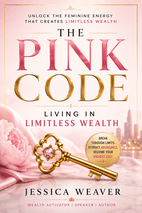
These quotes come from the pages of The Pink Code, a book that challenges readers to rethink their limits. You will find lines about taking risks, building community, and valuing your time. Some are sharp wake up calls. Others are soft affirmations.
That mix of toughness and tenderness is exactly why the book is so quotable. Jessica Weaver writes with an honesty that makes her words easy to remember and share. Every quote feels like a personal permission slip to stop playing small and start living without limits.
Top Quotes from The Pink Code
“If you are a lot like me, you just severely undersold yourself.”
Jen DeBuhr said this to the audience after a visualization exercise where they were asked to envision their desires.
It's a powerful gut-check that resonates with anyone who has ever minimized their own potential; it forces self-reflection on the gap between our true capabilities and our self-imposed limits.
“The only limits are the limits of your thoughts.”
The author states this as a core principle after explaining the four-step process to dismantle limiting beliefs.
It's a timeless, succinct truth that encapsulates the central message of the chapter—that our thoughts create our reality.
“What if by being YOU, you became limitless?”
The author asks a direct rhetorical question to the reader about authenticity.
It challenges readers to imagine the power of embracing their true selves, a central theme of the chapter.
“You are the spark, and the world stays dark unless you ignite.”
The author encourages readers to take action on their ideas.
This line uses a vivid metaphor to convey personal agency and the urgency of stepping into leadership.
“If your actions create a legacy that inspires others to dream more, learn more, do more, and become more, then you are an excellent leader.”
Opening quote of the chapter attributed to Dolly Parton.
This line encapsulates the chapter's core message about legacy and leadership, inspiring readers to think beyond personal wealth.
“Enough. What a limit this word has placed on women.”
The author reflects on a mother's statement that her daughter would have 'enough' inheritance, and on the broader cultural mindset.
This short, punchy observation captures a profound psychological barrier that holds many women back from pursuing greater abundance, making it deeply relatable and thought-provoking.
“Stop over-valuing your money and under-valuing your time.”
This is a closing quote attributed to Brittney Richardson.
It delivers a timeless, actionable insight about prioritization that resonates with anyone juggling multiple income streams or feeling stuck in the trade-off between effort and reward.
Themes Behind the Quotes
The most prominent theme is the rejection of scarcity thinking. Again and again the quotes call out the ways we hold ourselves back with thoughts of not enough. They push the reader to see that limits are often self created and that true power comes from believing in your own limitless potential. This is tied to a sense of spiritual trust, the idea that the universe or God wants you to feel good and succeed.
Another key thread is the importance of community and delegation. The quotes remind us that wealth is not just money but also the people around us and the way we spend our time. There is a strong emphasis on health as the foundation for everything else. And woven through it all is a call to action to stop undervaluing yourself and start making small consistent changes that alter your life's direction.
Quotes by Chapter
Chapter 1: The Wealth of Your Thoughts
“I love when life surprises me and delights me!”
The author's friend Nora uses this mantra to reframe anxiety into anticipation.
It's a simple, uplifting shift in perspective that can instantly change one's emotional state, making it a memorable and actionable phrase.
“It is safe to feel this good. Good things happen to me when I feel this good. The world wants me to feel this good. God wants me to feel this good. I am safe.”
The author shares her new mental script to combat the self-fulfilling prophecy of fear after success.
This series of affirmations addresses deep-seated fears of safety and worthiness, offering a powerful tool to break cycles of anxiety and embrace success.
Chapter 2: The Wealth of Your Community
“There is no power for change greater than a community discovering what it cares about.”
The chapter opens with this quote attributed to Margaret J. Wheatley.
It succinctly captures the core theme of the chapter: that collective passion is the engine of transformation. Readers feel inspired to find and amplify what their own communities care about.
“This is what happens when you talk yourself out of taking the leap. Your thought pattern gets more and more negative with all the excuses about why you shouldn't do it.”
The author describes her panic during a triathlon swim and the moment she considered giving up.
It vividly illustrates the self-sabotaging spiral of doubt that many face before a big risk. Readers recognize their own inner critic and are motivated to break free from negative thinking.
“I promise you that as you take more risks with your life, you will have limitless moments of beauty and calmness. So many more than if you live a life of regrets.”
After completing the triathlon, the author reflects on the payoff of pushing through fear.
This line offers a hopeful, direct counterweight to fear of failure. It reframes risk-taking as a path to reward rather than a source of anxiety.
“The community you build and foster is an asset, and it should be an asset in your portfolio.”
The author explains why relationships and networks are a form of wealth, especially for women in business.
It redefines community from a soft concept to a tangible, strategic resource. Readers are prompted to value and invest in their networks as seriously as they do financial assets.
Chapter 3: Thought Leadership for Limitless Impact
“Being vulnerable and opening their worlds up to the greater good is a new kind of sexy power.”
The author discusses the authentic behavior of successful thought leaders like Oprah and Sara Blakely.
It reframes vulnerability as an attractive and powerful trait, challenging conventional notions of strength.
“They didn't pigeonhole themselves into a specific role, but created one that allowed them to make the biggest imprint on the world around them.”
The author describes what separates underdog leaders from everyone else.
It highlights the importance of role creation over role acceptance, inspiring readers to define their own paths.
Chapter 4: Limitless Legacy
“Wealth management doesn't happen when you have the money; it occurs before that to get you the money.”
The author advises readers to build their financial team before accumulating wealth.
It flips conventional thinking, emphasizing proactive preparation over reactive management, which resonates with those seeking financial control.
“I don't want your family to go through this; you’ve worked too damn hard for your money to be wasted on taxes and fees!”
The author passionately urges readers to protect their estate from unnecessary losses.
This raw, emotional appeal connects with the reader's sense of fairness and hard work, motivating action to preserve their legacy.
“They move from fear to making decisions from a place of confidence that they have never felt before.”
Describing how female clients transform after working with the author's team.
It offers an empowering vision of financial confidence, particularly resonant for women who may have been excluded from financial decisions.
Chapter 5: Limitless Growth
“I can’t continue down this path. I am not the mother I want to be, the wife my husband deserves, or the advisor I strive to be.”
The author describes a moment of exhaustion and clarity one morning after months of overwhelm.
This raw, honest confession captures the universal struggle of balancing ambition with personal roles, making it deeply relatable for anyone feeling pulled in too many directions.
“Anything you are not delegating is costing you money.”
The author gives a wake-up call to business owners and advisors about the hidden cost of holding onto tasks.
This concise, direct statement reframes delegation as a financial imperative rather than a luxury, jolting readers into rethinking their own habits.
“What do you love to do, and what are you great at? This is your zone of genius.”
The author introduces a daily matrix for delegation and elevation, referring to Gay Hendricks' concept.
The phrase 'zone of genius' is memorable and empowering, offering a clear, aspirational target for where to focus energy for limitless growth.
“The numbers never lie or make up excuses; when we look at them, we can see very clearly what is working and what isn’t.”
The author explains the importance of tracking financial metrics like net worth and cash flow.
This no-nonsense line reinforces the power of objective data over subjective fears, motivating readers to confront their numbers without self-deception.
Chapter 6: Limitless Income
“Go for more because you are limitless, and the wealth you can create in this world is limitless.”
The author encourages readers after discussing how the word 'enough' limits women's financial potential.
This line is a bold, empowering call to action that reframes wealth-building as an unbounded opportunity, inspiring readers to break free from self-imposed limits.
Chapter 7: Limitless Health
“When you keep your mind, body, and heart active, your cells not only repair, but new ones are also created.”
The author explains the importance of staying active to counter the decay that often sets in after retirement.
This line offers a powerful, almost poetic vision of health as a regenerative process, inspiring readers to see activity as a source of renewal rather than just maintenance.
“It is these small adjustments that change the trajectory of your life.”
The author reflects on how a simple change in nutrition during workouts improved her recovery.
It distills the book's core message that incremental, consistent changes compound into transformative results, making the idea of personal growth feel achievable.
“There are no excuses, only the limits you place on yourself.”
The author observes disabled athletes competing in an Ironman, including a blind woman guided by her husband.
This succinct, challenging statement reframes obstacles as self-imposed, empowering readers to take ownership of their potential and push beyond perceived boundaries.
“Without your health, your wealth means nothing.”
The author emphasizes that building health should be prioritized over building wealth.
It is a stark, universal truth that cuts through the noise of modern life, reminding everyone that no amount of money can replace well-being.
Chapter 8: Limitlessness Is a Practice
“Limitless anything is a practice; it is never perfected, only growing and evolving.”
Opening of the chapter after the Emily Dickinson epigraph.
This line encapsulates the core theme that limitlessness is an ongoing process, not a final destination, which resonates with readers seeking growth without perfectionism.
“By limiting ourselves, we are really limiting God and our faith in God, who is infinite.”
The author explains why skipping the daily practice can limit one's spiritual and financial potential.
It reframes self‑limitation as a limitation on the divine, offering a powerful spiritual perspective that motivates readers to expand their beliefs.
“Power does not have to be rooted in the scarcity notion that it is limited to the few in authority.”
After discussing women's historical struggles with power and the campfire conversation.
This line challenges the traditional scarcity mindset about power and opens the door to a more inclusive, abundant definition of power for all.