The Pink Code Key Takeaways
by Jessica Weaver
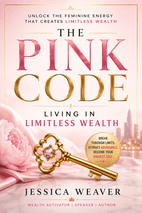
5 Main Takeaways from The Pink Code
Your Thoughts Create Your Reality—Feed Them Intentionally
Your Reticular Activating System (RAS) manifests whatever you focus on, so deliberately choose empowering thoughts. Use the four-step process to dismantle limiting beliefs and rewire your emotional baseline, and remember that low emotions are okay—name them, feel them, then choose a new thought.
Community and Legacy Require Intentional Investment
Build your presence around four pillars (expertise, behind-the-scenes, personal life, community invitations) and tell your story from a place of healing to avoid losing power. Reverse-engineer your vision into concrete steps and create scalable content (books, media) with trainable ambassadors to extend your mission.
Wealth Preservation Demands Mental and Financial Preparation
Your mindset is the #1 risk to inheriting wealth—guilt and overwhelm lead to self-sabotage, so prepare mentally, emotionally, and spiritually before money arrives. Proactive strategies like Roth conversions, life insurance, and family Money Manifestos protect assets from taxes, long-term care costs, and legal battles.
Diversify Income and Address Internal Money Blocks
Relying on a single paycheck creates vulnerability; examine childhood traumas and beliefs about 'enough' that block more money. Build a team of experts for tax strategies (1031 exchanges, depreciation) and rental property management, and always allocate new money with intention to avoid anxiety and debt cycles.
Limitlessness Is a Daily Practice of Gratitude and Forgiveness
Use morning scripting and the three-phrase claiming exercise to rewire your brain for abundance and expand your 'money container.' Honor life's seasons (investing, nurture, harvest, rest) and practice forgiveness—write a letter, burn it, and let the cord snap—so your grand vision can emerge from your future self.
Executive Analysis
These five takeaways form a cohesive blueprint for holistic wealth that integrates inner mindset work with outer financial and community strategies. The book argues that true limitlessness is not about reckless risk but about intentional discipline: you must first master your thoughts and emotions, then build a supportive community, protect your legacy through smart planning, diversify income, and commit to daily practices that keep you aligned. Each chapter reinforces that wealth is a multi-dimensional asset—mental, relational, financial, and spiritual.
This book matters because it bridges personal development with concrete, actionable advice on estate planning, tax optimization, and legacy building—areas often avoided in self-help literature. It stands out by addressing both the psychology of abundance (limiting beliefs, money narratives, forgiveness) and the practical mechanics (Roth conversions, 1031 exchanges, legal documents). For entrepreneurs, leaders, and anyone seeking to break generational patterns, The Pink Code offers a feminine-centered, community-driven approach that complements works by Tony Robbins or Rachel Rodgers while adding a distinctive focus on multi-generational wealth transfer.
Chapter-by-Chapter Key Takeaways
The Wealth of Your Thoughts (Chapter 1)
Your thoughts are the raw material of your reality; the RAS confirms whatever you feed it, so feed it intentionally.
“Going bigger” isn’t reckless—it’s a discipline of asking “How can I expand this?” at every opportunity.
Energy has a measurable frequency; protecting your vibration is essential to staying in a state of growth.
The four-step process can be used daily to dismantle limiting beliefs and rewire your emotional baseline.
It’s okay to feel low emotions—but don’t suppress them. Name them, feel them, then choose a new thought.
Try this: Feed your RAS intentionally by writing three thoughts you want to dominate your day, then use the four-step process to dismantle any limiting belief that arises.
The Wealth of Your Community (Chapter 2)
Taking a small, scary leap (like jumping into open water) builds the resilience needed to be bold in your brand.
Tell your story from a place of healing, not pain, to avoid losing power to critics.
Community is an asset that increases your energy, confidence, and performance—invest in it intentionally.
Build your online presence around four pillars: your expertise, behind-the-scenes work, personal life, and community invitations.
Legacy requires scalable content (books, media) and trainable ambassadors who can extend your mission.
Use reverse-engineering to turn your vision for your community into concrete action steps.
Try this: Take one small bold action (e.g., jumping into cold water) to build resilience, then structure your online presence around the four pillars: expertise, behind-the-scenes, personal life, and community invitations.
Thought Leadership for Limitless Impact (Chapter 3)
Your most painful experiences can become the foundation for a legacy that heals others.
Thought leadership isn't about playing small; it's about using your platform to meet real needs—whether through scholarships, grants, sober living houses, or donated books.
Journaling through specific prompts can unlock the clarity and courage needed to step fully into your role as a Thought Leader.
Once you have a vision, share it with one person and actively seek supporters who can help you scale your impact.
Try this: Journal on the question 'What painful experience can become my legacy?' then share that vision with one person and actively seek supporters to help you scale.
Limitless Legacy (Chapter 4)
Your mindset is the #1 risk to inheriting wealth; guilt and overwhelm lead to self-sabotage. Prepare mentally, emotionally, and spiritually before the money arrives.
Proactive tax strategies can save you millions. Get a tax report to see your “optional tax bill”—the amount you’re choosing to pay by doing nothing.
Inherited IRAs are tax bombs for heirs due to the 10-year rule. Consider converting to Roth IRAs or life insurance policies to pass wealth tax-free.
Long-term care costs can devour your estate. Leverage a small portion of assets (e.g., 10%) into a policy that multiplies coverage for care, protecting the rest.
Legal documents must be in place and properly funded. Review every 3–5 years or after major life events. Beneficiary designations trump wills—make sure they align.
Involve your family in estate planning conversations. Use a Money Manifesto to share your values and prevent costly misunderstandings and legal battles.
Try this: Order a tax report to see your optional tax bill, convert inherited IRAs to Roth or life insurance to avoid the 10-year rule, and create a Money Manifesto with your family.
Next chapter: “Limitless Growth” is locked
Keep learning from The Pink Code — and unlock all 600+ book summaries with audio, mindmaps and AI Q&A.
$0.00 due today · 7 days free, then $89.99/year ($7.49/mo) · Cancel anytime before day 7
plus sales tax where applicable